
African bonytongue
Heterotis niloticus (Cuvier, 1829)
Family Arapaimidae • the African cousin of the arapaima, giant filter feeder of the floodplains
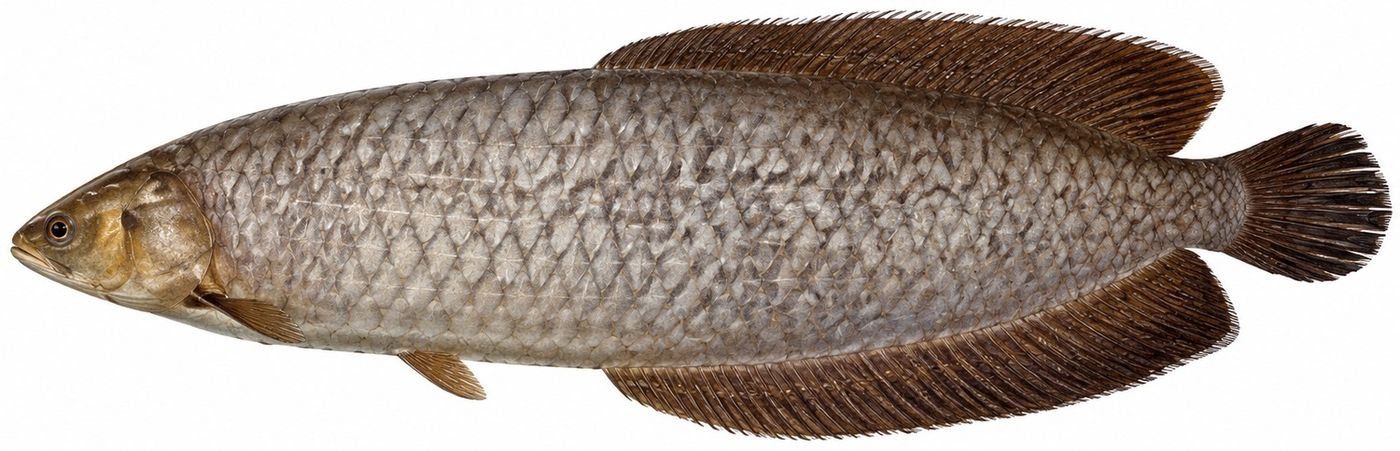
| French name | Faux-capitaine, Heterotis. Other names: kongo (regional usage) |
|---|---|
| Scientific name | Heterotis niloticus (Cuvier, 1829) |
| Family | Family Arapaimidae |
| English name (FAO) | African bonytongue |
| Local names | Kongo, faux-capitaine; names in Baoulé, Bété, Dioula to be documented |
| Habitat | Freshwater: rivers, floodplain lagoons, reservoirs, floodplains. Freshwater coastal pelagic. |
| IUCN status | LC Least Concern. Introduced and established in many basins. |
Identification
A large fish with a massive, compressed body, brown to grey back, silvery flanks, large clearly visible scales. Long, low dorsal fin running back to the rounded caudal. Bony head; it belongs to the “bonytongues” (osteoglossids). Not to be confused with the true threadfin (Polydactylus, marine/lagoon) despite the French name.
Features that never mislead
Large, distinct scales and a deep, silvery body, very different from a catfish.
Long, low dorsal and anal fins, extending towards the rounded tail.
Accessory breathing organ (spiral epibranchial organ): tolerates oxygen-poor water.
Terminal mouth without barbels (unlike catfishes).
Size and weight
Usually 40 to 70 cm; published maximum around 1 m for about 10 kg.
Behaviour and ecology
Filter feeder and detritivore: it sucks up mud, plankton, small invertebrates and organic debris. It tolerates warm, deoxygenated water thanks to its breathing organ, which makes it a flagship species for extensive aquaculture and reservoir stocking in West Africa.
Reproduction and season
Oviparous and a remarkable builder: the pair builds a circular nest of plants (up to 1 m across) in flooded weed beds, spawns in it, then guards the eggs and fry, which gather in a cloud above the nest.
Fishing practice
Techniques, from most to least effective
Bottom line with plant bait or paste, or small invertebrates, in calm, weedy areas. The top technique.
Cast net and gillnet in subsistence fishing.
Float fishing with groundbait in stocked reservoirs.
Fights with power, heavy pulls and runs towards weed beds where it tries to tangle the line. Tough mouth: strike firmly. No spines to worry about when handling, but the fish is heavy and powerful.
Eating quality
Popular white flesh, slightly oily, with intramuscular bones to watch for. Widely eaten grilled, smoked or in sauce; an important fish for food security in rural areas.
Sources: FishBase (Heterotis niloticus, Cuvier 1829); IUCN Red List (Least Concern); FAO (aquaculture); Lévêque & Paugy. Local names to be documented.