
West African lungfish
Protopterus annectens (Owen, 1839)
Family Protopteridae • the lungfish that survives in dried mud
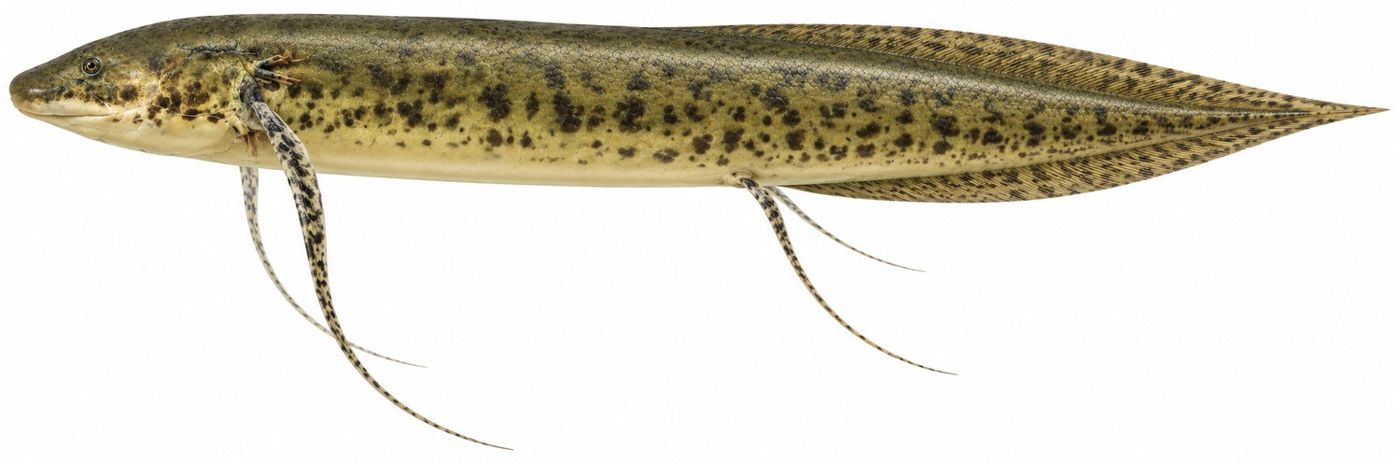
| French name | West African lungfish (dipnoan). Other names: lungfish, “fish with false legs” |
|---|---|
| Scientific name | Protopterus annectens (Owen, 1839) |
| Family | Family Protopteridae |
| English name (FAO) | West African lungfish |
| Local names | “Fish that sleeps in the mud”, “fish with legs”; names in Baoulé, Dioula, Agni to be documented |
| Habitat | Freshwater: swamps, temporary pools, floodplains, oxbows. Demersal. |
| IUCN status | LC Least Concern. Wide distribution in West and Central Africa. |
How to recognise it
- elongated eel-like body, 9 to 15 times the head length, tapering to a point towards the tail;
- two pairs of filamentous fins: pectorals about 3 times the head length, with a fringe at the base; pelvics about 2 times (Wikipedia, West African lungfish);
- a continuous fin along the rear of the back, around the tail and underneath;
- olive or brown above, lighter belly, large blackish spots on the body and fins, never on the belly;
- prominent snout, small eyes.
The giveaway: the four threadlike “false legs”, unique among our fishes.
Size
Usually 40 to 80 cm; published maximum 100 cm and 4 kg (FishBase).
Life
A dipnoan: it breathes air at the surface. When the pool dries up, it burrows into a chamber lined with hardened mucus and waits for the rains for weeks or months (aestivation). The male guards the nest in the rainy season; the young have feathery external gills. Persistence of small external gills in adults: to be checked (Paugy et al. 2003).
Fishing
Bottom line with natural bait in pools and flooded plains; trap and net at low water; digging in dried mud at the end of the dry season (traditional method). Very slimy skin, tooth plates that pinch hard: handle with a cloth.
At the table
Firm, highly prized flesh, fresh, smoked or in sauce.
Sources: FishBase, Protopterus annectens; Wikipedia, West African lungfish (accessed 23/10/2026); species sheet 87 V13. IUCN status: Least Concern (assessment of 25/10/2019, IUCN Red List, via FishBase, checked 23/10/2026).