
Otolithe nanka (Longneck croaker)
Pseudotolithus typus Bleeker, 1863
Family Sciaenidae • the large, long-bodied coastal drum
2 look-alikes to know
| French name | Otolithe nanka. Other names: bar, sosso, longneck croaker. |
|---|---|
| Scientific name | Pseudotolithus typus Bleeker, 1863 |
| Family | Family Sciaenidae |
| English name (FAO) | Otolithe nanka (Longneck croaker) |
| Local names | On Ivorian markets and landing sites: “Sosso” (Ouattara et al., 2016). |
| Habitat | Marine and estuarine, demersal. Depth 0 to 150 m, most often less than 60 m, over soft bottoms. |
| IUCN status | NE Not Evaluated / to be checked. A major demersal fisheries species, under regional pressure. |
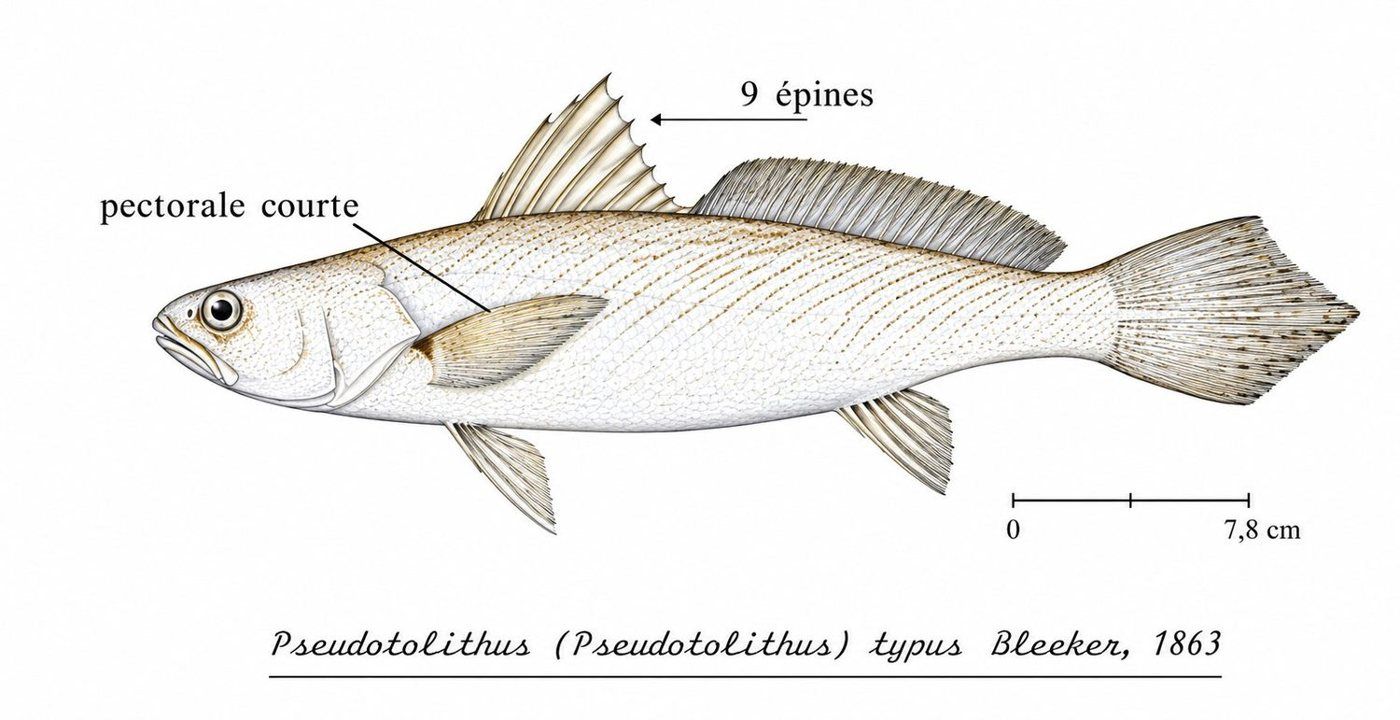
Plate: Guide de détermination des poissons des lagunes de Côte d'Ivoire (identification guide to the fishes of the lagoons of Côte d'Ivoire), E. Charles-Dominique and J. Raffray, CRO Abidjan, Archives scientifiques, 1986. Working reproduction, rights to be confirmed before publication.
Identification
A large sciaenid (drum) with an elongated, compressed body, greyish back with sheen, silvery flanks. Head profile more elongated than that of the cassava croaker, Pseudotolithus senegalensis, hence the English name longneck. Large, oblique mouth. Long dorsal fin in two parts. Produces grunts using its swim bladder.
Features that never mislead
Head profile more elongated than in the cassava croaker, Pseudotolithus senegalensis.
Elongated silvery body, large oblique mouth.
Long two-part dorsal fin (10 spines, then a long soft part).
Produces grunts, drum family.
Size and weight
Common size around 50 cm. Published maximum length 140 cm total length, for a maximum weight of about 15 kg (FishBase). Late maturity, at around 48 cm.
Behaviour and ecology
A coastal predator of soft bottoms that hunts shrimp, crabs and small fish near food-rich river mouths. Often found alongside the cassava croaker.
Present in the eastern Atlantic from Mauritania to Angola, rare north of Cape Verde. On the Ivorian coast, frequents the coastal shelf and the Vridi canal area. A major species of demersal fisheries.
Reproduction and season
Coastal spawning linked to estuarine inflows. Late maturity for such a targeted fish, which increases its vulnerability to overfishing.
Fishing practice
Techniques, from most to least effective
By bottom fishing with natural bait (shrimp, piece of fish) over soft bottoms and near river mouths.
By surfcasting from the beaches and rock breakwaters of the Vridi canal.
By slow trolling or with soft lures hard on the bottom.
The fight: solid, heavy pulls towards the bottom, like the cassava croaker. Keep in contact and tire it by pumping. Beware of the dorsal spines when bringing it aboard.
Eating quality
Firm, fine white flesh, highly appreciated like that of the cassava croaker. Excellent charcoal-grilled (braisé) or as fillets. Highly sought after on the markets, which weighs on the stock.
Sources: FishBase (Pseudotolithus typus, Bleeker 1863); FAO Guide Senegal-Gambia; Ouattara et al. 2016; IUCN status to be reconfirmed with CRO Abidjan.