
Comète maquereau (False scad)
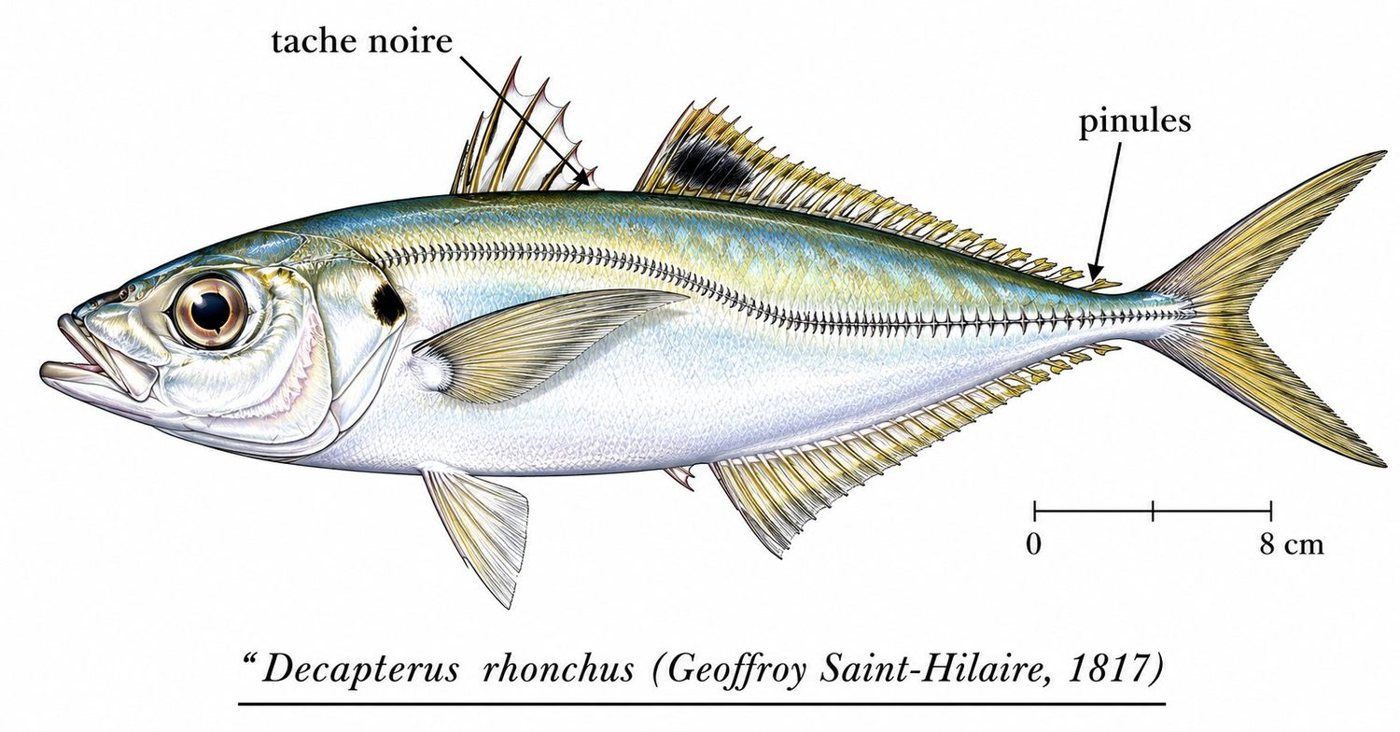
Decapterus rhonchus (Geoffroy Saint-Hilaire, 1817)
Family Carangidae • the slender scad of offshore schools
2 look-alikes to know
| French name | Comète maquereau. Other names: appolo blanc, chinchard comète, comète. |
|---|---|
| Scientific name | Decapterus rhonchus (Geoffroy Saint-Hilaire, 1817) |
| Family | Family Carangidae |
| English name (FAO) | Comète maquereau (False scad) |
| Local names | On Ivorian markets and landing sites: “Appolo blanc” (Ouattara et al., 2016). |
| Habitat | Marine, coastal and neritic pelagic. Forms large schools over the continental shelf. |
| IUCN status | LC Least Concern. A small pelagic under pressure from industrial fishing, local stock to be checked. |
Identification
A carangid with an elongated, spindle-shaped, almost cylindrical body, built for fast swimming in schools. Blue-green back, silvery flanks. Like horse mackerels, it bears scutes along the rear part of the lateral line, and a small detached finlet behind the dorsal and anal fins, the mark of the genus Decapterus.
Features that never mislead
A small detached finlet behind the dorsal and anal fins, the mark of the genus Decapterus.
Elongated, spindle-shaped, almost cylindrical body.
Scutes on the rear of the lateral line.
Blue-green back, silvery flanks.
Size and weight
A medium-sized schooling fish, usual catches of a few decimetres. Precise maximum size to be confirmed on FishBase.
Behaviour and ecology
A gregarious pelagic species that forms large schools over the shelf, feeding on zooplankton and small organisms. Highly mobile, sensitive to upwelling conditions.
Present on the West African coast. Caught in large quantities on the Ivorian coast by schooling-fish fisheries. IUCN status: Least Concern for the genus.
Reproduction and season
Open-water spawning, pelagic eggs and larvae. High fecundity typical of small schooling pelagics. Local stock data to be checked with CRO.
Fishing practice
Techniques, from most to least effective
With purse seines and seines on schools spotted offshore.
With a multi-hook rig of small shiny lures (sabiki) on the school.
By light trolling to catch live bait.
The fight: lively on a fine line, rapid vibrations. It is mainly a net and market fish, and an excellent live bait for offshore predators.
Eating quality
Rich, tasty flesh, like that of horse mackerels and mackerels. Excellent grilled, charcoal-grilled (braisé) or smoked. Very common and cheap on Ivorian markets. Best eaten fresh.
Sources: FishBase (Decapterus rhonchus, Geoffroy Saint-Hilaire 1817); IUCN Red List, LC; FAO Eastern Central Atlantic; Ouattara et al. 2016.