
Mulet curème (Sicklefin mullet)
Liza falcipinnis (Valenciennes, 1836)
Family Mugilidae • the lagoon mullet with sickle-shaped fins
2 look-alikes to know
| French name | Mulet curème. Other names: mulet, mulet de lagune, curème. |
|---|---|
| Scientific name | Liza falcipinnis (Valenciennes, 1836) |
| Family | Family Mugilidae |
| English name (FAO) | Mulet curème (Sicklefin mullet) |
| Local names | On Ivorian markets and landing sites: “Mulet” (Ouattara et al., 2016). |
| Habitat | Marine, brackish and freshwater, coastal and lagoon. Highly euryhaline, abundant in the Ébrié lagoon. |
| IUCN status | LC Least Concern. Precise status to be confirmed. |
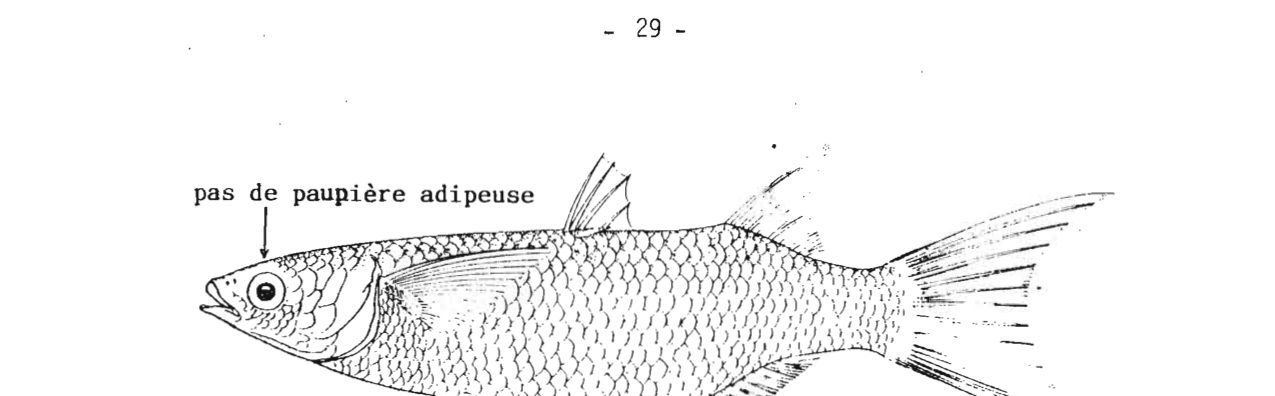
Plate: Guide de détermination des poissons des lagunes de Côte d'Ivoire (identification guide to the fishes of the lagoons of Côte d'Ivoire), E. Charles-Dominique and J. Raffray, CRO Abidjan, Archives scientifiques, 1986. Working reproduction, rights to be confirmed before publication.
Identification
A mullet with a spindle-shaped body, grey-blue on the back, silvery on the flanks, pale belly, like all Mugilidae. Small mouth, thin lips. It stands out for the falcate, sickle-like shape of its first dorsal and pectoral fins, hence its species name falcipinnis and the English name sicklefin.
Features that never mislead
First dorsal and pectoral fins sickle-shaped (falcate).
Spindle-shaped grey-blue body with silvery flanks, typical mullet profile.
Small mouth with thin lips.
Highly euryhaline, abundant in the lagoon.
Size and weight
A medium-sized mullet, usual catches of a few decimetres. Precise maximum size to be confirmed on FishBase.
Behaviour and ecology
A gregarious and highly euryhaline species that grazes the film of microalgae and detritus on muddy bottoms, also swallowing sediment that it filters. Moves easily from the sea to the lagoon and fresh water.
Present on the West African coast. In Côte d'Ivoire, it is one of the most common mullets in the Ébrié lagoon and the Vridi canal. IUCN status: Least Concern.
Reproduction and season
Spawning migration to the sea: the mullet leave the lagoon to spawn offshore, with pelagic eggs and larvae, then the young return to brackish waters, which serve as nurseries.
Fishing practice
Techniques, from most to least effective
Fishing with bread or paste, plant baits, in the lagoon and the canal.
With cast nets and lagoon gillnets.
With a small fine line near the surface.
The fight: lively and nervous for its size, the mullet runs along the surface and changes direction. On a fine line, it is a good float-fishing fish, popular in the lagoon.
Eating quality
Decent flesh, sometimes with a slightly muddy taste depending on where it was caught, better when the fish comes from flowing water. Eaten charcoal-grilled (braisé) or smoked. The roe (bottarga, poutargue) is renowned elsewhere.
Sources: FishBase (Liza falcipinnis, Valenciennes 1836); FAO Eastern Central Atlantic; Ouattara et al. 2016; IUCN status to be reconfirmed.