
Flathead grey mullet
Mugil cephalus Linnaeus, 1758
Family Mugilidae • the silver grazer of lagoons and channels
3 look-alikes to know
| French name | Mulet à grosse tête. Other names: mulet cabot, muge, mulet noir. |
|---|---|
| Scientific name | Mugil cephalus Linnaeus, 1758 |
| Family | Family Mugilidae |
| English name (FAO) | Flathead grey mullet |
| Local names | On Ivorian markets and landing sites: “Mulet” (Ouattara et al., 2016). |
| Habitat | Coastal, lagoon and estuarine, euryhaline. Schools over sand or mud bottoms, 0 to 10 m. Moves up rivers. |
| IUCN status | Least Concern (LC), IUCN Red List, assessed on 30/05/2022. Cosmopolitan coastal species of temperate to tropical waters. |
How to recognise it
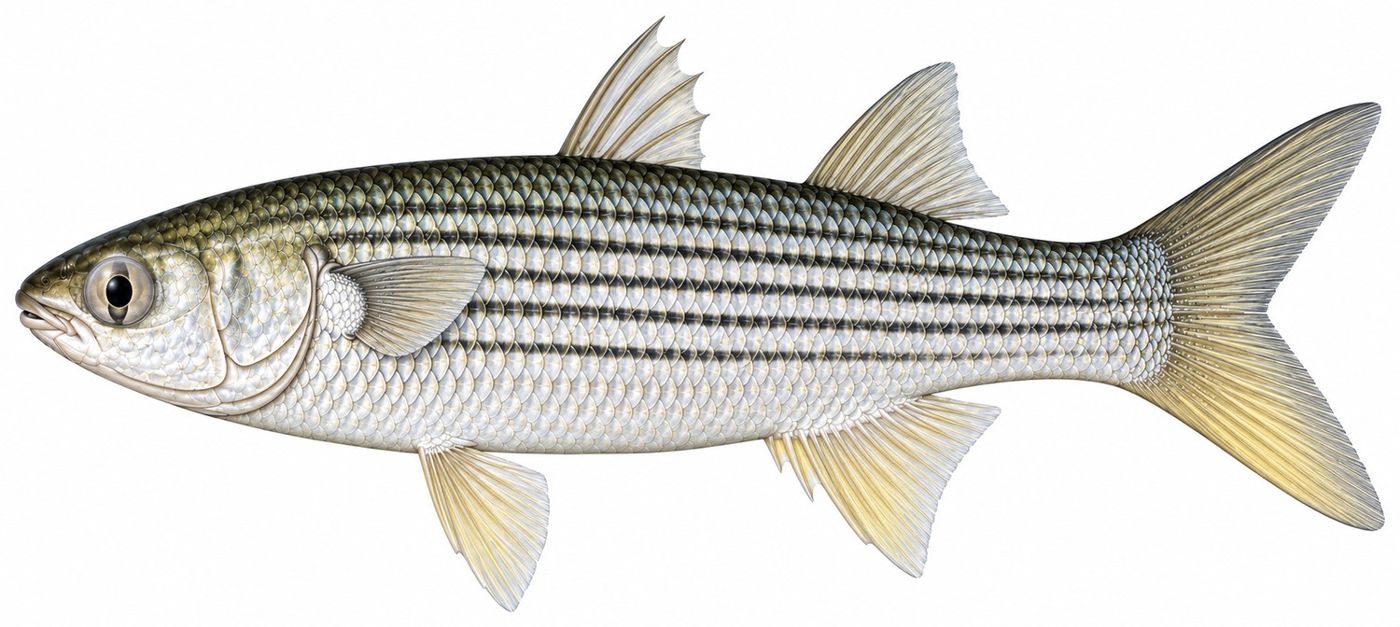
- spindle-shaped, almost cylindrical body; broad, flattened head;
- very well developed adipose eyelid covering most of the eye;
- first dorsal fin with 5 spines (4 visible) and second with 7 to 9 rays, well separated; anal fin with 3 spines and 8 to 9 rays;
- fine dark longitudinal lines on the flank; axillary process at the pectoral fin.
Do not confuse with: Chelon dumerili and other mullets, with a poorly developed eyelid; Mugil curema, dark spot at the base of the pectoral fin.
Size
Usual size 30 to 75 cm, usual catches of 0.3 to 2 kg in the lagoon; common size 50 cm standard length (FishBase).
Life, fishing and table
Behaviour and ecology
A gregarious, diurnal grazer: it sucks up the surface layer of mud and sand to filter out microalgae, detritus and small organisms. Remarkably euryhaline, it moves easily from the sea to the lagoon and rivers.
Very common in the Ébrié lagoon and around the Vridi canal, where schools move in and out with the tides and seasons. Often seen leaping at the surface.
Reproduction and season
Reproduction takes place at sea: adults migrate offshore to spawn, then the larvae return to coastal and lagoon waters, which serve as nurseries. No obligatory freshwater phase. The roe (bottarga, poutargue) is highly sought after.
Fishing practice
Techniques, from most to least effective
- With a fine line and plant bait or paste (bread, semolina) in the lagoon and channels, the top technique for this wary grazer.
- With cast nets and gillnets for subsistence fishing.
- With a groundbait ball (packed bait) or with a fly for sport anglers.
A very good fighter for its size: fast runs, head down, long glides. On fine tackle, a good-sized mullet offers a delicate, much-appreciated fight. A landing net is recommended, as the fragile mouth tears.
Eating quality
Decent white flesh, better from clean waters (mullet from muddy areas can taste earthy). Excellent grilled, charcoal-grilled (braisé) or smoked. The dried, salted roe gives bottarga (poutargue), a highly valued delicacy. Gut quickly after capture.
Did you know?
The mullet is a true salt nomad: born in the open sea, it grows up in the lagoon and can travel far up rivers, coping equally well with fresh water and with lagoons saltier than the sea. Its dried roe, bottarga, is among the most expensive seafood products in the world, over 200 euros per kilo in some regions.
Status
Least Concern (LC), IUCN Red List, assessed on 30/05/2022 (via FishBase, checked on 25/10/2026).
Sources: FishBase, Mugil cephalus (accessed on 25/10/2026); V13 species sheet 68.