Grand capitaine (Giant African threadfin)
Polydactylus quadrifilis (Cuvier, 1829)
Family Polynemidae • the filament-bearing giant of river mouths
2 look-alikes to know
| French name | Grand capitaine. Other names: capitaine royal, gros capitaine. |
|---|---|
| Scientific name | Polydactylus quadrifilis (Cuvier, 1829) |
| Family | Family Polynemidae |
| English name (FAO) | Grand capitaine (Giant African threadfin) |
| Local names | On Ivorian markets and landing sites: “Capitaine” (Ouattara et al., 2016). |
| Habitat | Marine, brackish and freshwater, demersal. Depth 15 to 55 m. Widely enters estuaries and river mouths. |
| IUCN status | Least Concern (LC), IUCN Red List, assessed on 15/07/2014. Flagship species for sport and subsistence fishing, under local pressure. |
How to recognise it
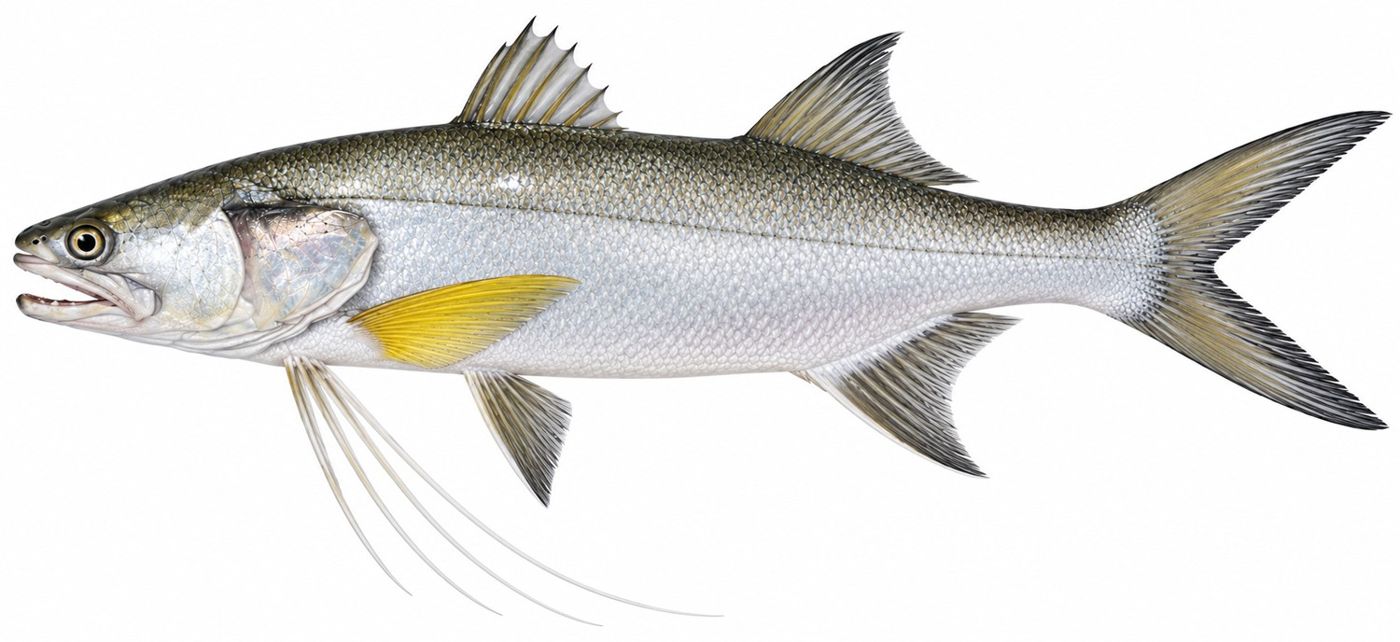
- four free filaments below the pectoral fin, white, the first the shortest, the fourth the longest (27 to 39% of standard length);
- pectoral fin set very low on the flank, bright yellow;
- conical, pointed and semi-transparent snout, overhanging an inferior mouth;
- two well-separated dorsal fins (9 spines, then 12 to 13 soft rays); anal fin with 3 spines and 11 to 12 rays;
- back and head silvery tinged with blackish, white belly; dorsal and caudal fins pale with a blackish rear edge; pelvic and anal fins dark, with white leading edge and base.
Do not confuse with: Petit capitaine (Lesser African threadfin) (Galeoides decadactylus), 9 to 10 filaments and a black shoulder spot; Pentanemus quinquarius (French name to be checked), 5 very long filaments.
Size
Common size 150 cm; published maximum 200 cm and 75 kg (FishBase). One of the largest coastal fish in the Gulf of Guinea.
Life
A predator of crustaceans and fish over sand and mud bottoms, from estuaries to the surf zone; tolerates low salinity well (FishBase; V13). In Côte d'Ivoire, emblematic of the Vridi canal area and river mouths.
Fishing
By surfcasting from beaches and rock breakwaters, with natural bait (shrimp, crab, fish); with soft lures imitating shrimp or fish near river mouths; by bottom fishing at the turn of the tide. A powerful fight in the surf: keep plenty of drag in reserve.
At the table
White, fine and firm flesh, highly sought after; baked, as fillets, in sauce; very high commercial value.
Status
Least Concern (LC), IUCN Red List, assessment of 15/07/2014 (via FishBase, checked on 24/10/2026).
Sources: FishBase, Polydactylus quadrifilis; Wikipedia, Giant African threadfin (accessed on 24/10/2026); species sheet 70 V13.