
Sardinelle plate (Madeiran sardinella)
Sardinella maderensis (Lowe, 1839)
Family Clupeidae • the keel-bellied sardinella of brackish waters
1 look-alike to know
| French name | Sardinelle plate. Other names: mangne sardine, grande allache, sardinelle de Madère. |
|---|---|
| Scientific name | Sardinella maderensis (Lowe, 1839) |
| Family | Family Clupeidae |
| English name (FAO) | Sardinelle plate (Madeiran sardinella) |
| Local names | On Ivorian markets and landing sites: “Mangne sardine” (Ouattara et al., 2016). |
| Habitat | Marine, coastal pelagic, tolerant of low salinity. Frequents estuaries and lagoons, including the Ébrié lagoon. |
| IUCN status | LC Least Concern. An exploited small pelagic, stock under strain. |
Identification
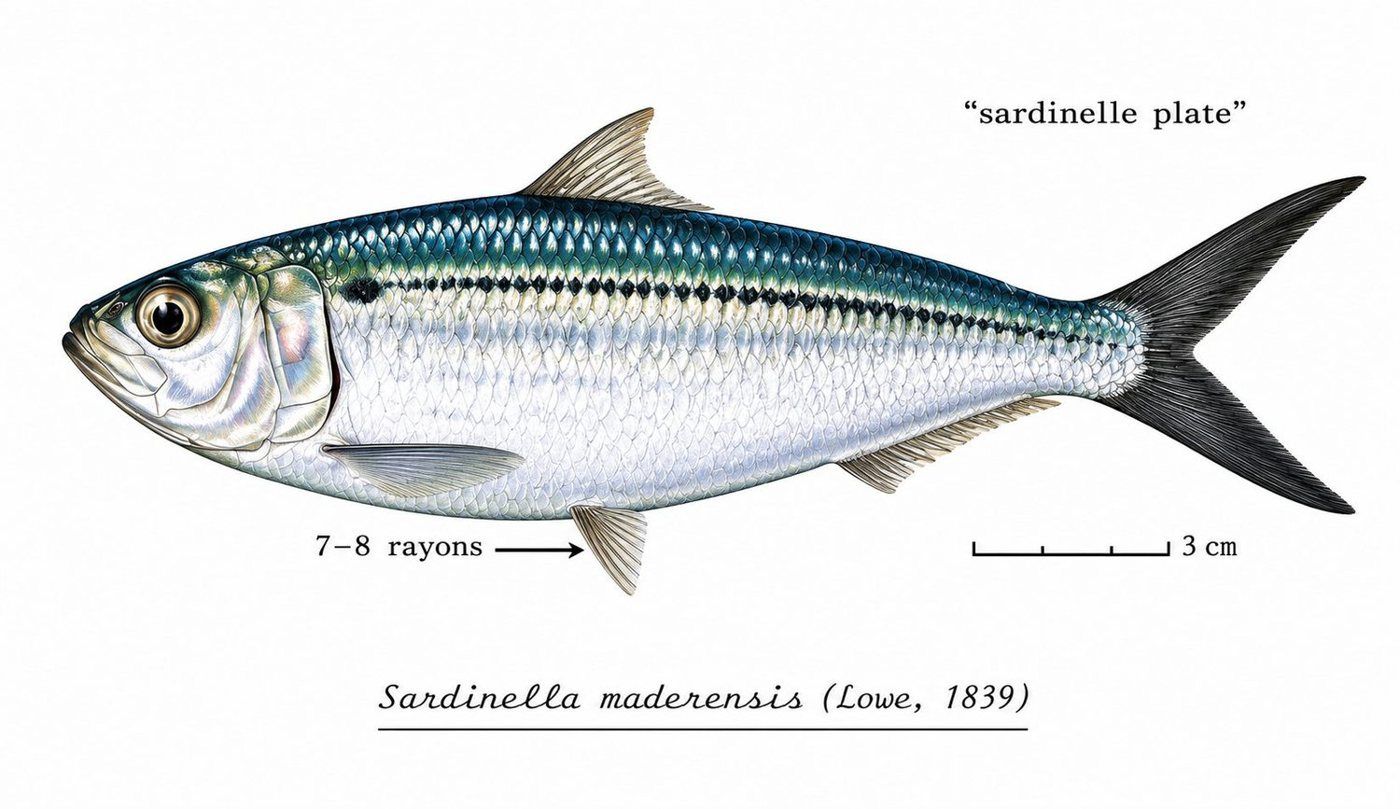
A sardinella with a deeper, more compressed body than the round sardinella, its belly clearly keeled with sharp scutes (31 to 34 in total). Silvery with a bluish back. Distinctive sign: the membrane between the first pectoral rays is blackened, and there is no clear spot at the rear of the gill cover, just a diffuse golden or dark area.
Features that never mislead
Deeper, more compressed body, belly keeled with sharp scutes.
Blackened membrane between the first pectoral rays.
No clear spot on the gill cover, a diffuse golden or dark area.
Pelvic fin with 1 unbranched and 7 branched rays (8 in S. aurita).
Size and weight
A medium-sized sardinella, comparable to the round sardinella. Precise maximum size to be confirmed on FishBase.
Behaviour and ecology
A gregarious coastal pelagic species, more tolerant of low-salinity water than its cousin: it readily enters estuaries and lagoons. Filters plankton in schools.
Present on the West African coast. In Côte d'Ivoire, it frequents the coastline and the Ébrié lagoon, where it is familiar to fishers. IUCN status: Least Concern.
Reproduction and season
Coastal and estuarine spawning, pelagic eggs and larvae. The young use brackish waters as nurseries. High fecundity.
Fishing practice
Techniques, from most to least effective
With purse seines and nets on coastal and lagoon schools.
With a baited multi-hook rig (sabiki) on the school.
Caught in lagoon and coastal nets.
The fight: modest given its size. It is a net and market fish and an excellent live bait, very common in lagoon fishing.
Eating quality
Rich, tasty flesh, like the round sardinella. Excellent grilled, charcoal-grilled (braisé) or smoked. A popular, cheap fish on the markets. Best eaten fresh.
Sources: FishBase (Sardinella maderensis, Lowe 1839); IUCN Red List, LC; FAO Eastern Central Atlantic; Ouattara et al. 2016.