
Senegal bichir
Polypterus senegalus Cuvier, 1829
Family Polypteridae • the scale-armoured dragon fish that breathes air
| French name | Senegal bichir. Nicknames: “dinosaur”, armoured eel |
|---|---|
| Scientific name | Polypterus senegalus Cuvier, 1829 |
| Family | Family Polypteridae |
| English name (FAO) | Senegal bichir |
| Local names | Bichir, “dinosaur”; local names to be documented |
| Habitat | Freshwater: swamps, floodplains, edges of weed beds in rivers and floodplain lagoons; demersal. |
| IUCN status | LC Least Concern. |
Identification
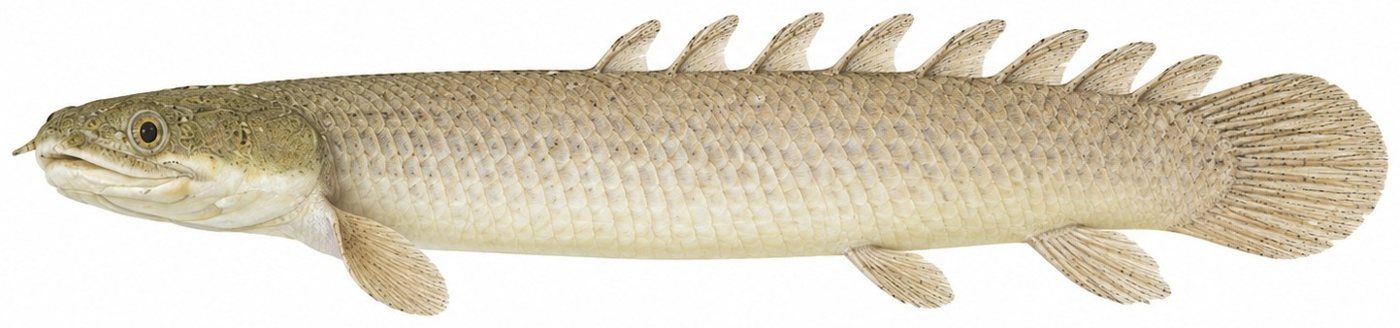
An archaic fish with an elongated body, grey to olive, covered in large, hard rhomboid scales (ganoid armour). Unique signature: a series of dorsal finlets (small spiny flags) lined up along the back instead of a continuous dorsal fin. Fleshy pectorals with a muscular base; it breathes air with lungs.
Features that never mislead
Row of dorsal finlets (small flags) instead of a single dorsal fin.
Large, hard, shiny (ganoid) scales, an almost armoured body.
Fleshy, lobed pectorals used for support.
Breathes air (lungs); survives out of water for a while.
Size and weight
Usually 20 to 35 cm; published maximum around 40 cm.
Behaviour and ecology
A slow, creeping nocturnal predator of weed beds and mud: worms, insects, crustaceans, small fish, which it locates by smell. Tolerates very oxygen-poor water thanks to its lungs. A living fossil close to the very first bony fishes.
Reproduction and season
Oviparous; spawns in the rainy season in flooded vegetation, where the fry have external gills (like tadpoles) before reabsorbing them.
Fishing practice
Techniques, from most to least effective
Bottom line with a worm or small piece of fish, near weed beds, at night. The top technique.
Trap in the vegetation.
Small-mesh net in subsistence fishing.
A snake-like, vigorous catch that twists itself in the line. Hard, slippery body; it nibbles before swallowing, so let the fish take the bait fully. No venomous spines to handle, but rough scales.
Eating quality
Decent white flesh, eaten locally, often smoked; more a supplementary fish than a market fish, also prized by aquarium keepers for export.
Sources: FishBase (Polypterus senegalus, Cuvier 1829); IUCN Red List (Least Concern); Lévêque & Paugy. Local names to be documented.