
African snakehead
Parachanna obscura (Günther, 1861)
Family Channidae • the serpent-headed snakehead lurking in the weed beds
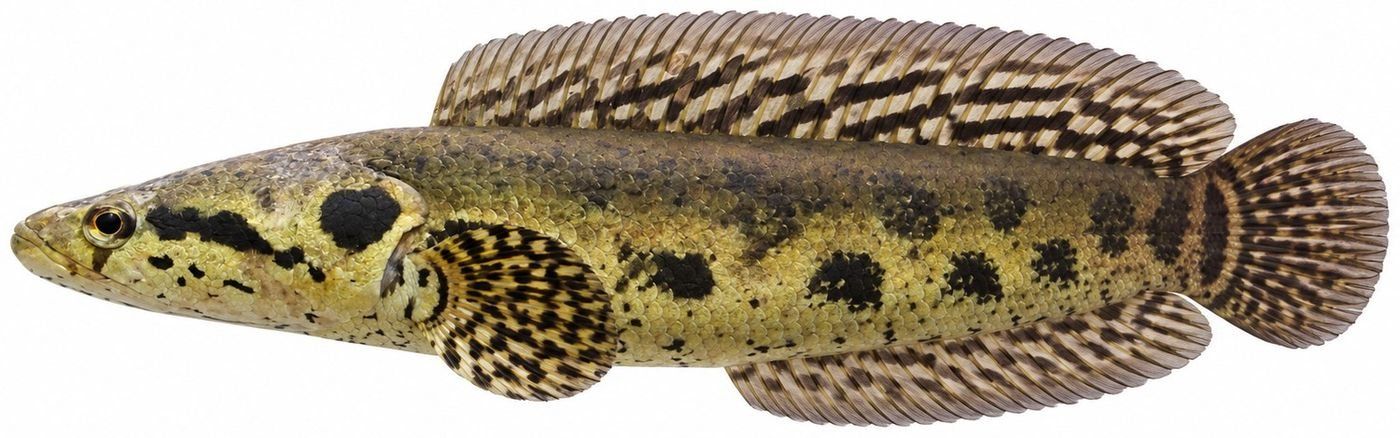
| French name | Poisson-serpent africain, African snakehead |
|---|---|
| Scientific name | Parachanna obscura (Günther, 1861) |
| Family | Family Channidae |
| English name (FAO) | African snakehead |
| Local names | Poisson-serpent; local names to be documented |
| Habitat | Freshwater: swamps, ponds, floodplains, weed beds of rivers and floodplain lagoons; demersal. |
| IUCN status | LC Least Concern. |
Identification
An elongated, cylindrical fish with a depressed, snake-like head, brown to olive marked with dark chevrons or blotches on the flanks. Long, low dorsal and anal fins running to the rounded tail. An accessory breathing organ lets it breathe air.
Features that never mislead
Flattened, scaly “snake” head, elongated cylindrical body.
Long dorsal and anal fins without strong spines, reaching the rounded tail.
Dark chevron/blotch patterns on an olive to brown background.
Breathes air; survives in stagnant, oxygen-poor water.
Size and weight
Usually 25 to 40 cm; published maximum around 50 cm.
Behaviour and ecology
An ambush predator of weed beds: it pounces on fish, frogs and insects from plant cover. Territorial, it tolerates warm, deoxygenated water by gulping air at the surface. Can briefly move over damp ground.
Reproduction and season
Oviparous with parental care: the pair guards a nest in the vegetation and protects the eggs and fry, sometimes sheltered near the surface.
Fishing practice
Techniques, from most to least effective
Surface lure (soft frog, popper) or live bait in gaps in weed beds. The top technique.
Bottom line with live bait along vegetated edges.
Trap and net in subsistence fishing.
Explosive surface strikes and runs towards cover: a lively, spectacular fight for its size. Mouth lined with small sharp teeth; unhook with pliers and hold this muscular, slippery fish firmly.
Eating quality
Firm, tasty white flesh, very popular; a fish sought after by maquis eateries, excellent grilled or in sauce.
Sources: FishBase (Parachanna obscura, Günther 1861); IUCN Red List (Least Concern); Lévêque & Paugy. Local names to be documented.