
Giraffe catfish
Auchenoglanis occidentalis (Valenciennes, 1840)
Family Claroteidae • the peaceful forager with an armoured head
| French name | Helmeted catfish, Auchenoglanis |
|---|---|
| Scientific name | Auchenoglanis occidentalis (Valenciennes, 1840) |
| Family | Family Claroteidae |
| English name (FAO) | Giraffe catfish |
| Local names | Catfish; local names to be documented |
| Habitat | Freshwater: rivers, lakes, reservoirs, sandy-muddy bottoms; demersal. |
| IUCN status | LC Least Concern. |
Identification
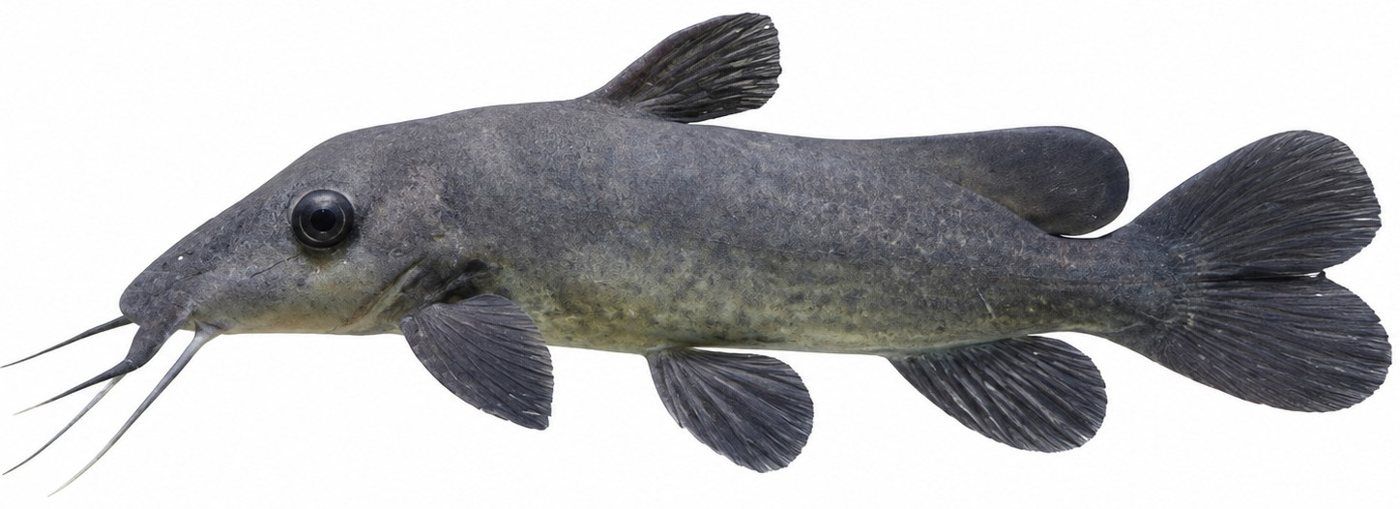
A stocky catfish with a naked body, brown to beige marked with dark spots and mottling (a pattern recalling a giraffe in juveniles), broad head armoured with a bony shield, rounded snout. Three pairs of short barbels. Rayed dorsal then adipose fin; slow, clumsy gait.
Features that never mislead
Light mottled/spotted pattern on a beige to brown background (juvenile “giraffe” look).
Broad armoured head; rounded, prominent snout.
Rather short barbels (3 pairs).
Naked body, adipose fin present; swims slowly near the bottom.
Size and weight
Usually 30 to 55 cm; published maximum around 70 cm for a few kilos.
Behaviour and ecology
A quiet, omnivorous bottom forager: molluscs, larvae, worms, seeds, detritus raked from sand and mud. Not very mobile, sedentary, it frequents the soft bottoms of rivers and reservoirs.
Reproduction and season
Oviparous; spawns in the rainy season. Some claroteids guard a dug-out spawning pit; details vary by habitat.
Fishing practice
Techniques, from most to least effective
Bottom line with worm, mollusc or paste, over soft bottoms. The top technique.
Trap and bottom net in subsistence fishing.
Light longline set in sandy areas.
A heavy but unspectacular fight: steady pulls towards the bottom. Handle with care (dorsal and pectoral spines); a calm fish once under control.
Eating quality
Decent white flesh, appreciated grilled or smoked; an everyday eating fish in river and reservoir areas.
Sources: FishBase (Auchenoglanis occidentalis, Valenciennes 1840); IUCN Red List (Least Concern); Lévêque & Paugy. Local names to be documented.