
Largetooth sawfish
Pristis pristis (Linnaeus, 1758)
Family Pristidae • the saw-snouted giant, emblematic and critically endangered
| French name | Poisson-scie commun, requin-scie (wrongly: it is a ray) |
|---|---|
| Scientific name | Pristis pristis (Linnaeus, 1758) |
| Family | Family Pristidae |
| English name (FAO) | Largetooth sawfish |
| Local names | Poisson-scie; local names and cultural references to be documented |
| Habitat | Coastal, estuaries and lagoons; historically it moved up into brackish and fresh water. Demersal. |
| IUCN status | CR Critically Endangered. Protected; historical presence to be confirmed locally. |
Identification
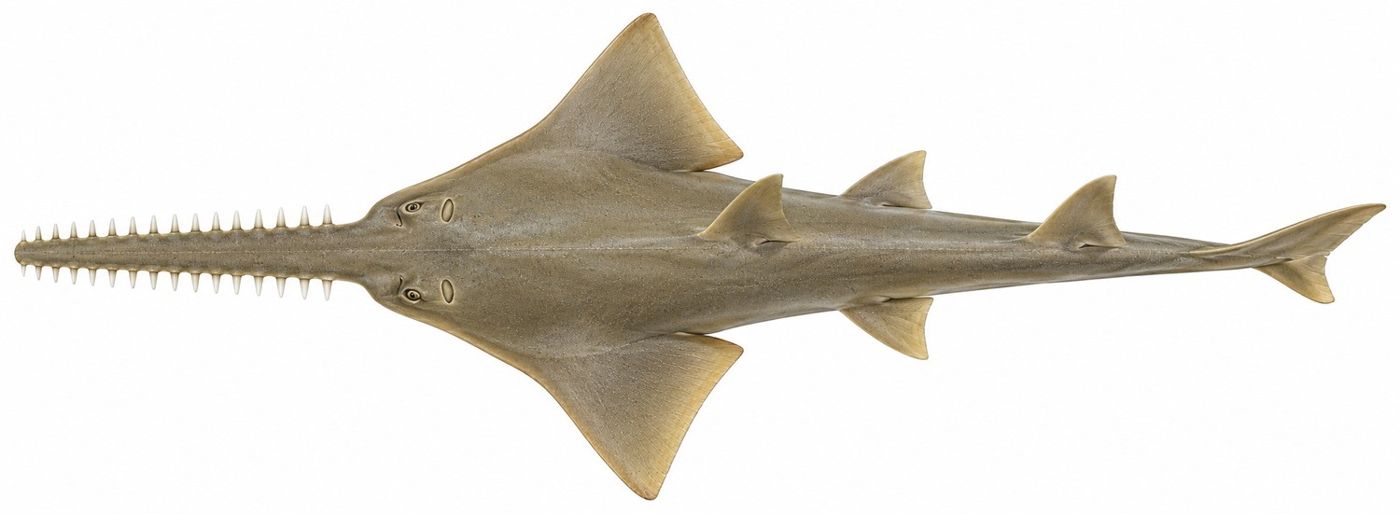
A huge batoid with an elongated, shark-like body extended by a long, flat rostrum edged with sturdy saw-like teeth. Grey to olive-brown back, pale belly. Two dorsal fins, large tail fin. The toothed rostrum is unique and absolutely characteristic.
Features that never mislead
Long, flat rostrum edged with large lateral saw-like teeth (the absolute signature).
Elongated shark-like body; two dorsal fins and a large tail fin.
Gills on the underside of the body (it is a ray, not a shark).
Can grow to an enormous size.
Size and weight
A giant species: usually several metres, historical maximum over 6 m including the rostrum.
Behaviour and ecology
A predator of coastal and estuarine bottoms: it slashes through schools of fish and digs up invertebrates with its rostrum, which is equipped with electroreceptors. Tolerant of low salinity, it once ventured far into lagoons and river mouths. Very slow growth, late maturity, low fecundity.
Reproduction and season
Aplacental viviparous; few litters, long gestation, the young born with the rostrum already formed but flexible. This life cycle explains the worldwide collapse of populations.
Fishing practice
Techniques, from most to least effective
NO TARGETED FISHING. A protected, Critically Endangered species: it must not be sought.
In case of accidental capture (net, bottom line): do not take the animal out of the water, cut the line or net, free the rostrum with the greatest care and release it immediately.
Report any sighting to the fisheries and scientific authorities (CRO): it is valuable data.
An exceptional and dangerous catch: the rostrum, swung sideways, can cause serious injury. The rule is not to “fight” the animal but to free it as quickly as possible, without hoisting it aboard, keeping clear of the rostrum. Its survival comes before any catch.
Eating quality
Not applicable: a protected species, not to be eaten under the law and given its status. Its value is heritage and ecological, not food.
Sources: FishBase (Pristis pristis, Linnaeus 1758); IUCN Red List (Critically Endangered); CITES Appendix I; regional studies on the decline of sawfishes. Historical local presence to be confirmed. Local names to be documented.