
Spadefish de Gorée (West African spadefish)
Chaetodipterus goreensis (Cuvier, 1831)
Family Ephippidae • the West African disc fish of coastal bottoms
2 look-alikes to know
| French name | Spadefish de Gorée. Other names: Saint-Pierre noir, disque de Gorée. |
|---|---|
| Scientific name | Chaetodipterus goreensis (Cuvier, 1831) |
| Family | Family Ephippidae |
| English name (FAO) | Spadefish de Gorée (West African spadefish) |
| Local names | On Ivorian markets and landing sites: “Saint-Pierre noir” (Ouattara et al., 2016). |
| Habitat | Marine and brackish, coastal benthopelagic. Frequents soft bottoms and the vicinity of structures. |
| IUCN status | NE Not Evaluated / to be checked. A coastal species exploited locally. |
Identification
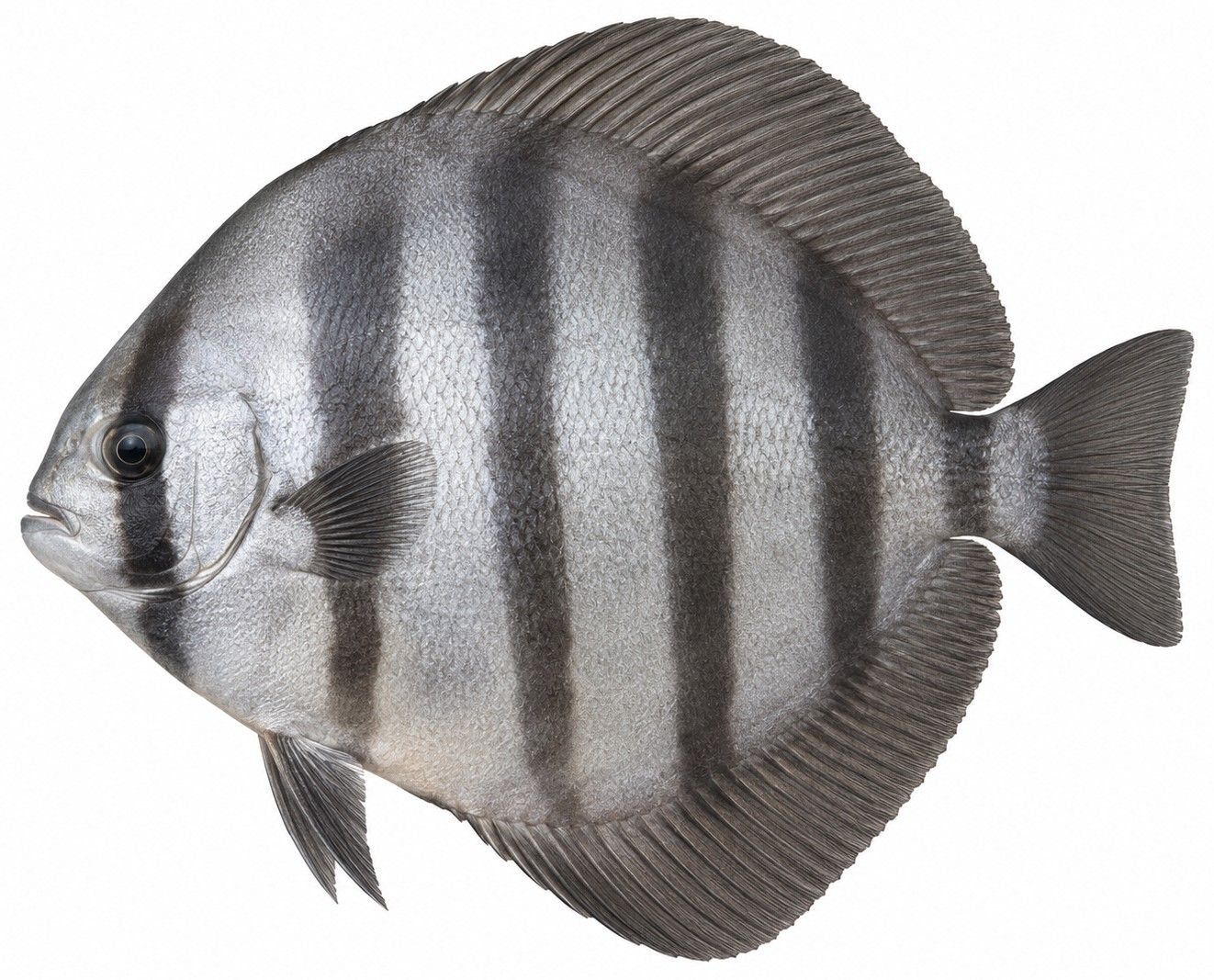
A fish with a very deep, compressed body, almost square to rounded, silvery to greyish. Symmetrical, well-developed dorsal and anal fins, giving a disc-shaped outline. The young are often barred with dark. Small mouth. Profile close to that of the African sicklefish but with shorter pectoral fins.
Features that never mislead
Very deep body, almost square to rounded, compressed.
Symmetrical, well-developed dorsal and anal fins.
Pectoral fins shorter than in the African sicklefish.
The young are often barred with dark, small mouth.
Size and weight
A medium-sized fish, usual catches of a few decimetres. Precise maximum size to be confirmed on FishBase. On the Ivorian coast, caught in coastal fisheries.
Behaviour and ecology
A coastal benthopelagic species that frequents soft bottoms and the vicinity of structures, often in small groups. Feeds on benthic invertebrates. Tolerates brackish waters.
Present on the West African coast, described from Gorée. Caught along the Ivorian coastline. IUCN status to be checked.
Reproduction and season
Coastal spawning, pelagic eggs and larvae. The young frequent sheltered coastal waters. Local spawning data to be documented.
Fishing practice
Techniques, from most to least effective
By bottom fishing with fine bait near structures and soft bottoms.
Caught in coastal nets.
With a small baited rig hard on the bottom.
The fight: respectable thanks to the flat body that resists in the current, like the African sicklefish. Mainly a net and market fish.
Eating quality
Decent white flesh, eaten charcoal-grilled (braisé) or fried. A commonly eaten fish, sold in lots on coastal markets. Best eaten fresh.
Sources: FishBase (Chaetodipterus goreensis, Cuvier 1831); FAO Eastern Central Atlantic; Ouattara et al. 2016; IUCN status to be reconfirmed.