
Disque africain (African sicklefish)
Drepane africana Osorio, 1892
Family Drepaneidae • the silvery disc fish with long pectoral fins
2 look-alikes to know
| French name | Disque africain. Other names: Saint-Pierre, forgeron, poisson-disque. |
|---|---|
| Scientific name | Drepane africana Osorio, 1892 |
| Family | Family Drepaneidae |
| English name (FAO) | Disque africain (African sicklefish) |
| Local names | On Ivorian markets and landing sites: “Saint-Pierre” (Ouattara et al., 2016). |
| Habitat | Marine and brackish, benthopelagic. Depth 10 to 75 m, most often 20 to 50 m. |
| IUCN status | LC Least Concern. Precise status to be confirmed. |
Identification
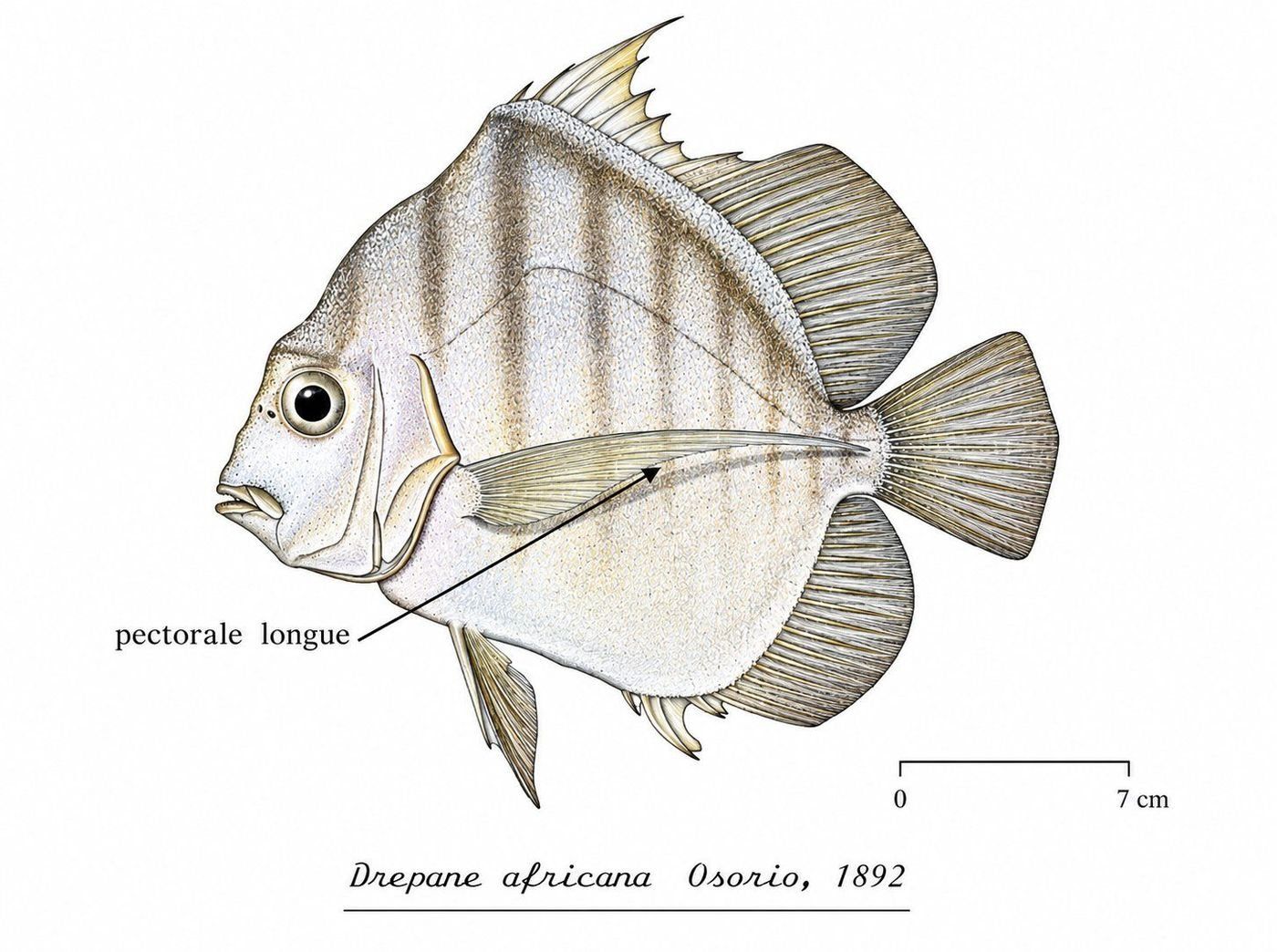
A fish with a very deep, almost round and strongly compressed body, silvery with sheen, giving it the outline of a disc. The pectoral fins are long and falcate, sickle-shaped, hence the English name sicklefish. Small, protractile mouth. The young are sometimes marked with dark bars that fade.
Features that never mislead
Very deep, almost round and compressed body, disc-shaped.
Long, falcate, sickle-shaped pectoral fins.
Silvery coloration with sheen, dark bars sometimes in the young.
Small, protractile mouth.
Size and weight
Common size around 30 cm. Published maximum length 45 cm total length, for a maximum weight of about 750 g (FishBase).
Behaviour and ecology
A coastal benthopelagic species of soft bottoms, which also frequents brackish waters. Feeds on benthic invertebrates and small bottom organisms. Often in small groups.
Present on the West African coast from Senegal to Angola. Caught along the Ivorian coastline in coastal fisheries. IUCN status: Least Concern.
Reproduction and season
Coastal spawning, pelagic eggs and larvae. The young frequent coastal and brackish waters. Local spawning data to be documented.
Fishing practice
Techniques, from most to least effective
By bottom fishing with fine bait over coastal bottoms.
Caught in coastal nets and trawls.
With a small baited rig near the bottom.
The fight: surprising for its size thanks to its flat body, which braces against the current. It is mainly a net and market fish.
Eating quality
Decent white flesh, eaten charcoal-grilled (braisé) or fried. A commonly eaten fish on Ivorian coasts, sold in lots. Best eaten fresh.
Sources: FishBase (Drepane africana, Osorio 1892); FAO Eastern Central Atlantic; Ouattara et al. 2016; IUCN status to be reconfirmed.