
Fiatole (Blue butterfish)
Stromateus fiatola Linnaeus, 1758
Family Stromateidae • the bluish butterfish of coastal waters
1 look-alike to know
| French name | Fiatole. Other names: mademoiselle, stromatée, fiatole bleue. |
|---|---|
| Scientific name | Stromateus fiatola Linnaeus, 1758 |
| Family | Family Stromateidae |
| English name (FAO) | Fiatole (Blue butterfish) |
| Local names | On Ivorian markets and landing sites: “Mademoiselle” (Ouattara et al., 2016). |
| Habitat | Marine, coastal and neritic pelagic. Forms schools in the water column over the shelf. |
| IUCN status | LC Least Concern. A widespread species, fished locally. |
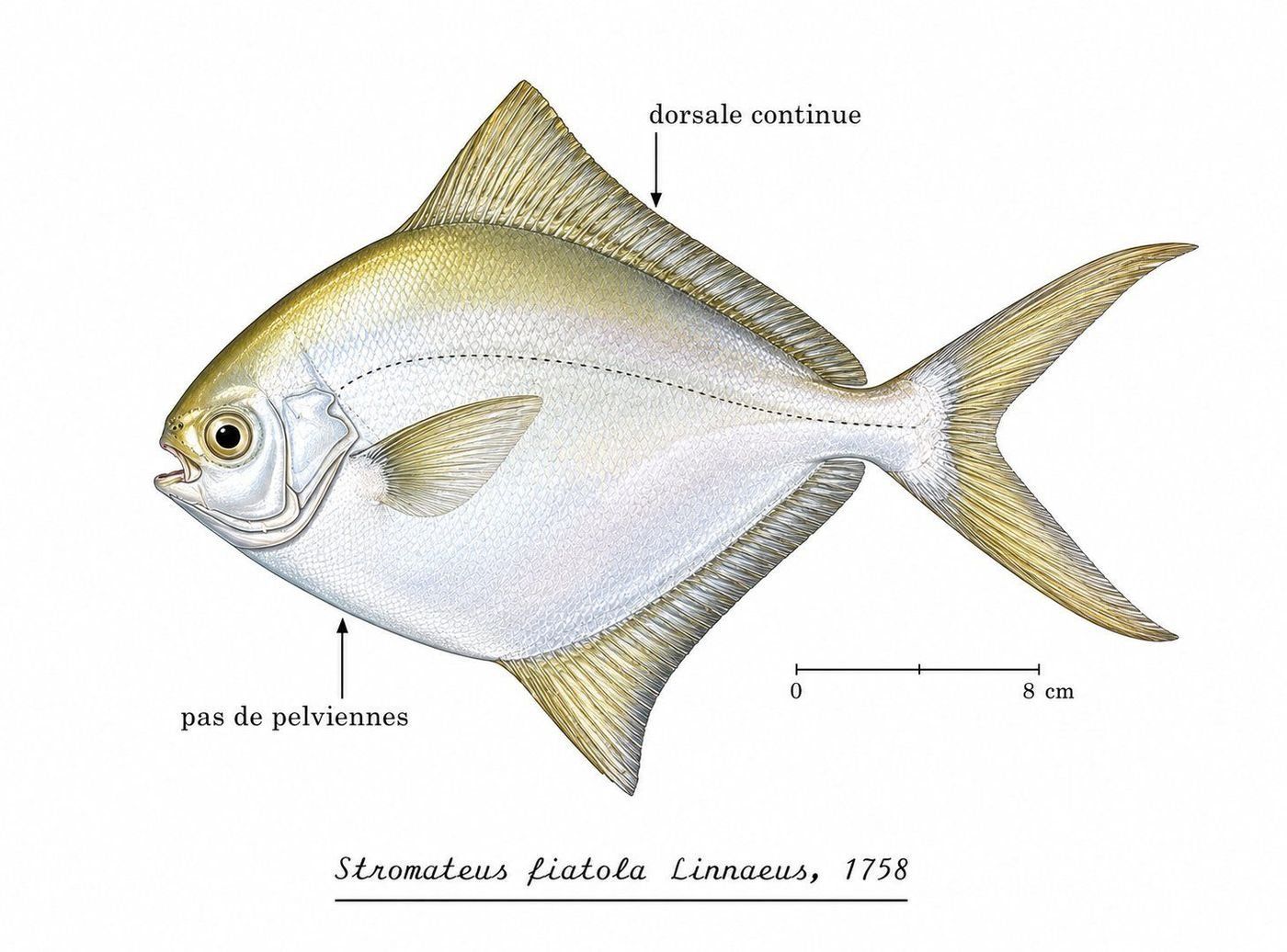
Plate: Guide de détermination des poissons des lagunes de Côte d'Ivoire (identification guide to the fishes of the lagoons of Côte d'Ivoire), E. Charles-Dominique and J. Raffray, CRO Abidjan, Archives scientifiques, 1986. Working reproduction, rights to be confirmed before publication.
Identification
A fish with an oval, deep and compressed body, silvery with bluish sheen, without pelvic fins in adults. Long, low dorsal and anal fins, forked tail. The young often carry dark bars or spots that fade. An elegant, smooth appearance.
Features that never mislead
Oval, deep and compressed body, silvery with bluish sheen.
No pelvic fins in adults.
Long, low dorsal and anal fins, forked tail.
Dark bars or spots in the young, faded in adults.
Size and weight
Common size around 40 cm. Maximum recorded length about 50 cm (FishBase). A medium-sized schooling fish.
Behaviour and ecology
A gregarious coastal pelagic species that forms schools in the water column over the shelf. Feeds on plankton, small invertebrates and jellyfish. The young sometimes shelter beneath jellyfish.
Present in the eastern Atlantic and the Mediterranean. Caught along the Ivorian coast in mixed fisheries. IUCN status: Least Concern.
Reproduction and season
Open-water spawning, pelagic eggs and larvae. Juveniles live in open water, sometimes close to jellyfish. Local spawning data to be documented.
Fishing practice
Techniques, from most to least effective
With purse seines and seines on the schools.
With a multi-hook rig of small baited hooks.
Caught in coastal nets.
The fight: modest given its size, vibrations on a fine line. It is mainly a net and market fish, valued for its flesh.
Eating quality
White, fine and delicate flesh, which justifies its English name, butterfish. Excellent grilled or charcoal-grilled (braisé). Best eaten fresh.
Sources: FishBase (Stromateus fiatola, Linnaeus 1758); IUCN Red List 2015 (LC); FAO Eastern Central Atlantic; Ouattara et al. 2016.