
Sole-langue de Monod (Guinean tonguesole)
Cynoglossus monodi Chabanaud, 1949
Family Cynoglossidae • the slender tonguesole of sandy bottoms
1 look-alike to know
| French name | Sole-langue de Monod. Other names: sole, sole-langue, langue d'Afrique. |
|---|---|
| Scientific name | Cynoglossus monodi Chabanaud, 1949 |
| Family | Family Cynoglossidae |
| English name (FAO) | Sole-langue de Monod (Guinean tonguesole) |
| Local names | On Ivorian markets and landing sites: “Sole” (Ouattara et al., 2016). |
| Habitat | Marine and brackish, demersal over coastal soft bottoms, sand and mud. Tolerates estuary margins. |
| IUCN status | NE Not Evaluated / to be checked. A coastal fisheries flatfish, poorly documented. |
Identification
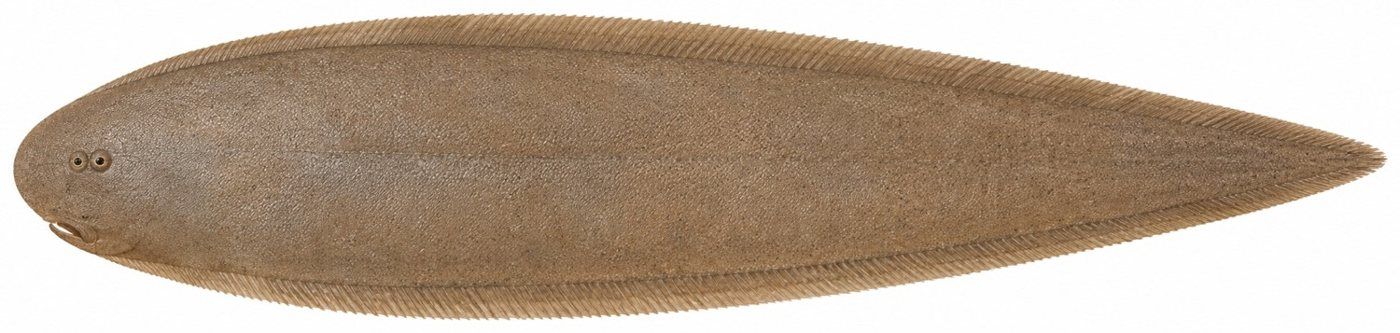
A very elongated flatfish tapering like a tongue, with both eyes on the same side (the left in Cynoglossidae). Eyed side brownish, blind side pale. Dorsal, caudal and anal fins continuous, encircling the pointed rear of the body. Small, twisted mouth. No pectoral fins in adults.
Features that never mislead
Very elongated body tapering like a tongue, ending in a point.
Both eyes on the left side, eyed side brownish.
Dorsal, caudal and anal fins continuous, encircling the rear.
Small twisted mouth, no pectoral fins in adults.
Size and weight
A medium-sized tonguesole, usual catches of a few decimetres. Precise maximum size to be confirmed on FishBase.
Behaviour and ecology
A demersal species of soft bottoms, lying flat on sand and mud, often buried. Feeds on small benthic invertebrates, worms and crustaceans. Active mainly at night.
Present over West African coastal soft bottoms, named in honour of the naturalist Théodore Monod. Caught along the Ivorian coast. IUCN status to be checked.
Reproduction and season
Coastal spawning, pelagic eggs and larvae. The young go through the flatfish metamorphosis. Local spawning data to be documented.
Fishing practice
Techniques, from most to least effective
By bottom fishing with fine bait (worm, shrimp) over sand and mud bottoms.
Caught in coastal trawls and nets.
With a small bottom rig at night.
The fight: modest, the fish presses itself against the bottom. It is above all a trawl and net catch, valued for its flesh.
Eating quality
White, fine and delicate flesh, sought after like that of true soles, even if the tongue shape makes it look different. Excellent pan-fried or grilled. Best eaten fresh.
Sources: FishBase (Cynoglossus monodi, Chabanaud 1949); FAO Eastern Central Atlantic; Ouattara et al. 2016; IUCN status to be reconfirmed.