
Brotule barbée (Bearded brotula)
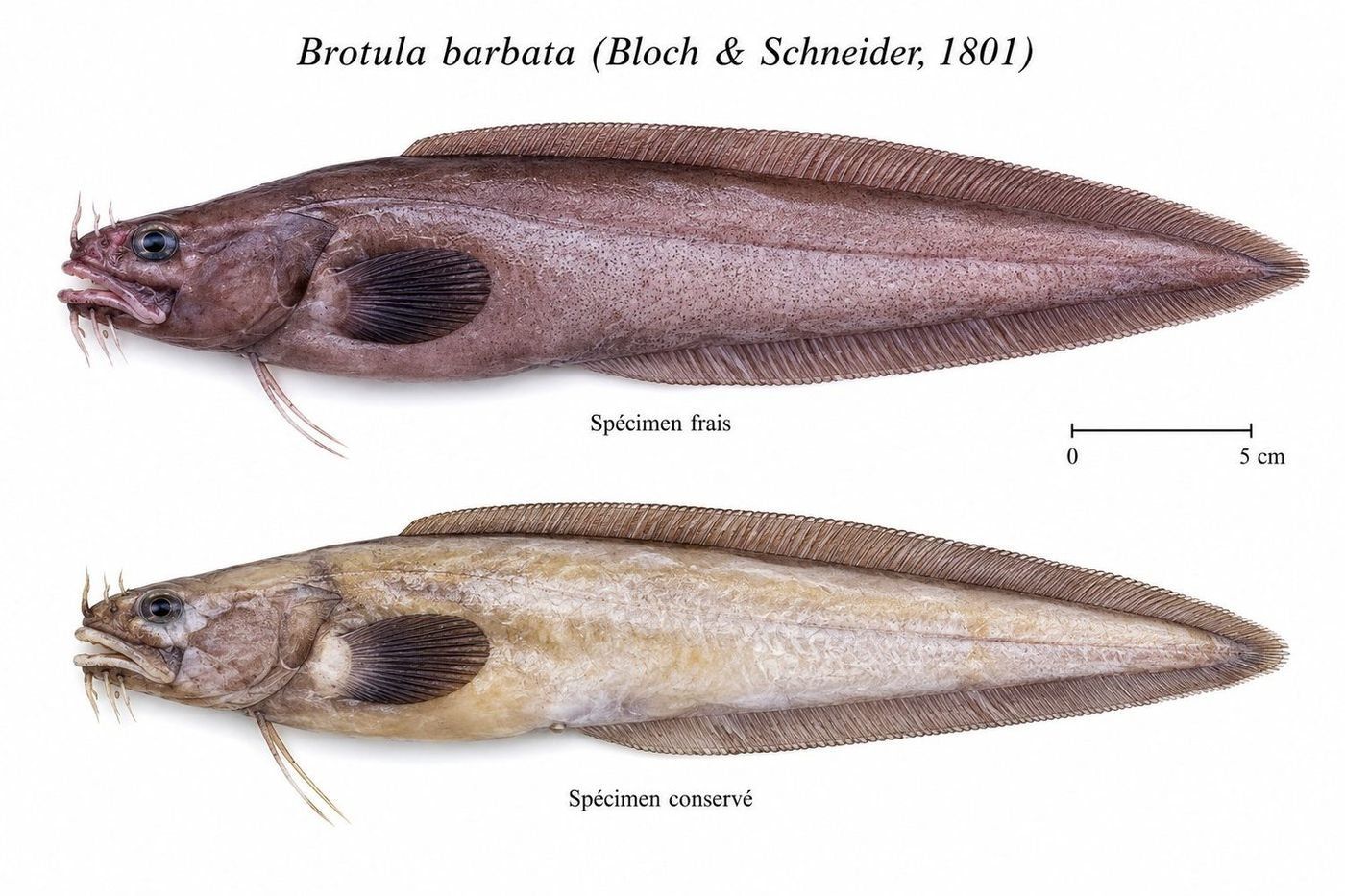
Brotula barbata (Bloch & Schneider, 1801)
Family Ophidiidae • the bearded sea loach of the deep
1 look-alike to know
| French name | Brotule barbée. Other names: loche, loche de mer, brotule. |
|---|---|
| Scientific name | Brotula barbata (Bloch & Schneider, 1801) |
| Family | Family Ophidiidae |
| English name (FAO) | Brotule barbée (Bearded brotula) |
| Local names | On Ivorian markets and landing sites: “Loche” (Ouattara et al., 2016). |
| Habitat | Marine, demersal on the bottoms of the shelf and continental slope, often deep. Near hard bottoms and caves. |
| IUCN status | NE Not Evaluated / to be checked. A deep-water fishing species, poorly documented. |
Identification
A fish with an elongated body tapering towards the rear, brown to pinkish, with the look of a loach. Dorsal, tail and anal fins continuous, forming a long fringe around the rear part of the body. Several barbels under the snout, sensory organs that earn it its name. Smooth skin.
Features that never mislead
Several barbels under the snout, hence the name bearded.
Dorsal, tail and anal fins continuous in a long rear fringe.
Elongated, tapering body, loach-like look, brown to pinkish.
Smooth skin, a bottom species.
Size and weight
A medium to large fish for its family. Precise maximum size to be confirmed on FishBase. Caught in deep bottom fishing on the Ivorian coast.
Behaviour and ecology
A demersal species that stays near the bottom, caves and crevices, often at considerable depth. A nocturnal predator of small fish and crustaceans, which it detects with its barbels.
Present on the West African shelf and slope. Caught in deep-water fishing off Côte d'Ivoire. IUCN status to be checked.
Reproduction and season
Spawns in deep water; spawning data poorly known. To be documented locally.
Fishing practice
Techniques, from most to least effective
Deep handline and bottom longline fishing.
Bottom fishing with natural bait near reliefs.
Caught in deep trawls.
The fight: heavy, sluggish pulls from the bottom, not very spectacular. It is above all a deep-water fish valued for its flesh.
Eating quality
White, firm flesh reputed to be fine, which justifies the name loche shared with other fish with highly regarded flesh. To be eaten fresh.
Sources: FishBase (Brotula barbata, Bloch & Schneider 1801); FAO Eastern Central Atlantic; Ouattara et al. 2016; IUCN status to be reconfirmed.