
Tile à bandes (Zigzag tilefish)
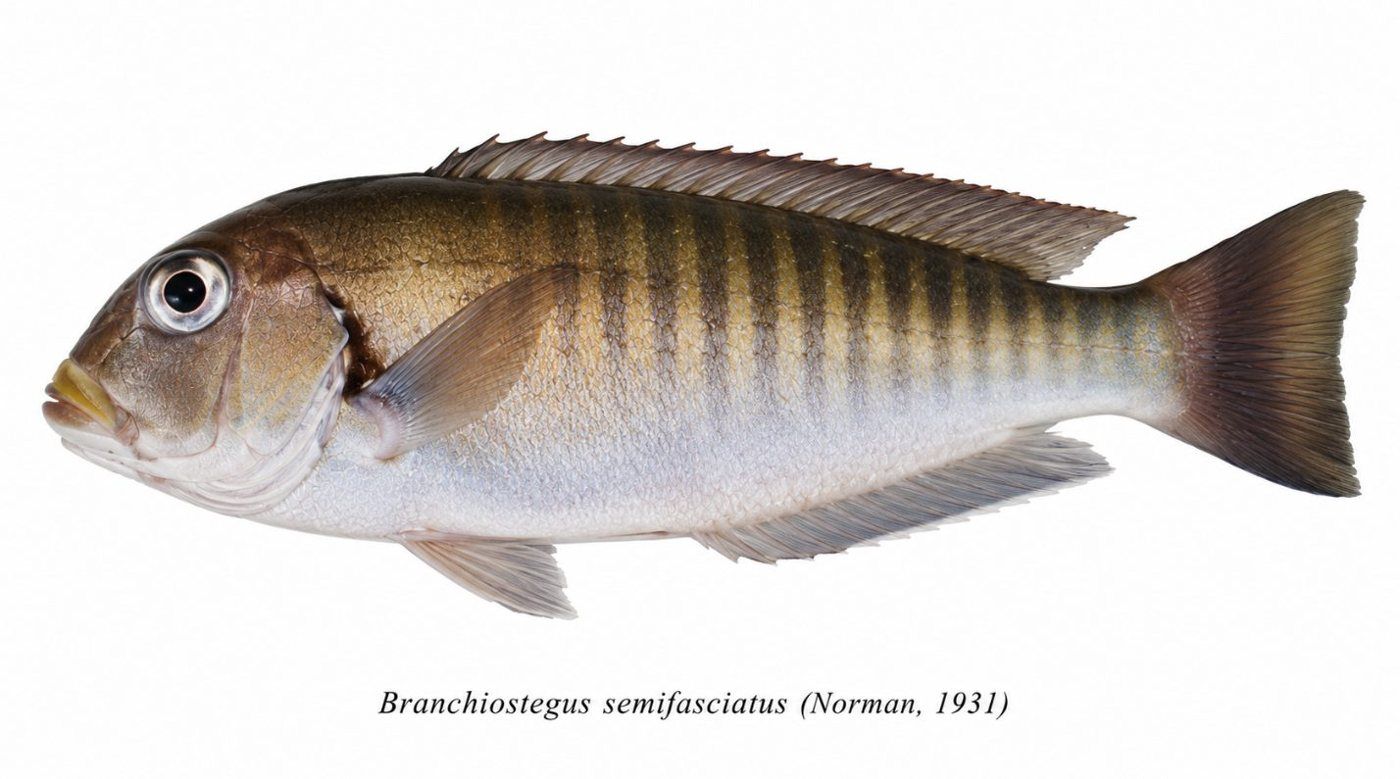
Branchiostegus semifasciatus (Norman, 1931)
Family Malacanthidae • the colourful tilefish of deep grounds
1 look-alike to know
| French name | Tile à bandes. Other names: poisson chat (local usage), tile ouest-africain. |
|---|---|
| Scientific name | Branchiostegus semifasciatus (Norman, 1931) |
| Family | Family Malacanthidae (Branchiostegidae) |
| English name (FAO) | Tile à bandes (Zigzag tilefish) |
| Local names | On Ivorian markets and landing sites: “Poisson chat” (Ouattara et al., 2016). |
| Habitat | Marine, demersal on the deep soft bottoms of the shelf and continental slope. Digs burrows. |
| IUCN status | NE Not Evaluated / to be checked. A deep-water fishing species, poorly documented. |
Identification
A fish with an elongated, robust body, a large head with a slightly rounded profile, and a colourful livery that often alternates darker bands or marbling on a pale to pinkish background. Long continuous dorsal fin. Tilefishes dig and live in burrows on deep soft bottoms.
Features that never mislead
Dark bands or marbling on a pale to pinkish background, colourful livery.
Elongated, robust body, large slightly rounded head.
Long continuous dorsal fin.
A deep-bottom species that digs burrows.
Size and weight
A medium-sized fish of deep grounds. Precise maximum size to be confirmed on FishBase. Caught by deep longline on the Ivorian slope.
Behaviour and ecology
A demersal species of deep soft bottoms, which digs and occupies burrows from which it watches for small invertebrates and fish. Sedentary behaviour tied to its shelter.
Present on the West African shelf and slope. Caught in deep-water fishing off Côte d'Ivoire. IUCN status to be checked.
Reproduction and season
Spawns in deep water; spawning data poorly known locally. To be documented.
Fishing practice
Techniques, from most to least effective
Deep handline and longline fishing over the soft bottoms of the slope.
Heavy bottom fishing with natural bait.
Caught in deep trawls.
The fight: heavy pulls from the depths, not very spectacular but sustained. It is mainly a fish of deep-water fishing and specialised markets.
Eating quality
Fine, appreciated white flesh, like that of most tilefishes. Sought after by connoisseurs of bottom fish. To be eaten fresh.
Sources: FishBase (Branchiostegus semifasciatus, Norman 1931); FAO Eastern Central Atlantic; Ouattara et al. 2016; IUCN status to be reconfirmed.