
Smooth puffer
Lagocephalus laevigatus (Linnaeus, 1766)
Family Tetraodontidae • the pufferfish to be handled with care
2 look-alikes to know
| French name | Compère lisse. Other names: faux perroquet, poisson-lampe, tétraodon (pufferfish). |
|---|---|
| Scientific name | Lagocephalus laevigatus (Linnaeus, 1766) |
| Family | Family Tetraodontidae |
| English name (FAO) | Smooth puffer |
| Local names | Commonly referred to by its usual French name on Ivorian markets and landing sites. Names in lagoon languages (Ébrié, Alladian, Avikam) are being collected in the field. |
| Habitat | Marine and brackish, pelagic-neritic. Depth 10 to 180 m, over sand or mud bottoms. |
| IUCN status | LC Least Concern. Eastern Atlantic: from Mauritania to Namibia. |
Identification
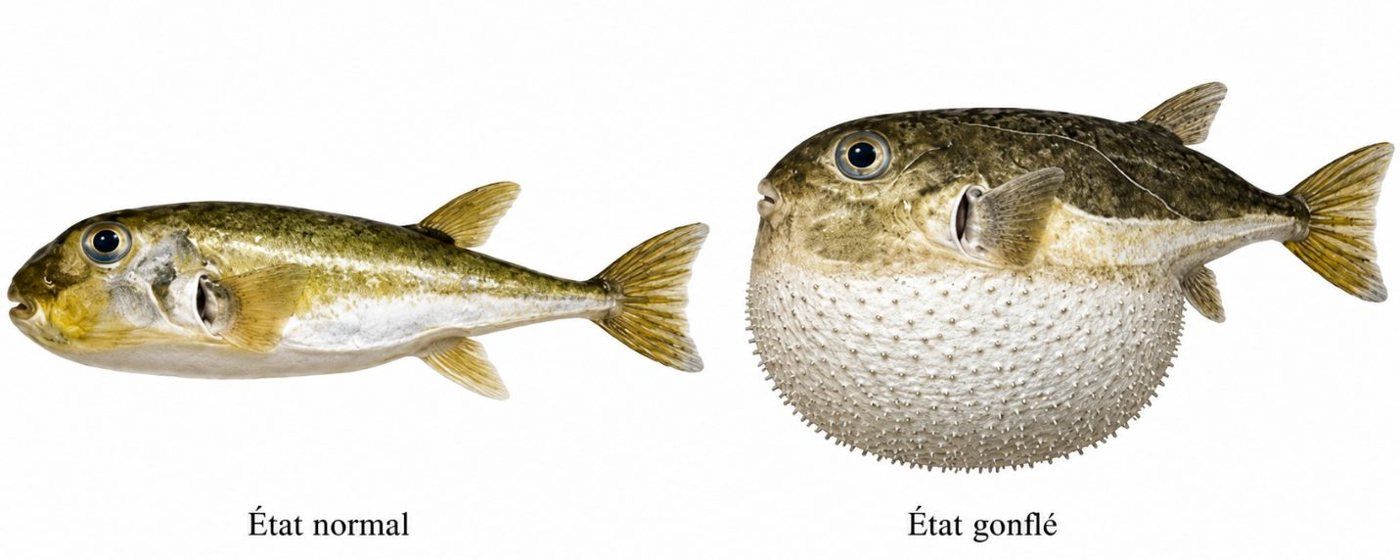
An elongated, smooth body, able to inflate with water or air when threatened. Grey to bluish back, silvery flanks, white belly. The snout is longer than the space between the eyes, which are set high on the head. The skin is naked (without scales), with small spines only on the belly.
Features that never mislead
- A hard beak made of four fused teeth, two above and two below, with a central suture.
- A single short dorsal fin, set far back, with no spiny rays; no pelvic fins.
- Clearly forked tail fin, the two lobes roughly equal.
- Body able to inflate like a balloon, smooth skin without scales.
Size and weight
Common size around 60 cm. Published maximum length 100 cm TL for a published maximum weight of about 4.9 kg (FishBase). It is one of the largest pufferfishes.
Behaviour and ecology
A predator of soft bottoms: it crushes shellfish, crustaceans and small fish with its powerful beak. Adults live near the coastal slope, juveniles closer to the shore, alone or in small loose groups.
On the Ivorian coast, it frequents the sand and mud bottoms of the shelf and enters the brackish waters of river mouths. It is regularly taken as bycatch.
Reproduction and season
An oviparous species, spawning at sea. Local maturity data to be confirmed (FishBase gives no maturity size for this species).
Fishing practice
Techniques, from most to least effective
- Most often caught unintentionally on a handline or bottom line with natural bait, over soft bottoms.
- In bottom fishing with bait, this crushing jaw cuts fine leaders cleanly.
Taken on the bottom, it resists feebly and then inflates. What matters is not the fight but safety when unhooking: keep your fingers away from the beak, and cut the leader rather than force it.
Eating quality
To be treated as dangerous. The toxin is concentrated mainly in the liver, gonads, intestines and skin. Without a specialised cutting chain, this fish must not be eaten. This book strongly advises against preparing it at home.
Did you know?
The pufferfish owes its defence to a unique physiology: by rapidly swallowing water, it triples its volume and becomes a sphere that is hard to grasp and swallow. But its real weapon is chemical: the tetrodotoxin it accumulates is one of the most powerful natural poisons known, hundreds of times more toxic than cyanide. This is what makes Japanese fugu, a cousin, a delicacy as prestigious as it is risky.
Sources: FishBase (Lagocephalus laevigatus, Linnaeus 1766); IUCN Red List (Least Concern); WoRMS; FAO Eastern Central Atlantic. Ivorian data to be reconfirmed with the CRO Abidjan.