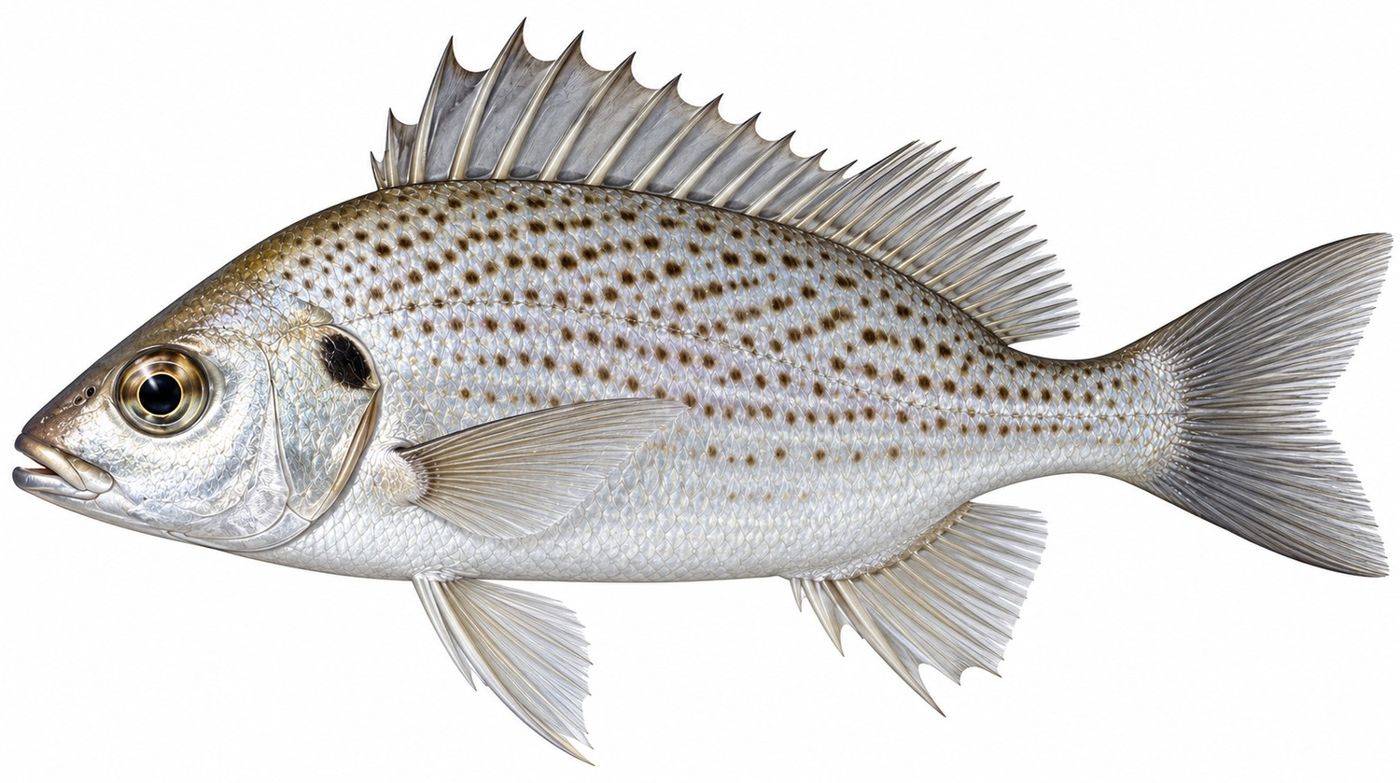
Family Haemulidae • the coastal grunt of brackish waters
Plate validated 2026
4 look-alikes to know
Loading 3D model
3D model: rotate it with your finger or mouse
ID card
French name
Dorade grise. Other names: carpe-blanche, grogneur sompat, sompat.
Scientific name
Pomadasys jubelini (Cuvier, 1830)
Family
Family Haemulidae
English name (FAO)
Grogneur sompat (Sompat grunt)
Local names
On Ivorian markets and landing sites: “Carpe-blanche” (Ouattara et al., 2016).
Habitat
Marine, brackish and freshwater, demersal. Depth 0 to 100 m, most often 20 to 50 m.
IUCN status
LC Least Concern. Precise status to be confirmed.
Identification
A grunt with an oval, compressed body, silvery grey with golden reflections, darker back. Even head profile, modest mouth with two pores and a pit on the chin, the mark of the Haemulidae. It produces grunting sounds with its swim bladder. Pelvic and anal fins sometimes washed with yellow.
Features that never mislead
Two pores and a central pit under the chin, the mark of the grunts.
Oval compressed body, silvery grey with golden reflections.
Produces grunting sounds with the swim bladder.
Modest mouth, even head profile.
Size and weight
Common size around 45 cm. Published maximum length about 60 cm total length (FishBase). Early maturity, at around 13 cm.
Behaviour and ecology
A euryhaline species very much at home in brackish waters: it frequents the shoreline and estuaries and even enters fresh water. It searches soft bottoms for worms, molluscs and small crustaceans.
Present along the entire West African coast from Mauritania to Angola. In Côte d'Ivoire, it is a familiar species of the Ébrié lagoon and the Vridi canal. IUCN status: Least Concern.
Reproduction and season
Coastal and estuarine spawning, pelagic eggs and larvae. Early maturity. Young fish use the lagoons as nursery areas.
Fishing practice
Techniques, from most to least effective
Bottom fishing with natural bait (worm, shrimp) on lagoon and estuary bottoms.
Surfcasting from the beaches and the canal mouth.
Caught in coastal and lagoon nets.
The fight: honest and sustained, with steady pulls along the bottom. A good fish for static bottom fishing in the lagoon as well as for surfcasting.
Eating quality
White, fine and appreciated flesh. Excellent braised or grilled. Very common on Ivorian markets, a popular lagoon fish.
Sources: FishBase (Pomadasys jubelini, Cuvier 1830); FAO Eastern Central Atlantic; Ouattara et al. 2016; coastal IUCN status to be reconfirmed.