
Vivaneau de Gorée (Gorean snapper)
Lutjanus goreensis (Valenciennes, 1830)
Family Lutjanidae • the coastal snapper of the island of Gorée
3 look-alikes to know
| French name | Vivaneau de Gorée. Other names: carpe-rouge, vivaneau goréen, Gorean snapper. |
|---|---|
| Scientific name | Lutjanus goreensis (Valenciennes, 1830) |
| Family | Family Lutjanidae |
| English name (FAO) | Vivaneau de Gorée (Gorean snapper) |
| Local names | On Ivorian markets and landing sites: “Carpe-rouge” (Ouattara et al., 2016). |
| Habitat | Marine, associated with hard bottoms and inshore reefs of the continental shelf; juveniles in estuaries, lagoons and lower river courses. |
| IUCN status | DD Data Deficient. Targeted by West African coastal fishing. |
Identification
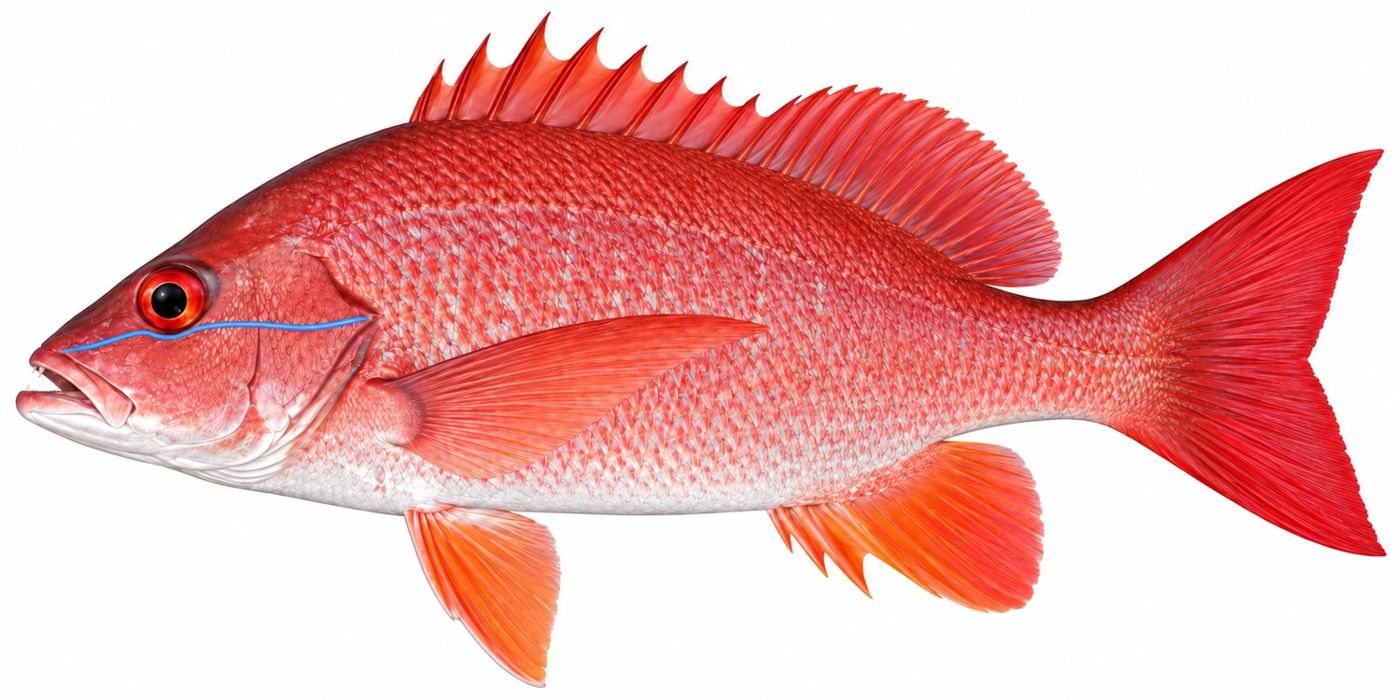
Oblong-bodied snapper with a pointed snout, a straight head profile and thick lips. Back and upper sides vermilion red, pink in large fish, belly silvery white. A thin blue line runs from the snout, below the eye, to the angle of the gill cover (sometimes reduced to blue spots). Described from Gorée Island, hence its name. Formerly called Lutjanus guineensis.
Features that never mislead
Thin blue line from the snout to the gill cover.
Plain vermilion red colour, silvery white belly.
Dorsal fin with 10 spines and 14 soft rays, anal fin with 3 spines and 8 rays.
Emarginate tail fin.
Size and weight
Large hard-bottom snapper, up to 80 cm total length (FishBase). Fine fish of several kilos along the Ivorian coast.
Behaviour and ecology
A demersal predator of hard bottoms and coastal reefs, hunting fish and crustaceans near shelters.
Found along the West African coast, described from Gorée. Juveniles live in estuaries, lagoons and lower river courses: this is the “carpe rouge” caught, notably by trolling, in the Ébrié Lagoon. IUCN status: Data Deficient.
Reproduction and season
Coastal spawning, pelagic eggs and larvae. Slow growth. Local spawning data to be documented.
Fishing practice
Techniques, from most to least effective
Bottom fishing with natural bait over hard bottoms and wrecks.
Heavy handline and jig fishing.
With live bait near reliefs.
The fight: powerful, with a run towards the structure on the bite. Same advice as for its cousins: hold it hard right from the start.
Eating quality
Firm, highly appreciated white flesh, like that of all snappers. Excellent baked or braised. Good commercial value.
Sources: FishBase (Lutjanus goreensis, Valenciennes 1830; formerly L. guineensis); IUCN Red List (Data Deficient); FAO Eastern Central Atlantic; Ouattara et al. 2016.