
Vivaneau à dents de chien (African brown snapper)
Lutjanus dentatus (Duméril, 1861)
Family Lutjanidae • the large brown snapper with powerful canines
3 look-alikes to know
| French name | Vivaneau à dents de chien. Other names: carpe-métis, vivaneau brun d'Afrique. |
|---|---|
| Scientific name | Lutjanus dentatus (Duméril, 1861) |
| Family | Family Lutjanidae |
| English name (FAO) | Vivaneau à dents de chien (African brown snapper) |
| Local names | On Ivorian markets and landing sites: “Carpe-métis” (Ouattara et al., 2016). |
| Habitat | Marine and brackish, associated with reefs and hard bottoms. Enters estuaries and river mouths. |
| IUCN status | DD Data Deficient. Targeted by artisanal fishing, stock status poorly known. |
Identification
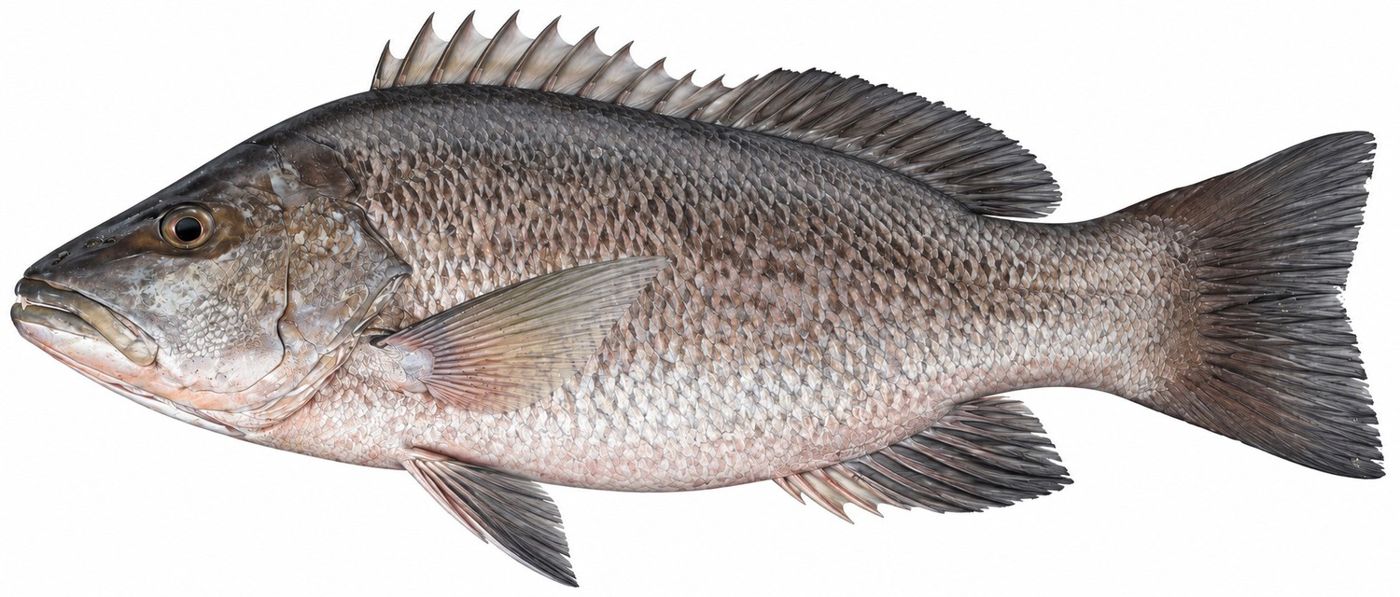
A large snapper with a robust, deep body, pointed snout and somewhat angular forehead. Brownish to grey livery, darker on the back, paler on the belly. It differs from its Gorean cousin in its clearly longer and stronger teeth, especially the front canines, hence its name. Tail fin only slightly forked.
Features that never mislead
Long, powerful front canines, stronger than in the Gorean snapper.
Large, robust, deep body, pointed snout.
Brownish to grey livery, darker back.
Dorsal fin with 10 spines, profile of a large lutjanid.
Size and weight
Common size around 50 cm. Published maximum length 150 cm total length, for a maximum weight of around 50 kg (FishBase). It is one of the largest snappers of the Gulf of Guinea.
Behaviour and ecology
A demersal predator of hard bottoms and coastal reefs, hunting fish and crustaceans. Tolerates reduced salinity and enters estuaries.
Present on the West African coast from Senegal to Angola, mainly in the Gulf of Guinea, rare north of Cape Verde. On the Ivorian coast, it is a fine bottom and wreck fish. IUCN status: Data Deficient.
Reproduction and season
Coastal spawning, pelagic eggs and larvae. Local spawning data to be documented. Slow growth typical of large lutjanids.
Fishing practice
Techniques, from most to least effective
Bottom fishing with natural bait (whole fish, squid) on wrecks and hard bottoms.
Heavy handline and jig fishing on structures.
With live bait presented near shelters.
The fight: brutal and deep, the snapper charges for the structure on the bite to saw through the line. Everything happens in the first few seconds, with the drag locked.
Eating quality
White, firm and excellent flesh, among the most prized of the snappers. Highly sought after baked or as a steak. Good commercial value.
Sources: FishBase (Lutjanus dentatus, Duméril 1861); IUCN Red List (Data Deficient); FAO Eastern Central Atlantic; Ouattara et al. 2016 (given as 1858, corrected to 1861 according to FishBase).