
Little tunny
Euthynnus alletteratus (Rafinesque, 1810)
Family Scombridae • the small spotted tuna of coastal feeding frenzies
1 look-alike to know
| French name | Thonine commune. |
|---|---|
| Scientific name | Euthynnus alletteratus (Rafinesque, 1810) |
| Family | Family Scombridae |
| English name (FAO) | Little tunny |
| Local names | On Ivorian markets and landing sites: “Kpokou-Kpokou” (Ouattara et al., 2016). |
| Habitat | Small, gregarious coastal tuna, a swift predator of baitfish schools, which it drives to the surface in boiling feeding frenzies that can be spotted by the birds. |
| IUCN status | Least Concern (LC), IUCN Red List, assessed on 01/03/2022. |
How to recognise it
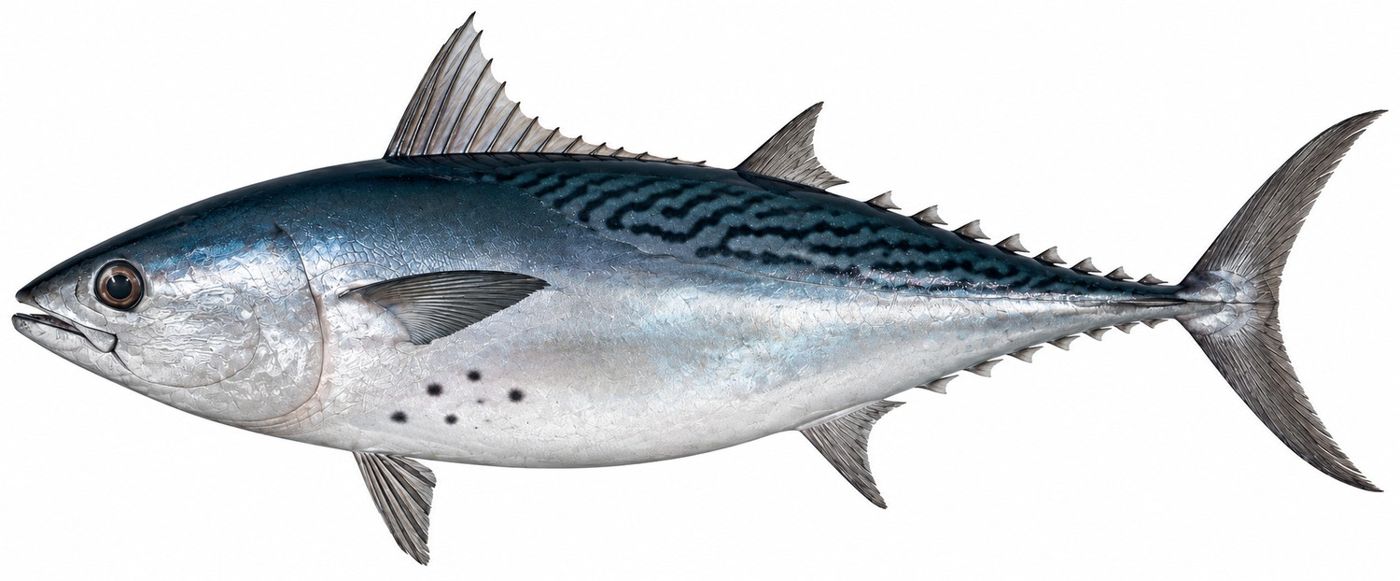
- steel-blue back marked with dark, oblique, broken, zigzag bands, confined to the rear of the back;
- 3 to 7 round dark spots between the pectoral and pelvic fins, an unmistakable feature;
- silvery belly without longitudinal stripes (its lookalike, skipjack tuna, has 4 to 6 belly stripes and an unmarked back);
- first dorsal fin deeply notched, its first spines much taller than the middle ones; 15 to 16 dorsal spines; 7 to 8 finlets;
- body scaleless except for the corselet and the lateral line.
Also not to be confused with bullet tuna (Auxis rochei), which is smaller, with widely separated dorsal fins.
Size
Common size 80 cm; published maximum 122 cm and 16.5 kg; first maturity at about 42 cm (FishBase).
Life
Gregarious, it hunts clupeids (sardinellas, anchovies), squid and crustaceans in schools, often at the surface under the birds. Spawns several times in the warmest waters; pelagic eggs and larvae (FishBase). In Côte d'Ivoire it is common at the mouth of the Vridi canal and along the beaches.
Fishing
With lures cast into the feeding frenzy (stickbait, popper, small shiny jig), from shore or boat; by fast trolling small spoons along the coast; with live bait or fish strips at current spots. A nervy fight in tight circles, one of the best sport fish on light spinning tackle.
At the table
Dark red, firm flesh with a strong taste. Bleed and chill without delay. Grilled, in a spicy sauce or marinated.
Status
Least Concern (LC), IUCN Red List, assessment of 01/03/2022 (via FishBase, checked on 24/10/2026).
Sources: FishBase, Euthynnus alletteratus; Wikipedia, Little tunny (accessed on 24/10/2026); species sheet 3 V13.