
Skipjack tuna
Katsuwonus pelamis (Linnaeus, 1758)
Family Scombridae • the schooling tuna that feeds the Atlantic
1 look-alike to know
| French name | Listao. |
|---|---|
| Scientific name | Katsuwonus pelamis (Linnaeus, 1758) |
| Family | Family Scombridae |
| English name (FAO) | Skipjack tuna |
| Local names | On Ivorian markets and landing sites: “Listao” (Ouattara et al., 2016). |
| Habitat | The most fished tuna in the world. |
| IUCN status | Least Concern (LC), IUCN Red List, assessed on 15/01/2021. |
Check against V13
Size, maturity and age data consistent with FishBase; maximum age specified (12 years reported); IUCN status dated. The comparison with young yellowfin tuna has been removed pending a source (to be checked).
How to recognise it
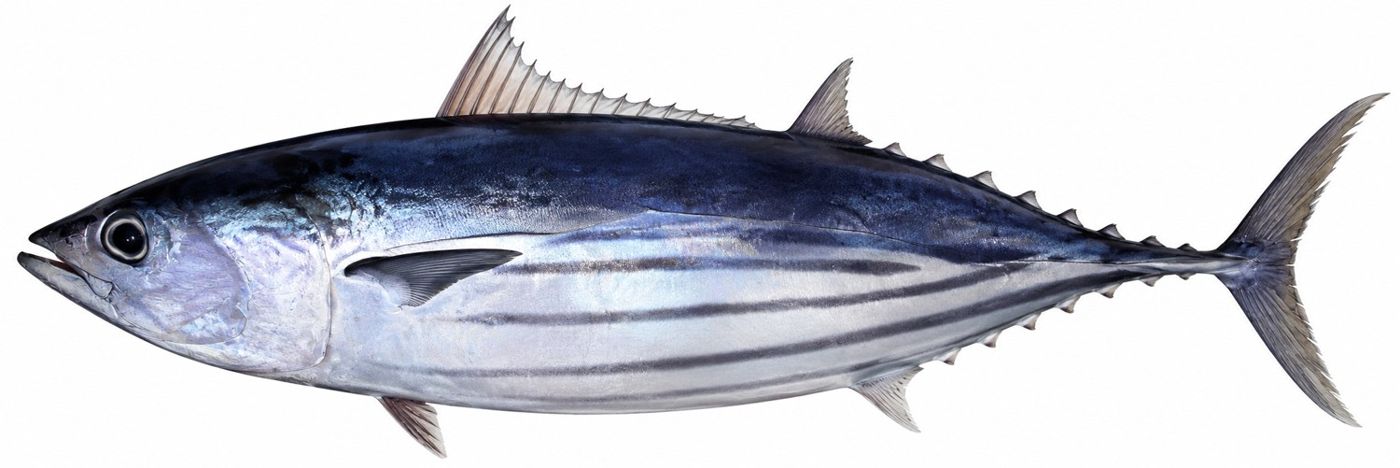
- 4 to 6 dark longitudinal stripes on the lower flanks and belly, never on the back;
- dark blue-violet back, unmarked;
- body scaleless except for the corselet and the lateral line; two close-set dorsal fins followed by finlets; crescent-shaped tail.
Not to be confused with: little tunny (Euthynnus alletteratus), back marked with zigzag bands, belly without stripes, 3 to 7 spots below the pectoral fin.
Size
Common size 80 cm fork length; published maximum 110 cm and 34.5 kg; first maturity at about 41 cm; up to 12 years (FishBase).
Life
Strictly gregarious pelagic, in large schools often associated with floating objects, dolphins and thermal fronts; feeds on small fish, squid and crustaceans. Off Côte d'Ivoire, a major target of purse seiners.
Fishing
Industrial purse seining, on free schools or on FADs; selective artisanal pole-and-line fishing with live bait; in sport fishing, fast trolling with small lures. Fights in tight circles towards the bottom; firm drag.
At the table
Dark red flesh, the world’s main canning fish; grilled, in sauce or raw when very fresh. Bleed and chill straight away.
Status
Least Concern (LC), IUCN Red List, assessment of 15/01/2021 (via FishBase, checked on 24/10/2026).
Sources: FishBase, Katsuwonus pelamis (accessed on 24/10/2026); species sheet 4 V13.