
Bigeye tuna
Thunnus obesus (Lowe, 1839)
Family Scombridae • the big-eyed tuna of deep waters
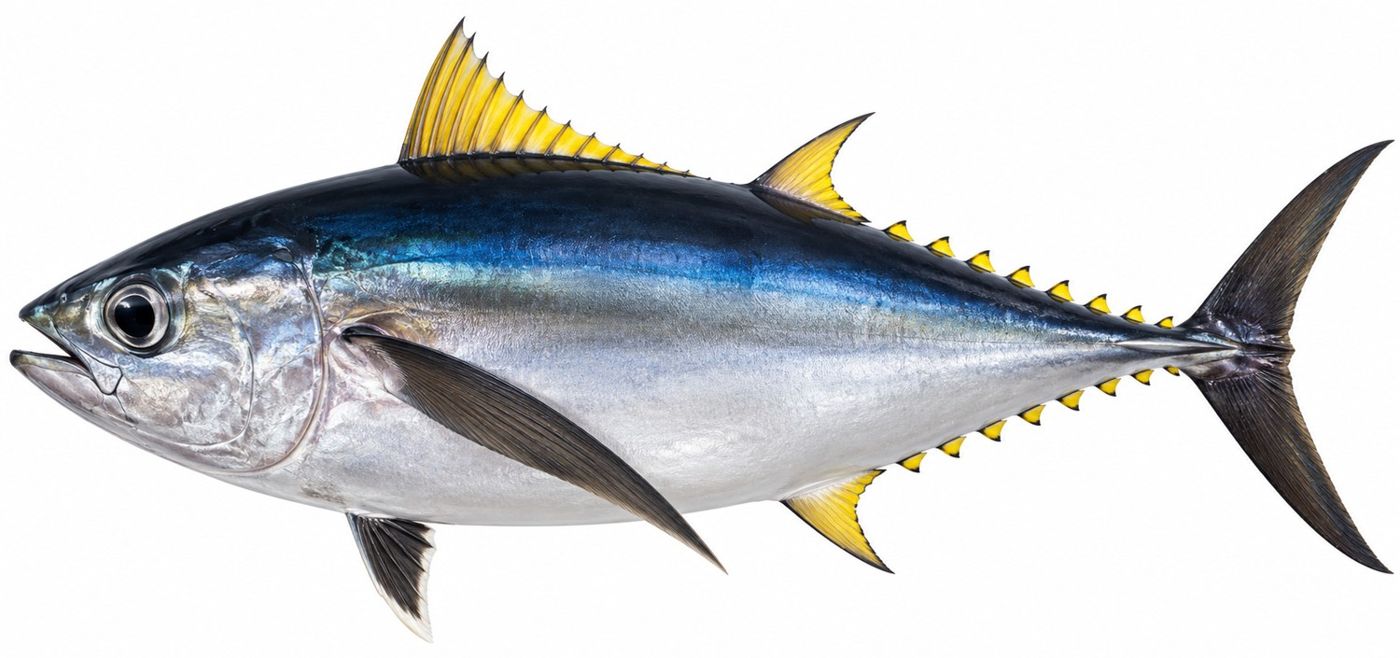
| French name | Patudo. |
|---|---|
| Scientific name | Thunnus obesus (Lowe, 1839) |
| Family | Family Scombridae |
| English name (FAO) | Bigeye tuna |
| Local names | On Ivorian markets and landing sites: “Thon blanc” (Ouattara et al., 2016). |
| Habitat | Large pelagic tuna of warm waters, able to dive deep by day, down to several hundred metres, to follow the forage layer, and to rise |
| IUCN status | VU Vulnerable. See main text of the sheet. |
Identification
Very robust fusiform body, deeper and stockier than yellowfin tuna. Deep blue-black back, silvery flanks and belly. The feature that gives it its name: an eye clearly larger than in other tunas, adapted to hunting at depth and in low light. The second dorsal and anal fins remain short even in adults; pale yellow finlets edged in black. It is confused with yellowfin tuna, especially as juveniles: the larger eye, the short median fins and the more massive body distinguish bigeye.
Features that never mislead
Very large eye, the species’ signature, hence “bigeye” in English.
Second dorsal and anal fins short even in large fish; long in yellowfin tuna.
Deep, stocky body, bright yellow first dorsal fin.
Liver striated with fine veins on its underside, a fine identification criterion for juveniles.
Size and weight
Common size around 150 cm. Maximum length about 2.5 m, with a maximum weight exceeding 200 kg (FishBase). Slower growth and greater longevity than yellowfin tuna.
Behaviour and ecology
Large pelagic tuna of warm waters, able to dive deep by day, down to several hundred metres, to follow the forage layer, and to rise again at night. Its large eyes and particular physiology allow it to hunt in the cold half-light of the depths.
Found in all tropical and warm temperate waters. Off the Ivorian coast it is mainly caught by deep longlines and by purse seines set on fish aggregating devices, where juveniles mix with skipjack and yellowfin. IUCN status Vulnerable, with a declining population trend: late maturity and strong demand for sashimi put the species under pressure. Managed by ICCAT in the Atlantic, with strict quotas.
Reproduction and season
Batch spawner in tropical open water, with extended spawning. Matures later than yellowfin tuna, which makes it more sensitive to overfishing.
Fishing practice
Techniques, from most to least effective
Deep drifting longline, the dominant commercial method for large fish.
Weighted deep trolling and heavy jigging for specialist sport fishing.
Purse seining on fish aggregating devices, mainly on juveniles, as a mixed catch.
The fight: heavy and deep; bigeye dives and stays down, with exhausting vertical pulls. For big-game tackle only.
The heavy jig rig, piece by piece
- Short, powerful jigging rod, PE 5 to 8
- Powerful jigging reel, high drag
- Main line: braid PE 5 to 8
- Fluorocarbon leader 130 to 170 lb, 3 to 5 m
- Solid ring and split ring
- Long metal jig of 200 to 400 g
- Two assist hooks on cords
Eating quality
Pink flesh, fattier and richer than yellowfin, highly sought after for premium sashimi. Excellent raw, as grilled loin or seared rare. Bleed and chill immediately.
Sources: FishBase (Thunnus obesus, Lowe 1839); IUCN Red List, Vulnerable; FAO Scombrids of the World; ICCAT; Ouattara et al. 2016. Illustrated rig (2026): indicative values from common sport-fishing practice (IGFA line classes, West African fishing-guide usage), to be confirmed with local anglers.