The techniques
Six chapters, six ways to fish Ivorian waters. Each follows the same path: the principle, the tackle, the rigs, the techniques, the calendar, then the target species with references to their species sheets. The first five chapters are for your rod. The sixth is for your eyes: it describes the traditional fisheries that sustain the coast, and how to share the water with them properly.
Chapter 1: Pole fishing and handlining, from the lagoon to the Trou sans fond
The principle
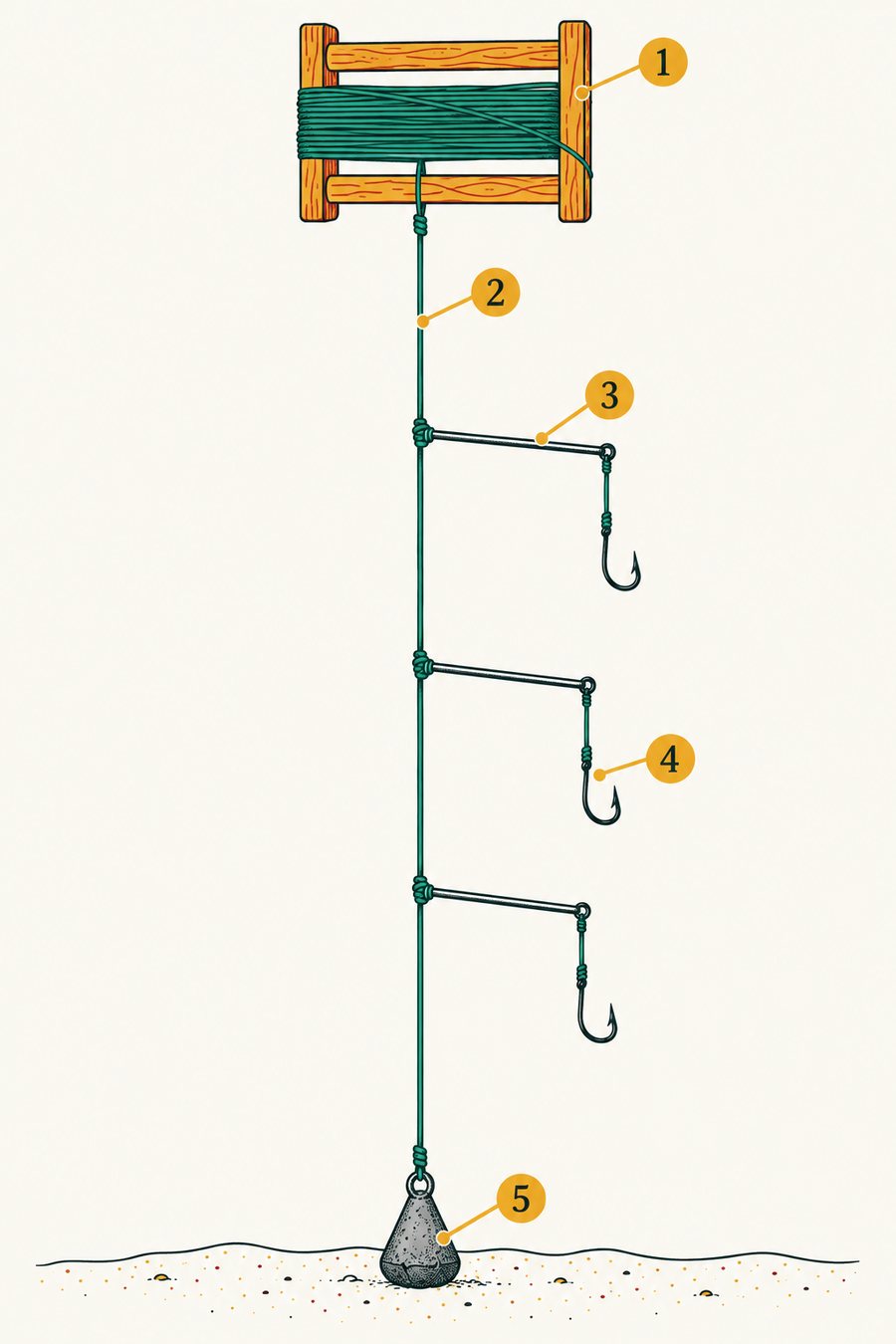
This is the school of Ivorian fishing. A line, a natural bait set near the bottom or under a float, and the patience of calm waters. The handline, a weighted hand line armed with two or three hooks, is fished from a pirogue or a pontoon; pole fishing with a rod, from the shore or a boat. Both rest on the same three steps: find the spot, present a fresh bait, feel the bite.
Tackle
A simple rod of 3 to 4 metres, or a hand line on a winder. Main line of 0.25 to 0.35 mm nylon: lagoon waters are cluttered with branches and catfish give no quarter. Hooks size 6 to 1/0 depending on bait size, a running sinker so the fish takes the bait without suspicion. A landing net, a bucket, a rag: the gear fits in one bag.
Rigs
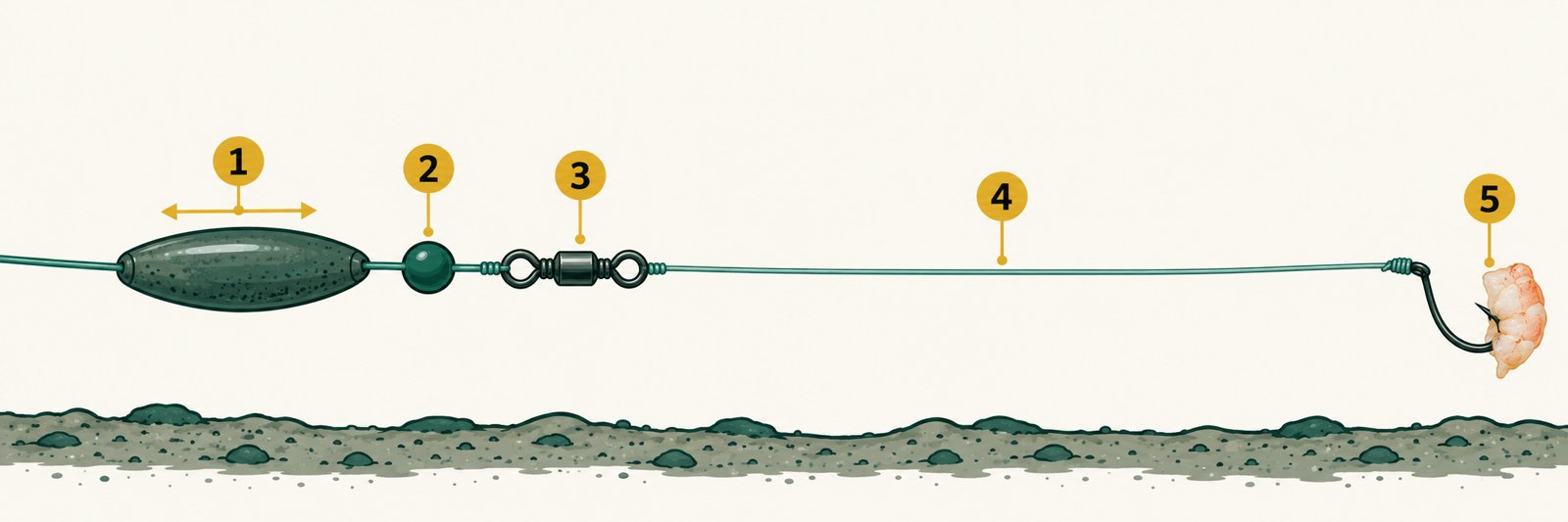
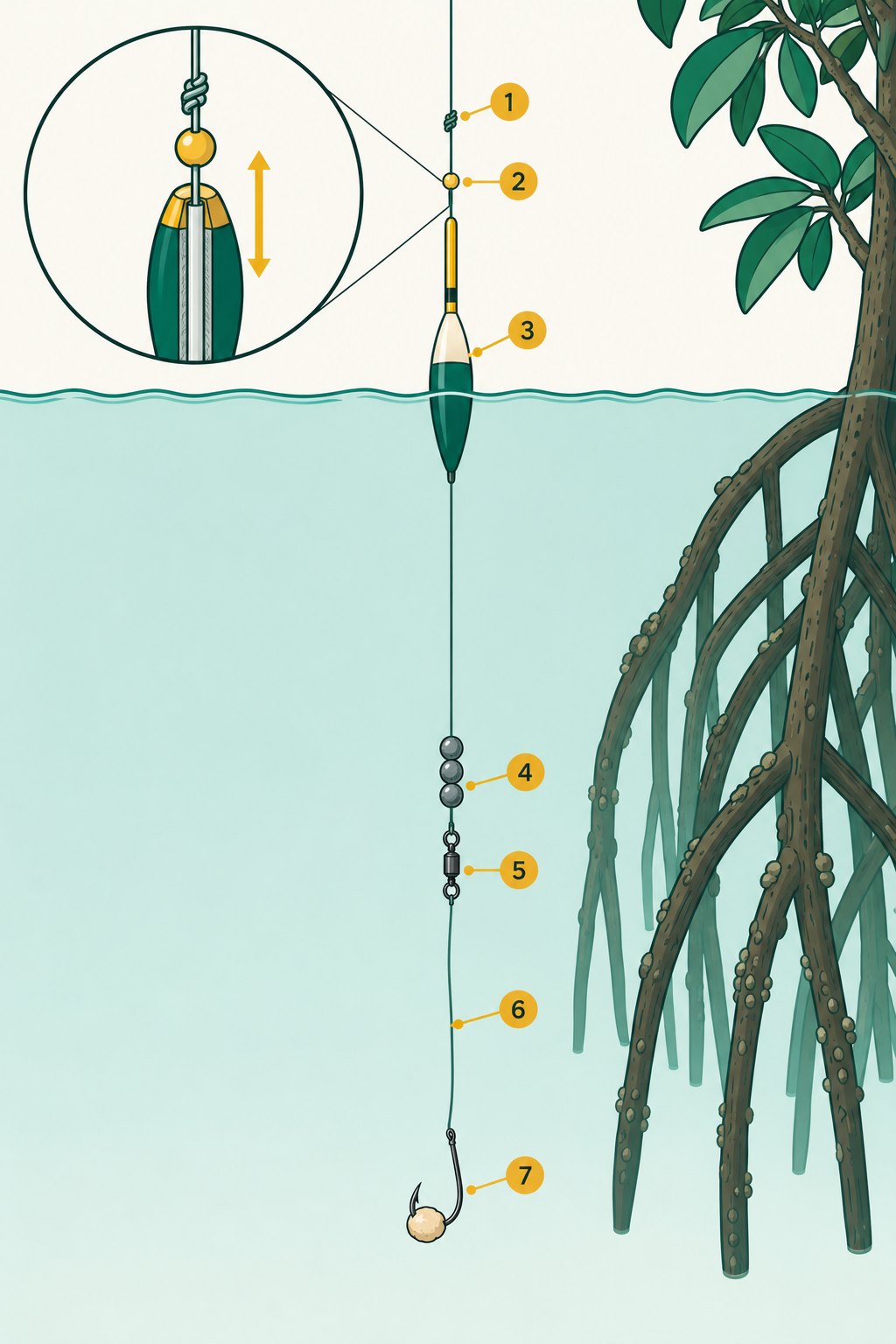
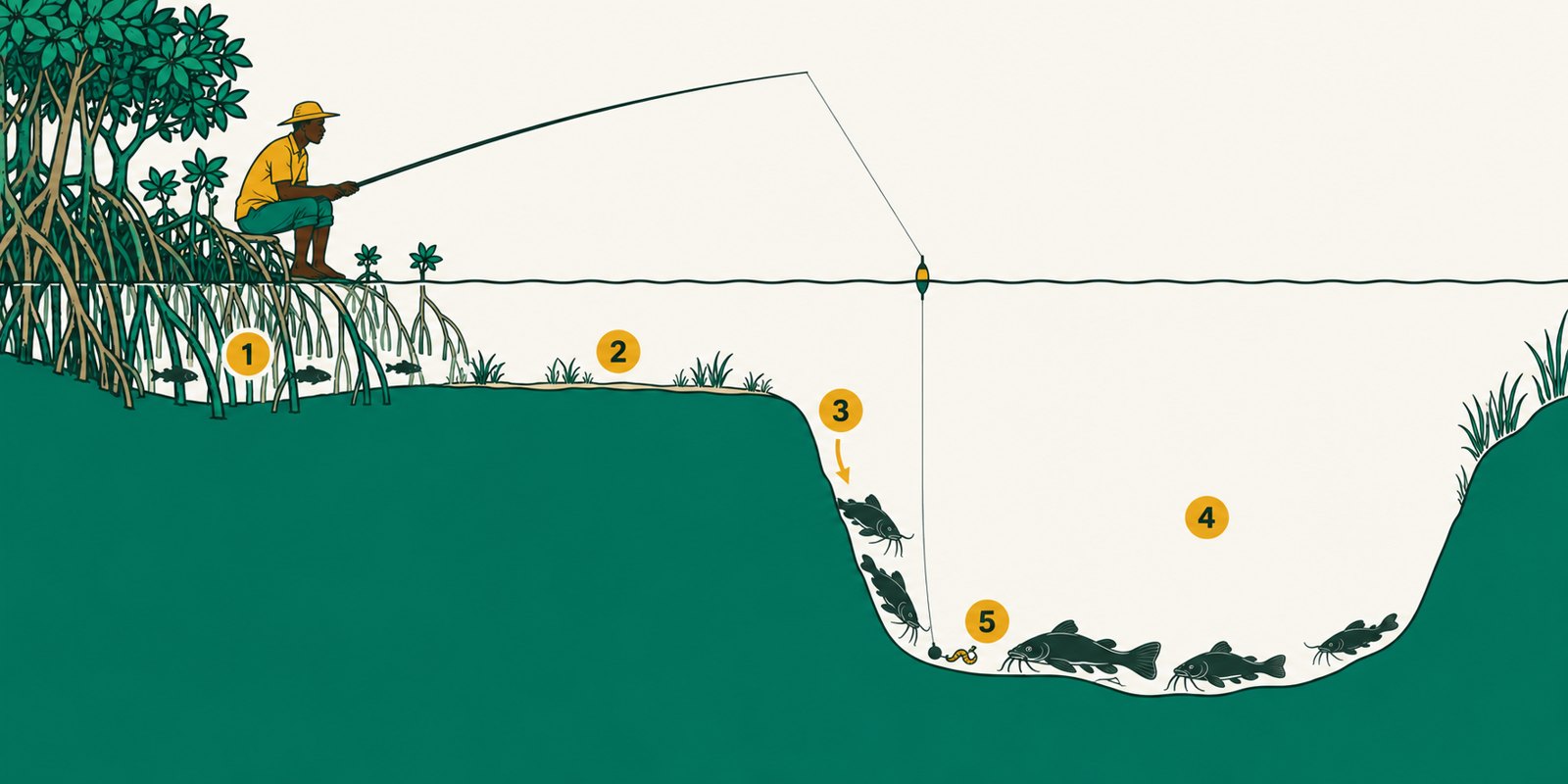
The running ledger is the all-purpose lagoon rig: an olive sinker of 10 to 30 grams depending on the current, a swivel, 40 centimetres of leader. To fish mid-water near the mangroves, the sliding float lets you adjust the depth to the nearest metre.
Techniques
Sound the depth before fishing: the lagoon alternates flat mudflats and holes several metres deep, and fish hold on the breaks. Groundbait lightly and sparingly: a few handfuls of shrimp scraps or oilseed cake are enough to hold the fish without overfeeding them. On the bite, let it run for a second, then strike gently. A catfish is hooked with a sharp strike, a tilapia is lifted out gently.
Baits
Worms, lagoon shrimp whole or peeled, pieces of fresh fish (sardinella, bonga shad), dough for tilapias. The golden rule: the bait of the day is the one you find on the spot. The bait chapter in Part IV details collection and keeping.
Calendar and target species
The lagoon can be fished all year round, with two nuances: marine species move up into the lagoon when salinity rises in the dry season, and night fishing transforms the results on catfish. Target species: Bagrid catfish (species sheet 63), Blackchin tilapia (species sheet 62), croakers (species sheets 75-76), Shortfin pompano (species sheet 22), Disque africain (African sicklefish) (species sheet 72), Grogneur sompat (Sompat grunt) (species sheet 42).
Deep handlining: the edges of the Trou sans fond
Ivorian handline fishing has a stage the whole world would envy if it knew about it: the edges of the Trou sans fond (“Bottomless Pit”), the submarine canyon that plunges off Vridi. A few miles from the port, the rocky bottoms of 50 to 100 metres flanking the canyon hold a rare density of bottom fish: several species come up on the same drift.
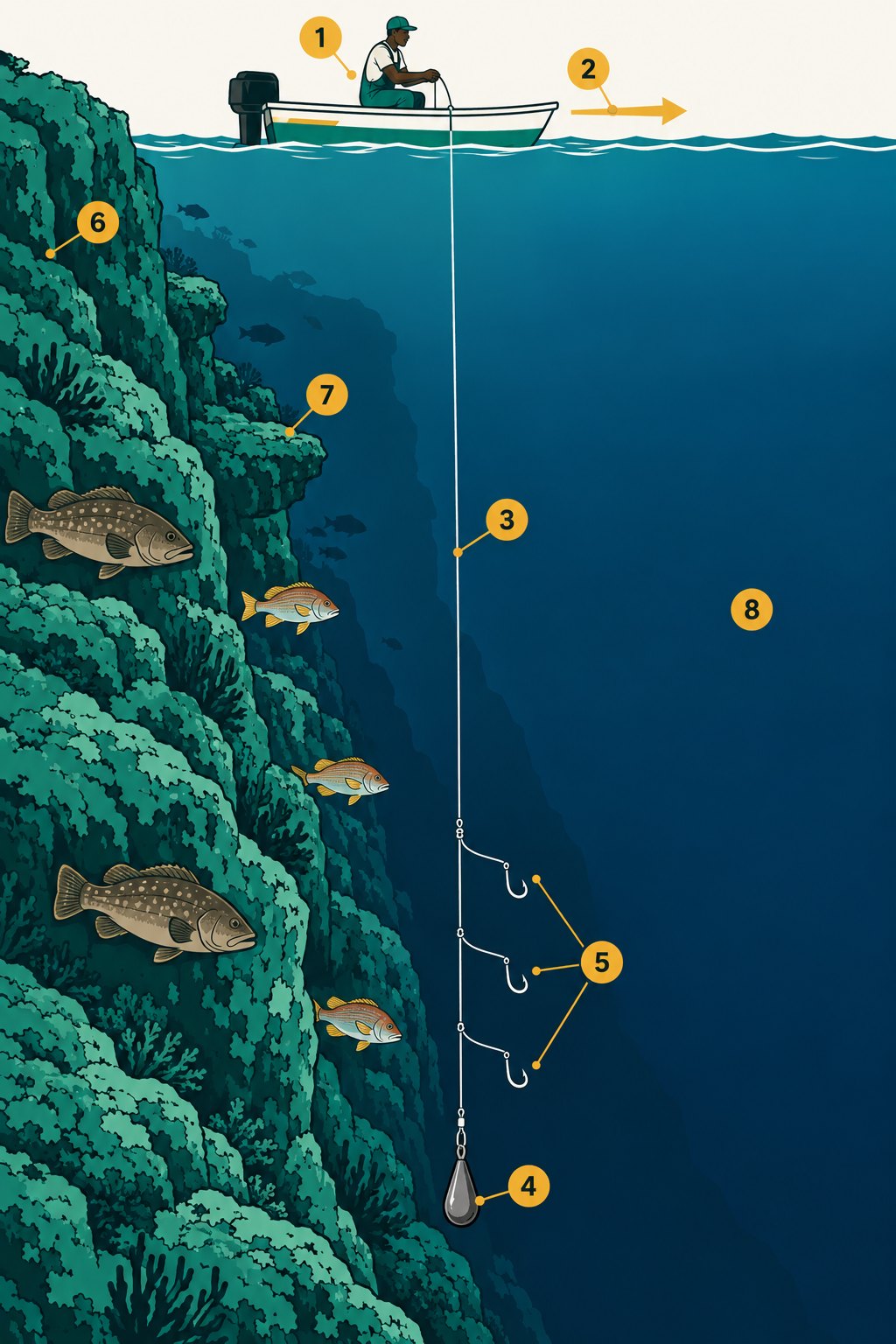
The principle remains that of the handline, in a beefed-up version: a strong main line (0.60 to 0.80 mm nylon or braid), a 300 to 500 gram sinker depending on the drift, two to three short droppers armed with strong-wire hooks sizes 1/0 to 5/0, baited with pieces of sardinella, squid or shrimp. Let it go down to touch the bottom, lift it one metre, and follow the boat’s drift along the structures. Electric reels have their followers at these depths; the hand line keeps its own, for direct contact.
The menu on the rocky edges is a festival of chapters III and IV of this book: groupers (species sheets 29-30), snappers (species sheets 38-41), dentex and seabreams (species sheets 31-34), Pageot à têche rouge (Red pandora) and West African goatfish (species sheets 35, 37), Tile à bandes (Zigzag tilefish) and Brotule barbée (Bearded brotula) on deeper bottoms (species sheets 52-53), scorpionfish to be handled with respect (species sheet 48), and the occasional Saint-Pierre (John Dory) (species sheet 50). Bring fish up without rushing: decompression turns some fish belly-up, and a fish meant for release is brought up slowly or not at all.
Two precautions specific to this area: the drift over the canyon quickly becomes strong, so watch your position relative to the walls; and you are fishing at the gates of a major port, which means constant traffic, VHF watch and safe distances from the channel. Trips are ideally made with a skipper who knows the rock heads: they appear on no recreational chart.
Chapter 2: Surfcasting and jetty fishing
The principle
Fishing the sea with your feet on dry land. Surfcasting sends baits beyond the first waves, where the surf break hollows the sand and feeds the hunters; jetty fishing works the riprap of Vridi and the ports, where the current concentrates everything. These are the most accessible kinds of fishing on the coast: no boat, no fixed schedule, the whole sea at the end of your cast.
Reading the beach
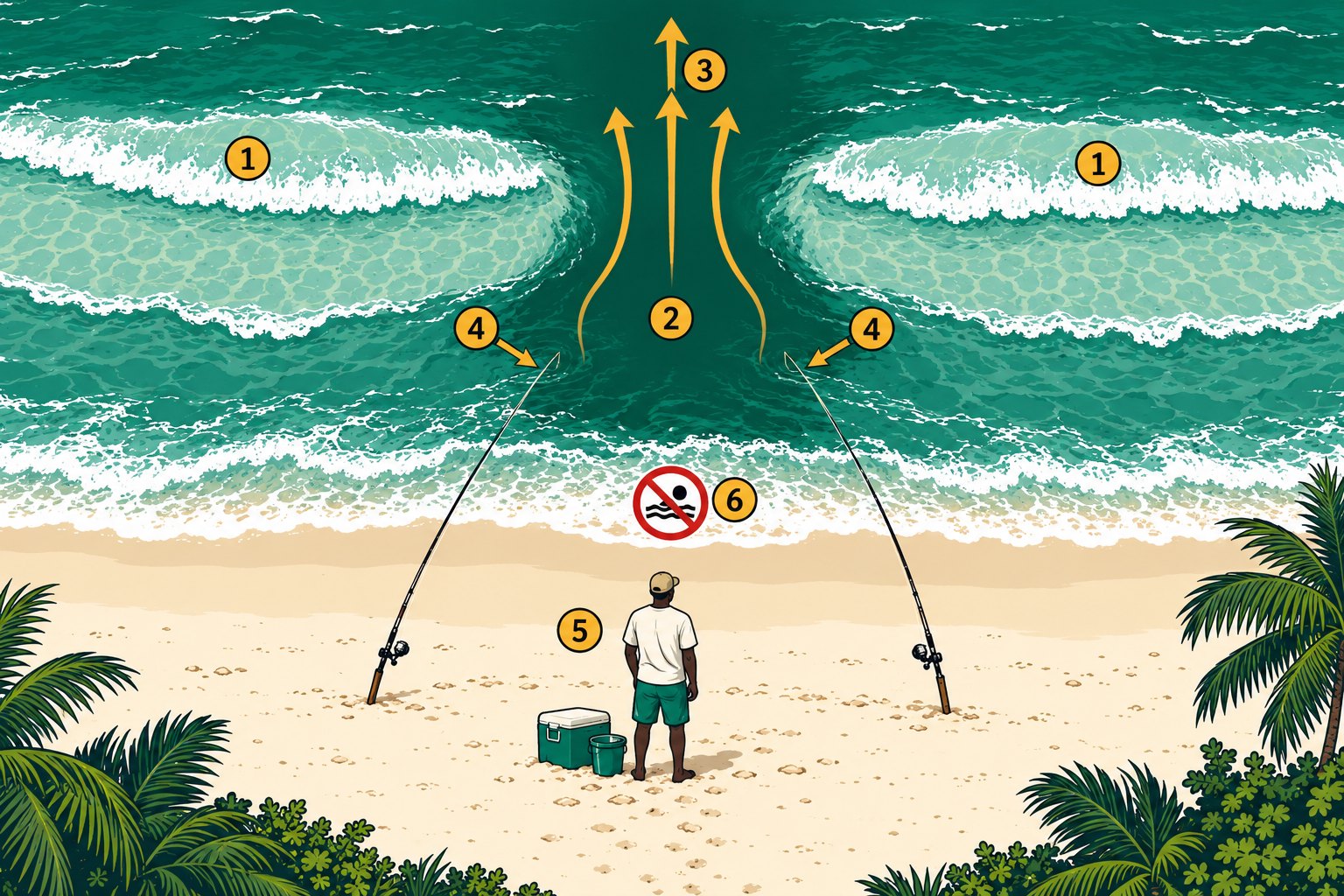
A beach is never uniform. Look for the baïnes, those hollows where water trapped between two sandbanks escapes seaward: their outflow currents are conveyor belts of food. Spot them by eye: darker water, waves that do not break, a rippled surface. Fish their edges. Beware of them too: these same currents make swimming deadly on this coast.
Tackle
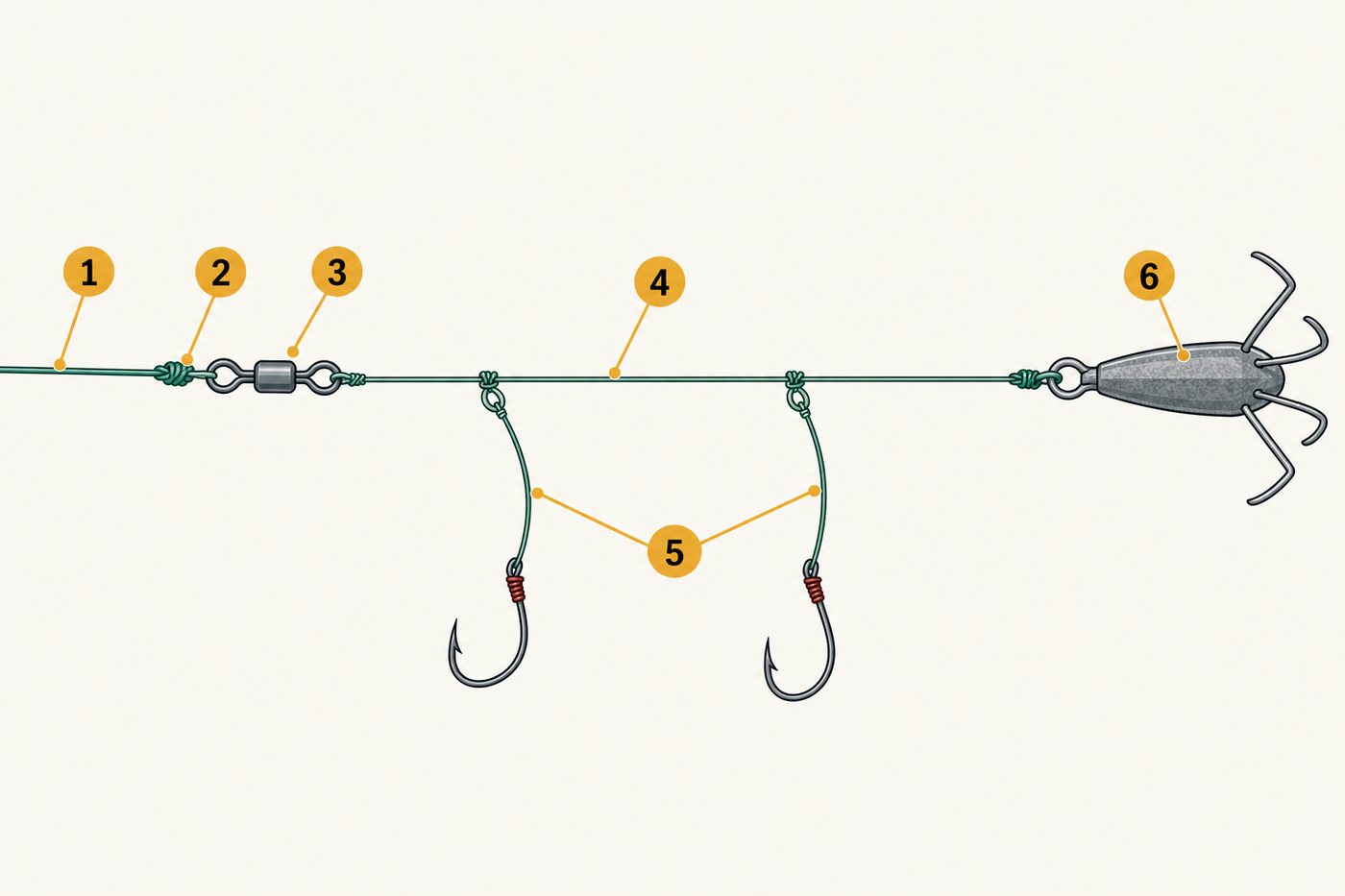
Surf rod of 4 to 4.5 metres, casting weight 100 to 200 grams, size 8000 reel loaded with 250 metres of 0.35 mm nylon or braid with a shock leader. Grapnel sinkers of 100 to 150 grams to hold in the swell. Leader of 0.50 to 0.60 mm: a threadfin in the current is not open to negotiation. On the jetty, a shorter 3-metre rod is enough, but the leader must be beefed up to match the rocks.
Rigs
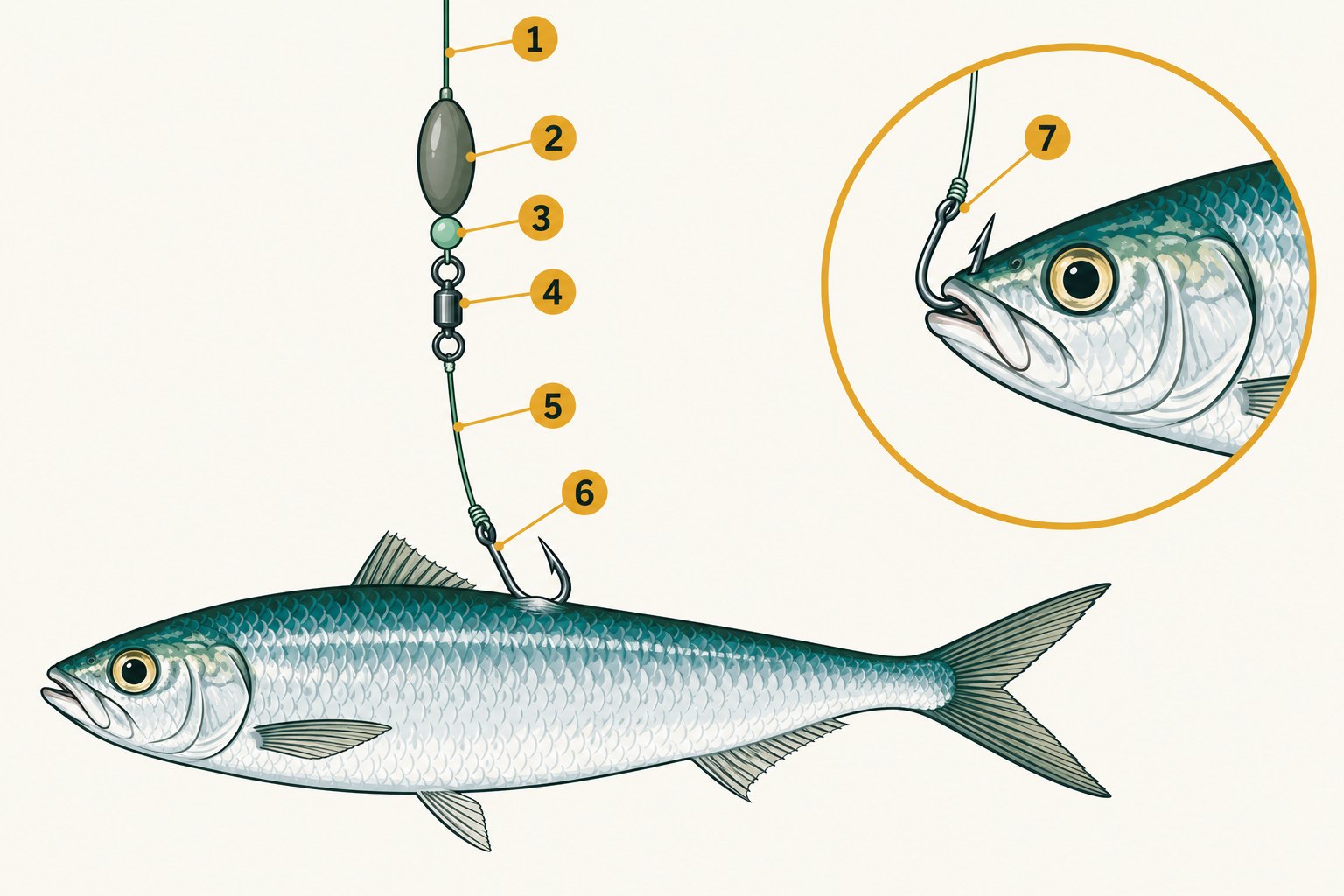
Techniques and calendar
In the surf, the prime windows are the rising tide at dusk and the two hours after nightfall: croakers and threadfins then move up the beach slope. During the long cold season from July to October, feeding frenzies of jacks and barracudas come within casting range: always keep a lure rod rigged next to the bait rods. On the jetty, every turn of the tide revives the activity.
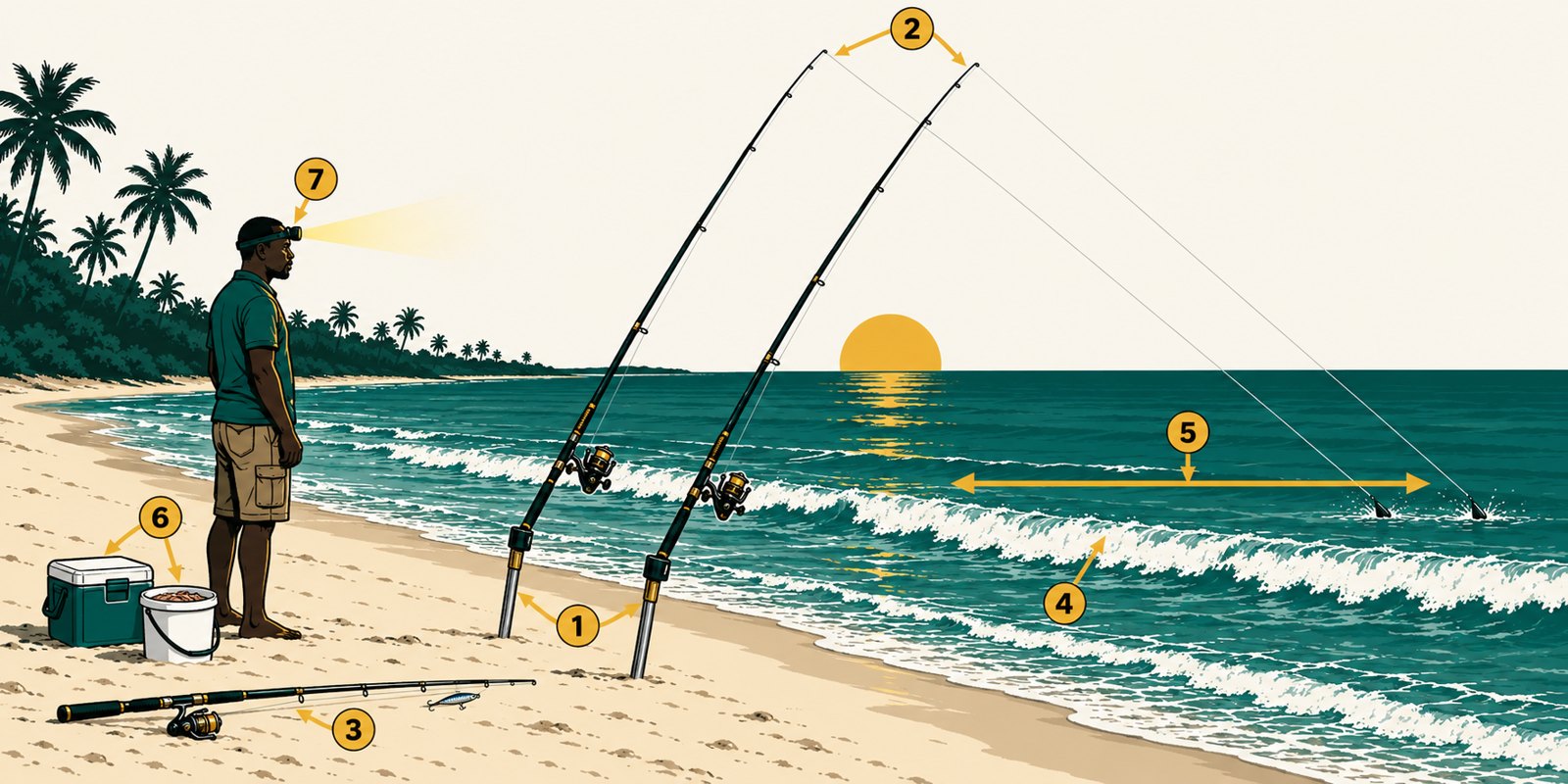
Target species: croakers (species sheets 75-76), Grand capitaine (Giant African threadfin) and Petit capitaine (Lesser African threadfin) (species sheets 70-71), Grogneur sompat (Sompat grunt) and other grunts (species sheets 42-44), Crevalle jack (species sheet 16), Guinean barracuda (species sheet 25), Pompano and pompanos in the surf (species sheets 22-24).
Chapter 3: Casting, jigging, popping: lures in the tropics
The principle
Here, we no longer offer food: we provoke. The lure plays on aggression and the predatory reflex. This is the most active fishing in the book: search, cast, work the lure, start again. And it offers the most spectacular strikes in the tropical Atlantic, from the popper engulfed at the surface to the jig stopped dead twenty metres below the boat.
The three families of lures
Cast-and-retrieve lures: spoons, plugs, soft plastics on jig heads. They fish from the shore, in the lagoon, at the channels and in coastal waters. Jigs: metal blades of 100 to 200 grams worked vertically over structures, wrecks and drop-offs. Surface lures: poppers and stickbaits, which imitate a fish in distress and trigger strikes in full view.
Tackle
For the shore and the lagoon: 2.4 to 2.7 metre rod, casting weight 20 to 60 grams, fine braid and a 0.40 to 0.60 mm fluorocarbon leader. For jigging and popping from a boat: dedicated outfits, PE 3 to 6 braid, 80 to 100 lb leaders. A regional constant: barracudas and Spanish mackerels slice through everything; as soon as their teeth come into play, finish with 20 centimetres of flexible wire.
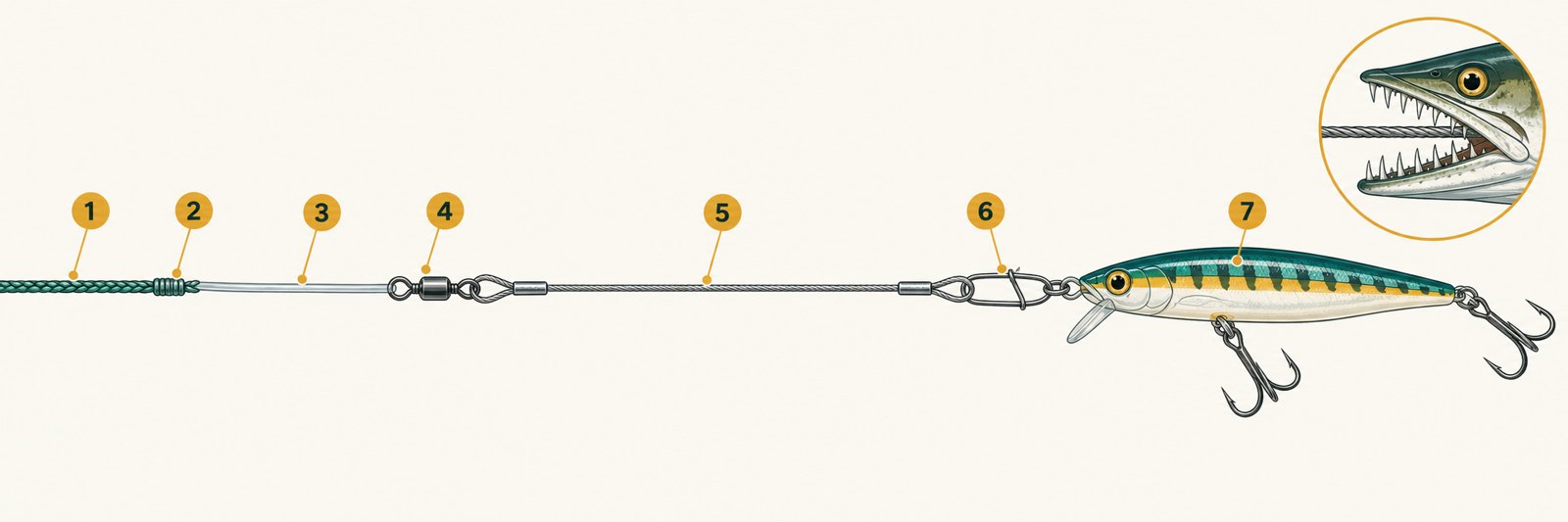
Techniques and calendar
When casting, vary everything: speed, pauses, rod-tip twitches, until you find the action of the day. With a jig, let it sink to the bottom then bring it up with sharp jerks; the strike often comes on the drop. With a popper, long sweeping pulls and one rule: do not strike at the splash, wait until you feel the weight. The long cold season is the lure festival: feeding frenzies of jacks, Spanish mackerels over the banks, barracudas at the channels. The popper gives its best hours at dawn over calm areas.
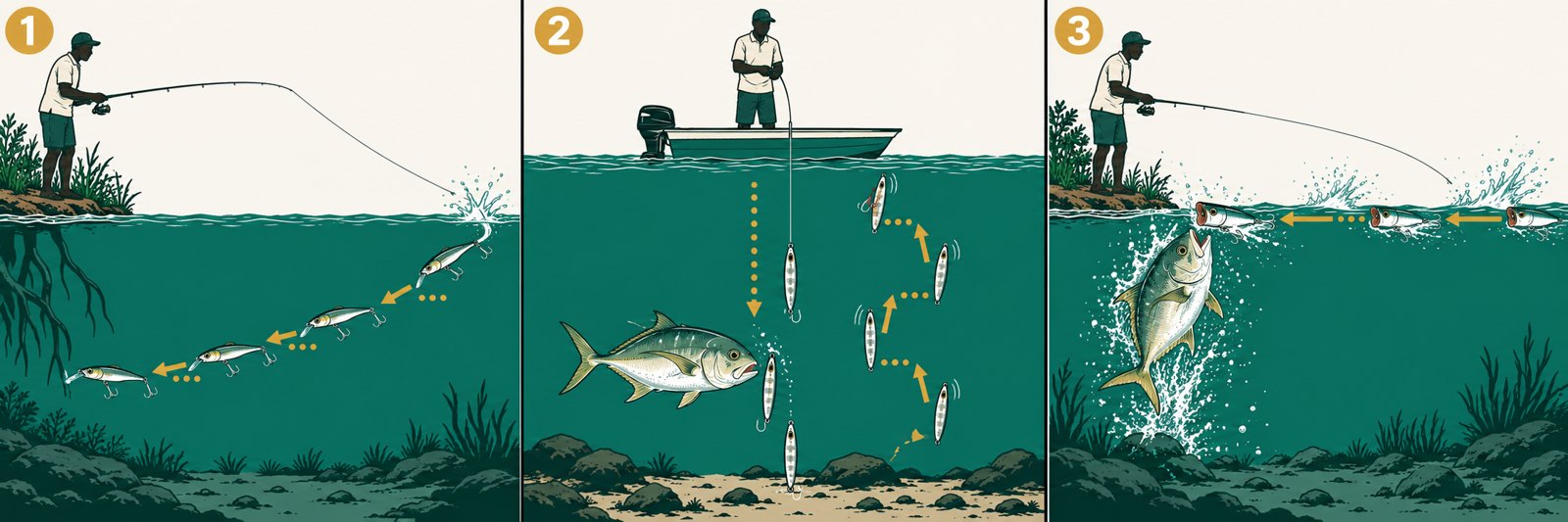
Target species: jacks (species sheets 16-18), Guinean barracuda (species sheet 25), Spanish mackerels (species sheets 8-9), Mafou (Cobia) (species sheet 28), groupers on soft plastics (species sheets 29-30), Pompano (species sheet 23).
Chapter 4: Trolling, from the coast to the open ocean
The principle
Trolling means making your lures swim behind a moving boat and covering in an hour what a caster searches in a day. Coastal trolling follows drop-offs and wrecks at moderate speed; offshore trolling deploys skirts and large plugs over offshore waters, in search of tunas and billfish. This is the technique behind the great Ivorian thrills: yellowfin tuna, sailfish and marlin are caught here.
Coastal trolling
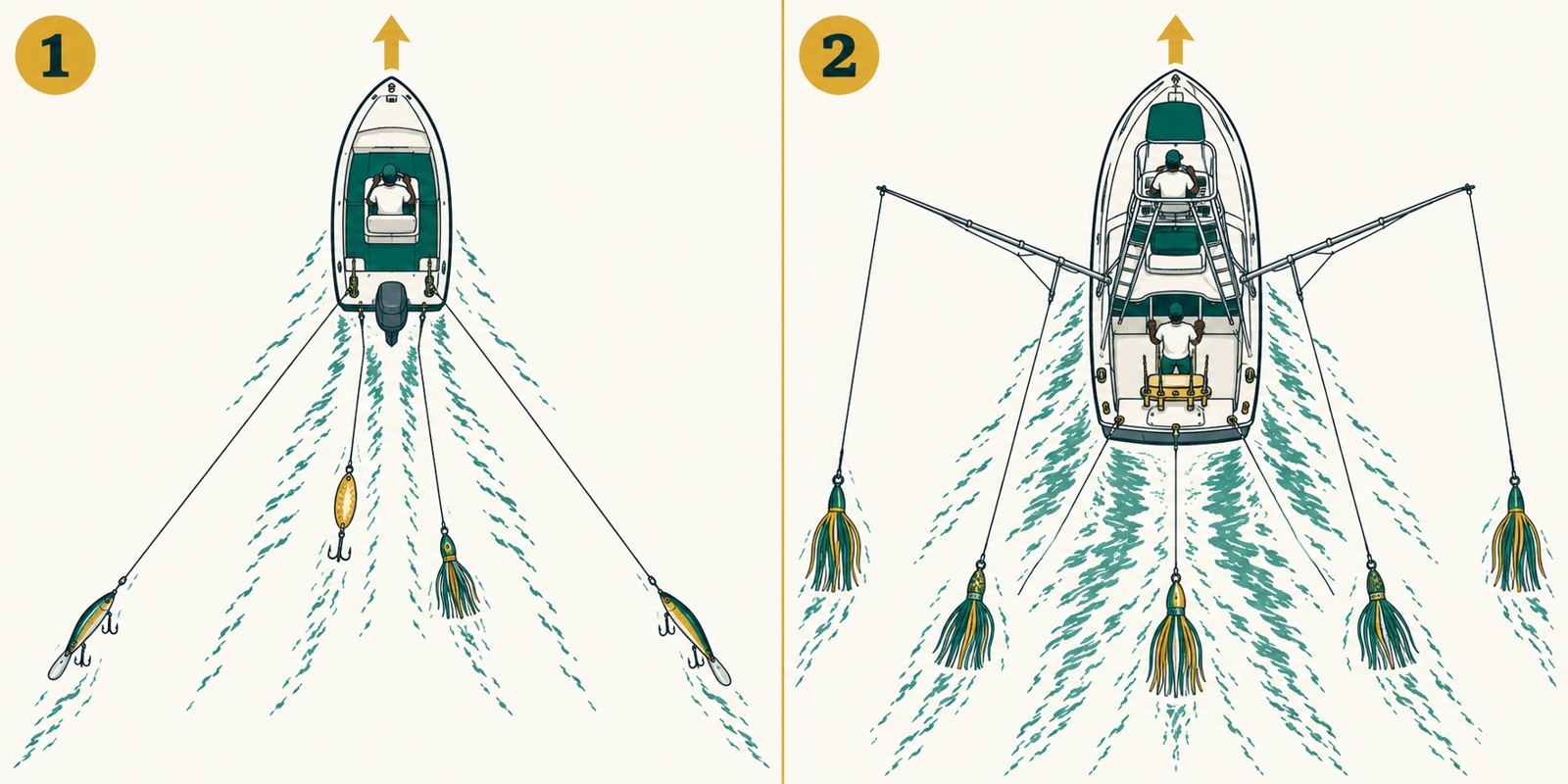
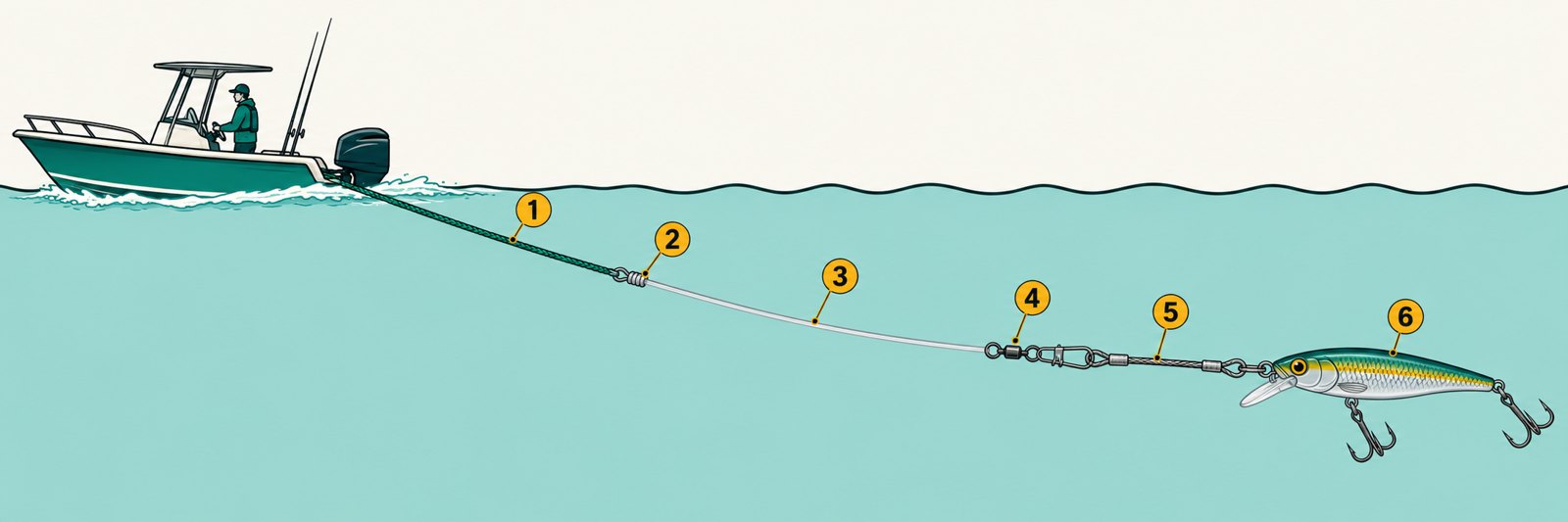
At 4 to 6 knots, two to four rods spread fan-wise behind the boat: a diving plug on each side, a spoon or soft plastic in the bow wake. Look for bottom breaks, rocky points, wrecks and changes in water colour. Tackle: 20 to 30 lb outfits, 80 to 100 lb fluorocarbon leaders, and wire as soon as Spanish mackerels are prowling. Targets: Spanish mackerels, barracudas, jacks, bonitos, groupers along rock edges.
Offshore trolling
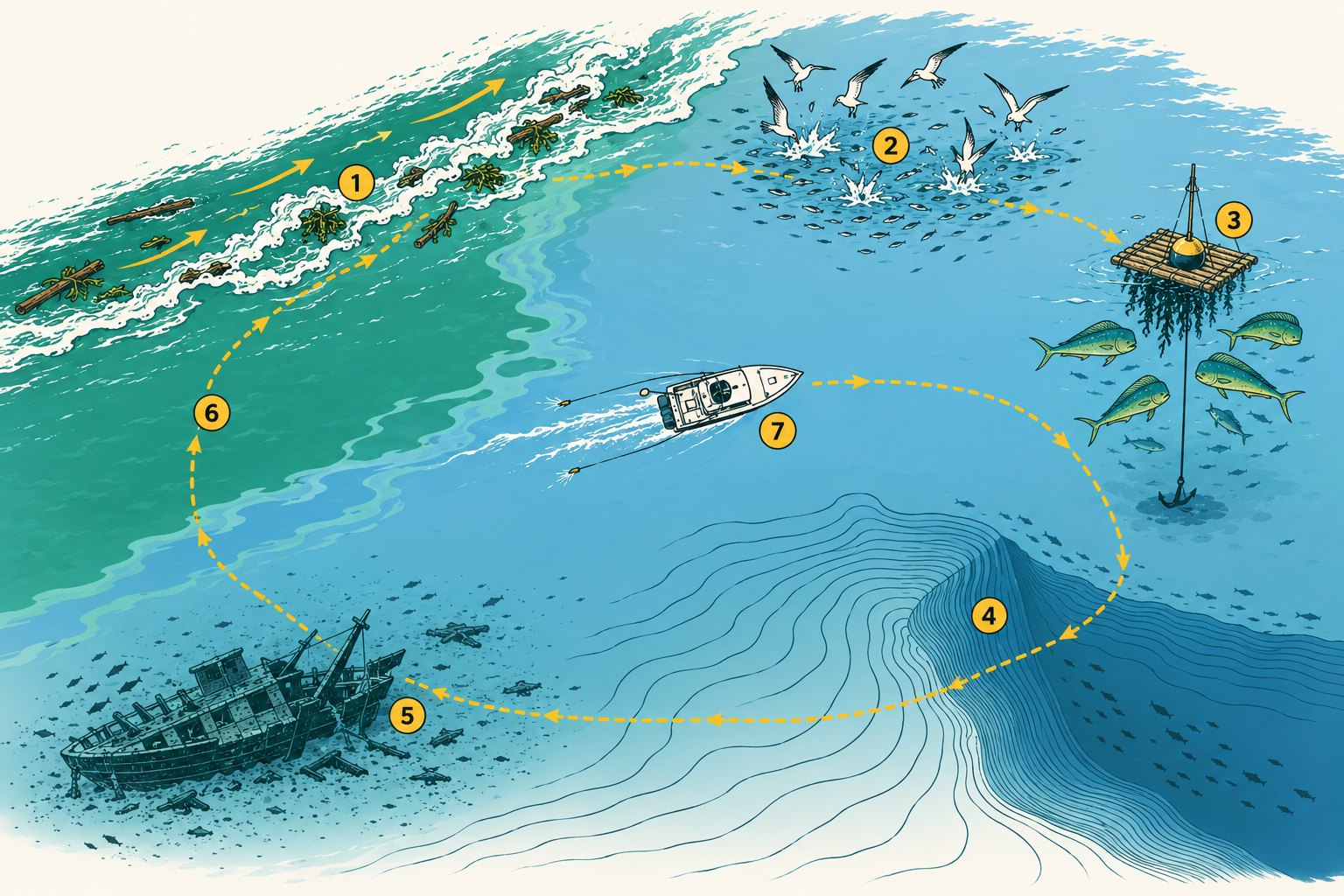
At 6 to 9 knots, the big game: ocean skirts (konas), large plugs, sometimes a hookless teaser to raise billfish. Four to six lines staggered between 20 and 60 metres behind the boat, outriggers deployed. Tackle: 30 to 50 lb outfits, reels with progressive drag loaded with 400 metres or more. The hunting grounds: current lines, gatherings of birds, floating objects and FADs, around which dolphinfish and tunas patrol.
The fight and the release
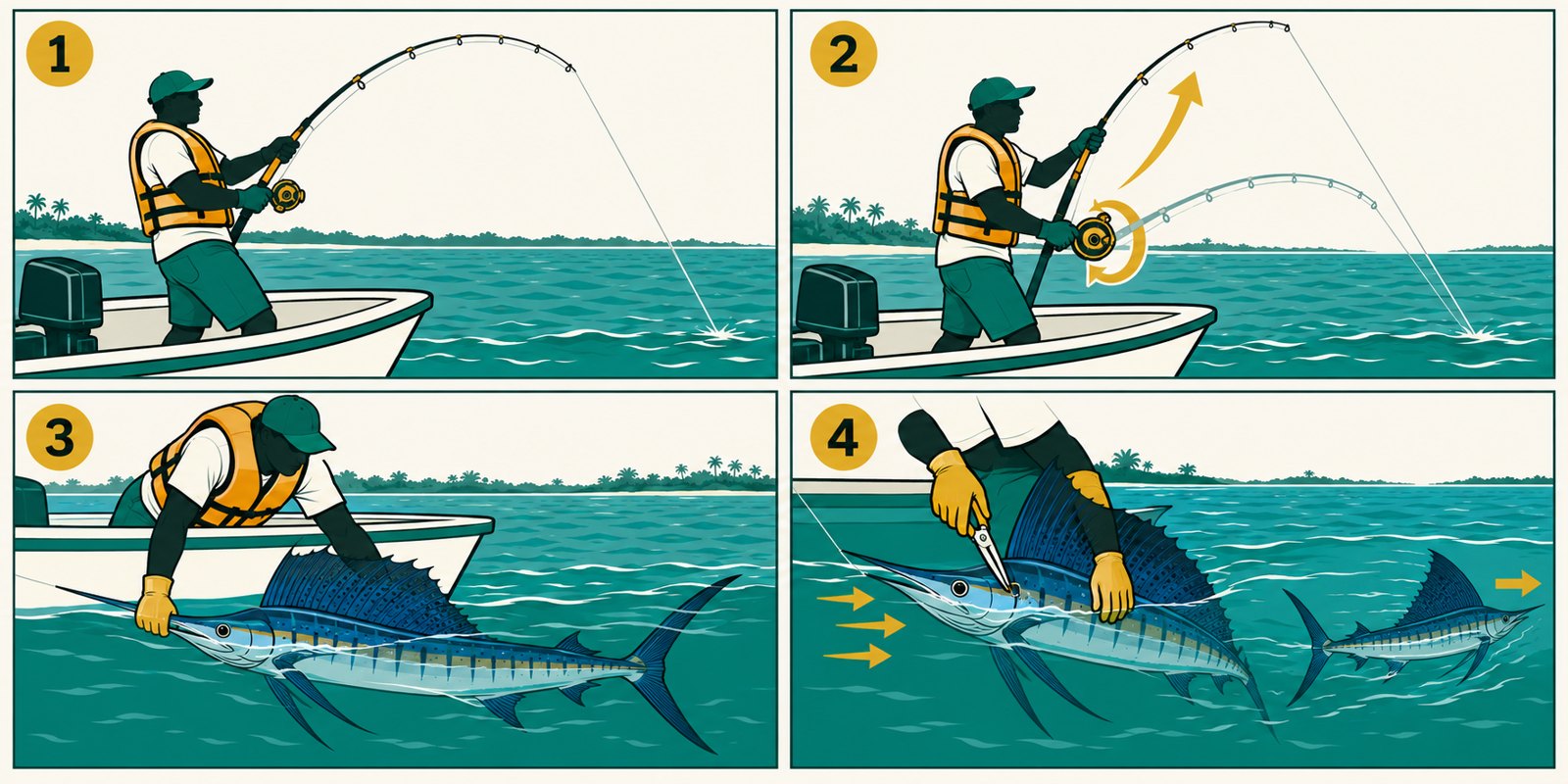
On the strike, the boat keeps moving for a few seconds to hook up on the other lines, then everything is cleared and the fight begins: rod high, drag set to a third of the line’s breaking strength, pump without rushing. Billfish are released: a photo alongside the boat, the hook cut off if necessary, and the sailfish swims away. This book stands by that choice, detailed in Part V: a living marlin is worth more than all the dockside photos.
Calendar and target species
The long cold season concentrates tunas and Spanish mackerels near the coast; the warm transition seasons remain good for billfish and dolphinfish offshore. Abidjan’s clubs and charters know the windows to the day: rely on them for your first trips. Target species: Yellowfin tuna (species sheet 1), Skipjack tuna and bonitos (species sheets 4-6), West African Spanish mackerel and Wahoo (species sheets 8-9), Common dolphinfish (species sheet 10), Atlantic sailfish (species sheet 14), Atlantic blue marlin (species sheet 15), Swordfish (species sheet 12).
Chapter 5: Fishing from a pirogue, the lagoon approach
The principle
The pirogue is the natural vehicle of the lagoon. Stable on calm water and silent, it reaches the mangrove fringes and fish parks where no boat can go. For the sport angler, it offers a double gain: access to the best spots, and the company of those who have known them since childhood. Hiring a pirogue boatman means hiring a guide, an engine and a library.
Organising your trip
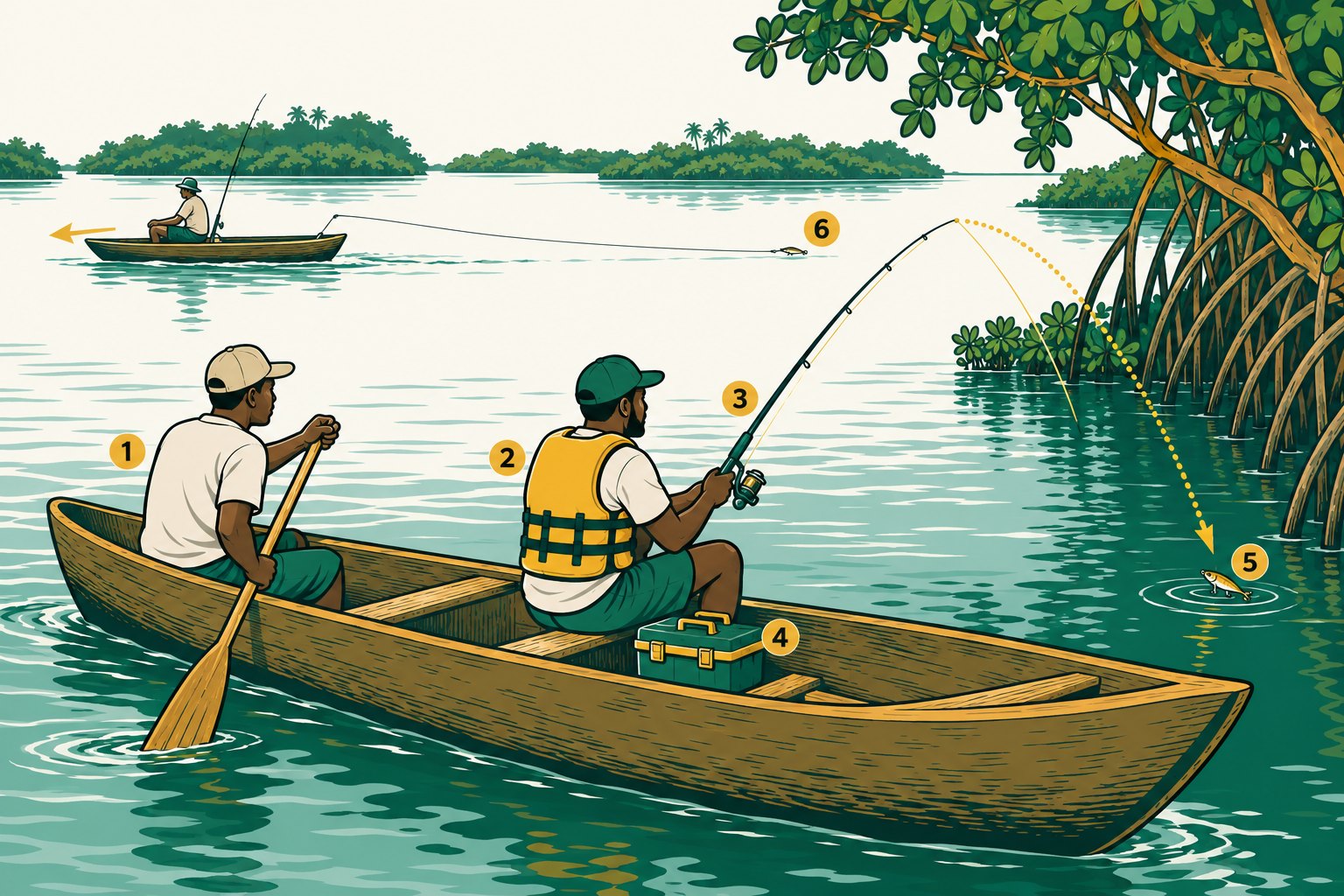
The trip is negotiated at the landing site, the day before or early in the morning: duration, area, price agreed before departure, and the shared coffee is part of the deal. Respect the seating arrangements: the boatman is in command of his craft. Board light: one rigged rod, a compact box, the life jacket, water. Any loose object ends up on the bottom or overboard.
Fishing from a pirogue
Three kinds of fishing work wonderfully here. Drifting handline over the deep holes, deadly on catfish and croakers. Light casting along the mangrove edge, where tilapias, Shortfin pompano and small jacks hunt among the roots: soft plastic or small plug, accurate casts under the branches. And lagoon trolling, popular and productive enough to deserve its own section.
Lagoon trolling: from Boulay island to Dabou, and beyond
This is one of the most popular kinds of fishing in the Ébrié lagoon, and one of the most pleasant: a plug or spoon twenty or thirty metres behind the pirogue or small boat, at low speed, and hours of searching along the banks. The classic route starts from Boulay island, opposite Abidjan, and runs up the great western arm of the lagoon to Dabou and beyond: channels between the islands, mangrove points, bay mouths; every break in the landscape is worth a pass.
The area fishes all year round, following the salinity: in the dry season, when the sea pushes back into the lagoon, barracudas and jacks move far west and trolling becomes a festival; in the flood season, the fish gather towards the saltier areas near the channels. Lures diving between 1 and 3 metres, natural colours in clear water, bright or flashy ones in coloured water. The leader is matched to the menu: 0.50 mm fluorocarbon as standard, flexible wire as soon as barracudas show up.
Lagoon trolling targets: Guinean barracuda (species sheet 25), a regular of brackish waters, jacks (species sheets 16-18), Grand capitaine (Giant African threadfin) near the deep channels (species sheet 70), croakers when passing over the deep holes (species sheets 75-76).
Sharing the water
The lagoon is a workplace. Gillnets marked by floats, lines of fish traps, fish parks: give them a wide berth, never cross them, and lift your line as you approach. If you snag some gear, do not cut it: unhook it cleanly or tell the owner. Morning courtesy brings evening tips: nobody knows the lagoon like those who make their living from it.
Target species: Bagrid catfish (species sheet 63), Blackchin tilapia (species sheet 62), Shortfin pompano (species sheet 22), croakers (species sheets 75-76), jacks in the channels (species sheets 16-18), barracuda in the salty season (species sheet 25).
Chapter 6: Traditional fisheries, understanding and sharing the water
This chapter will not teach you how to set a seine. It will teach you how to look. The traditional fisheries of the Ivorian coast feed tens of thousands of families, shape the villages and predate by several centuries everything this book describes. The sport angler who understands them fishes better, disturbs less, and joins the conversations that matter at the landing site.
The beach seine
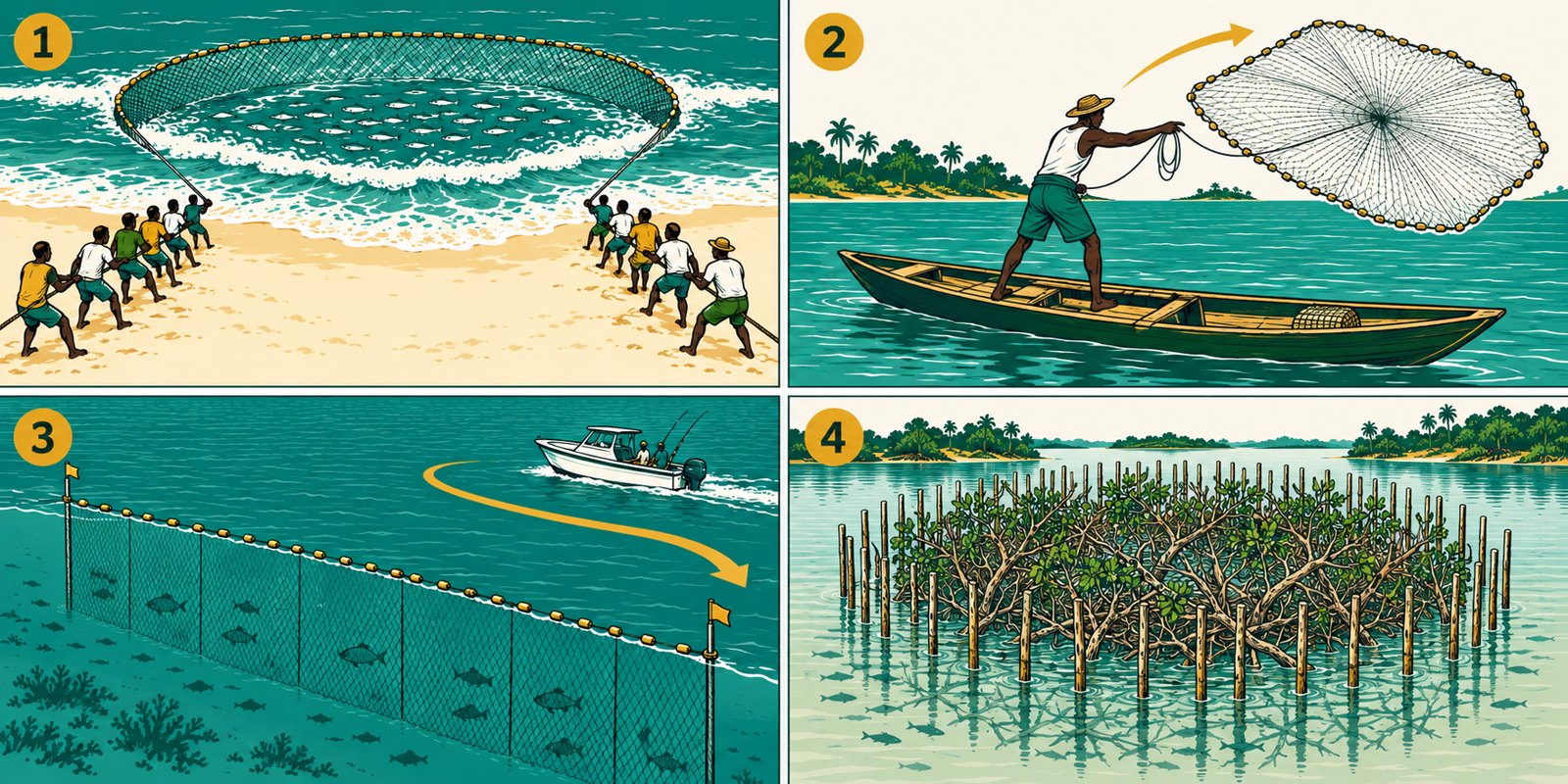
This is the most spectacular: a net several hundred metres long laid out in an arc from the beach by a pirogue, then hauled in by hand by two teams, for hours, to a work song that sets the rhythm of the effort. The coastal fishing communities, including long-established crews of Ghanaian origin, have made it a collective art. The catch (sardinellas, bonga shad, jacks and everything the bay held) is shared according to precise rules between the haulers, the net owner and the village.
The cast net
The most photographed gesture in West Africa: the circular net thrown in a wide bloom from the pirogue or the shore, opening in mid-air and capping the school. Years of practice for a perfect throw. The cast net targets surface and edge fish: mullets, bonga shad, tilapias. Watch the throwers at dusk in the lagoon: where the cast net is working, forage fish abound, and predators are never far away.
Gillnets, traps and longlines
Set gillnets, laid in the evening and hauled at dawn, crisscross lagoons and coastal areas: their lines of floats are the signals you absolutely must know before trolling a line. Pots and traps, set on the bottom, target crabs and catfish. Set longlines string their hooks out over hundreds of metres. The law regulates mesh sizes, zones and seasons: the MIRAH services publish the rules in force.
Acadjas and lamp fishing
Acadjas, brushwood parks planted on lagoon bottoms, create artificial reefs where fish gather and breed before being harvested. Productive, they are also controversial: uncontrolled spread, conflicts of use, pressure on the bottom, and their regulation is changing. Lamp fishing, for its part, draws schools of sardinellas and bonga shad at night into the glow of lamps before the net is cast. Two practices worth knowing, if only to read the night-time landscape of the lagoon.
The sport angler as a good neighbour
Four simple rules. Give fishing gear a wide berth and lift your lines as you approach. Buy at the landing site: it is the best fish in the country and the best way to be welcomed. Photograph people with their consent, not as scenery. And remember that where you are having fun, others are working: they always have priority.