
Redbelly tilapia
Coptodon zillii (Gervais, 1848)
Family Cichlidae • the herbivorous, territorial tilapia of the banks
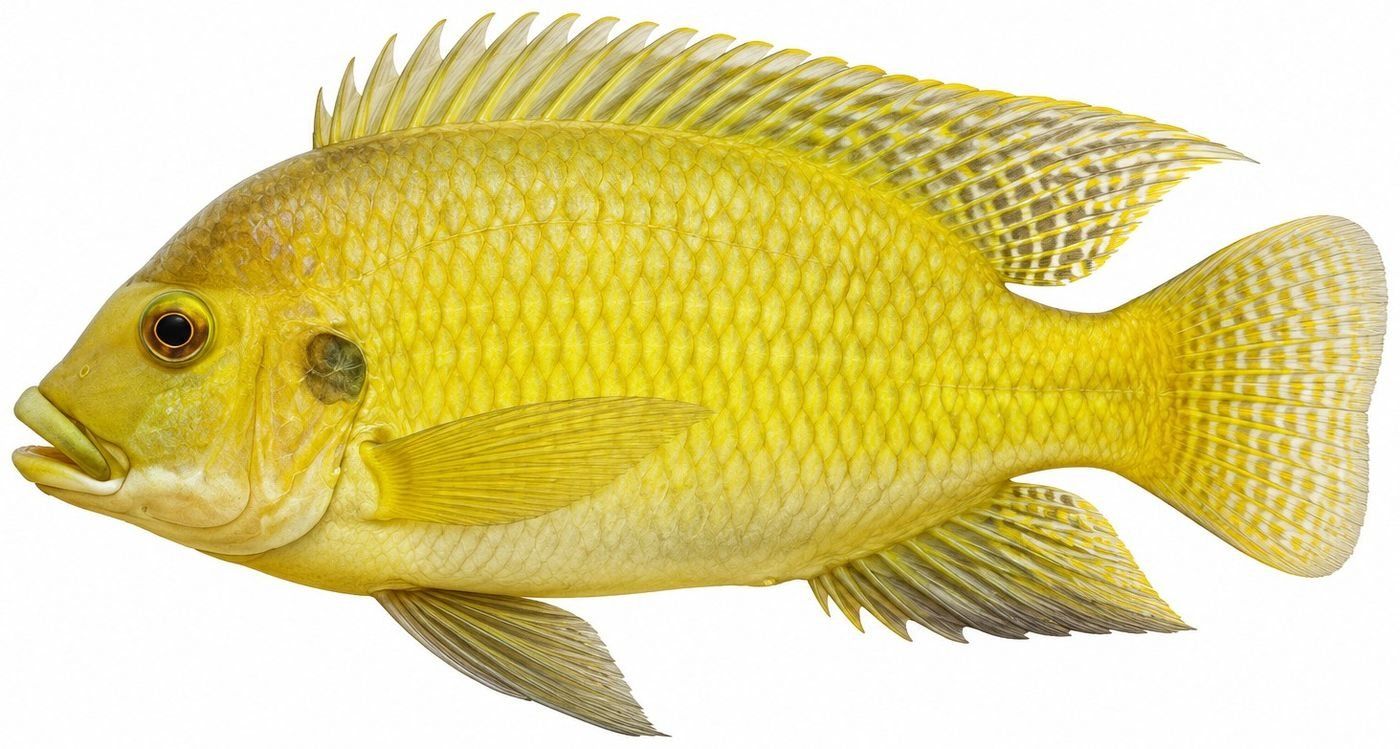
| French name | Zill's tilapia. Called “carpe” like the other tilapias |
|---|---|
| Scientific name | Coptodon zillii (Gervais, 1848) (formerly Tilapia zillii) |
| Family | Family Cichlidae |
| English name (FAO) | Redbelly tilapia |
| Local names | Carpe, red tilapia; local names to be documented |
| Habitat | Freshwater: ponds, canals, edges of rivers and reservoirs, weed beds; tolerates brackish water. |
| IUCN status | LC Least Concern. |
Identification
A deep-bodied cichlid, greenish to olive, often with a dark spot (the “tilapia spot”) at the rear of the dorsal fin in juveniles; belly and throat turn red in the breeding season, hence the English name. Vertical bars on the flanks.
Features that never mislead
Reddish belly and throat in breeding adults.
Deep body with dark bars; overall olive to green colour.
No vertical bands on the caudal fin (unlike the Nile tilapia).
Substrate spawner (nest spawner), no mouthbrooding.
Size and weight
Usually 15 to 25 cm; published maximum around 30 cm for a few hundred grams.
Behaviour and ecology
Strongly herbivorous (macrophytes, algae) supplemented with invertebrates; territorial and hardy. Quickly colonises new habitats, including canals and rice fields, which makes it common but sometimes invasive.
Reproduction and season
Substrate spawner: the pair cleans out a pit, lays the eggs in it and actively guards eggs and fry (biparental care), unlike the mouthbrooding tilapias.
Fishing practice
Techniques, from most to least effective
Float fishing with plant bait or paste near weed beds. The top technique.
Light bottom line along the banks.
Net in subsistence fishing.
A scrapper for its size, pulls sideways; small mouth requiring a fine hook. Handle the dorsal spines with care.
Eating quality
Pleasant white flesh, a little firmer than the Nile tilapia; eaten grilled or fried, often mixed with other tilapias in markets.
Sources: FishBase (Coptodon zillii, Gervais 1848); IUCN Red List (Least Concern); Lévêque & Paugy. Local names to be documented.