
Mâchoiron à grandes plaques (Rough-head sea catfish)
Carlarius latiscutatus (Günther, 1864)
Family Ariidae • the marine catfish of the Ébrié lagoon
2 look-alikes to know
| French name | Mâchoiron à grandes plaques. Other names: mâchoiron de Gambie, mâchoiron de Guinée, mâchoiron géant. |
|---|---|
| Scientific name | Carlarius latiscutatus (Günther, 1864) |
| Family | Family Ariidae |
| English name (FAO) | Mâchoiron à grandes plaques (Rough-head sea catfish) |
| Local names | On Ivorian markets and landing sites: “Mâchoiron” (Ouattara et al., 2016). |
| Habitat | Marine, brackish and lagoon, demersal over muddy bottoms. Depth 0 to 70 m, most often 0 to 30 m. |
| IUCN status | LC Least Concern. A species of commercial interest, increasingly exploited. |
Identification
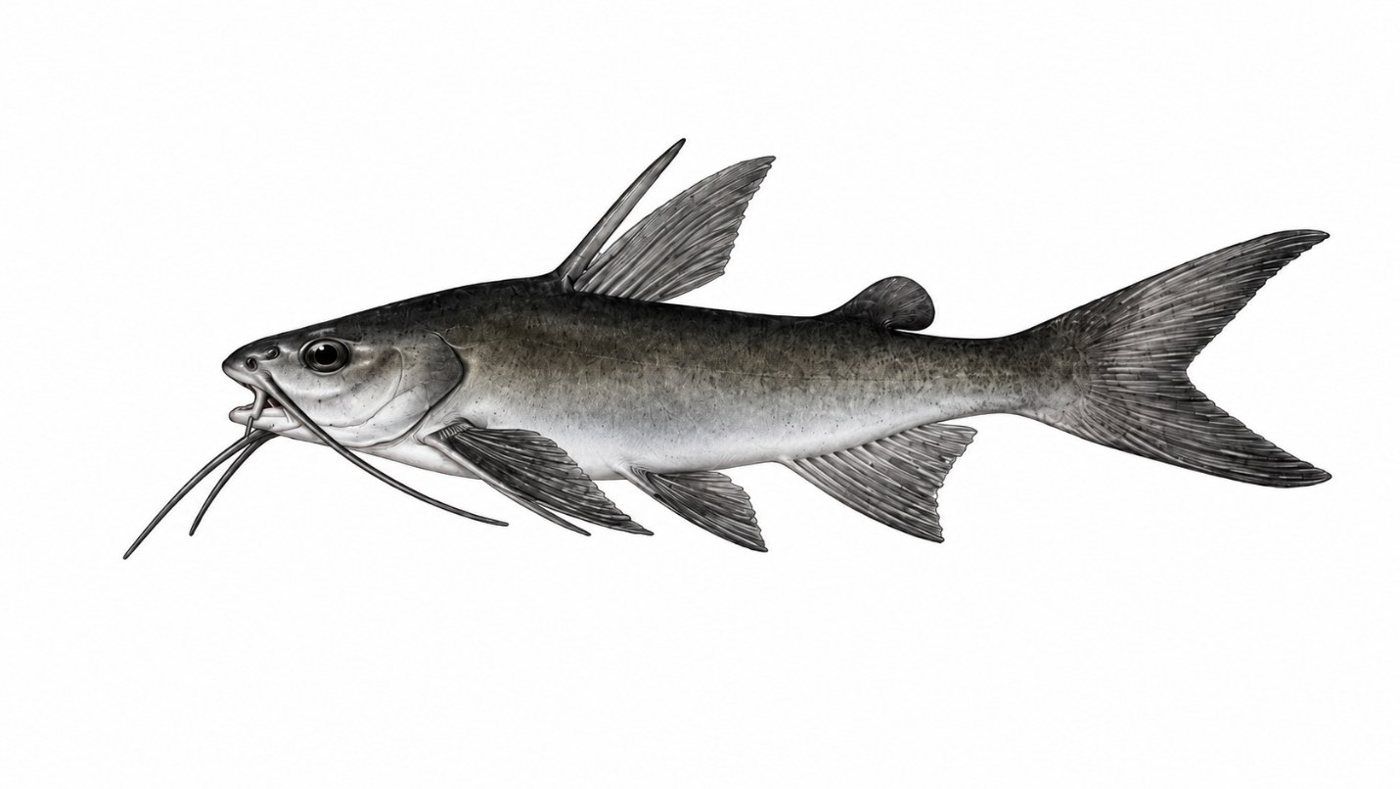
A marine catfish with an elongated body, broad bony head and naked, scaleless skin. Three pairs of barbels around the mouth, organs of touch and taste. A strong spiny sting at the front of the dorsal and pectoral fins, to be handled with caution. The occipital process, on top of the head, is wider than it is long, hence the French name meaning “large plates”.
Features that never mislead
Occipital process on the head wider than long, a prominent bony plate.
Three pairs of barbels around the mouth.
Naked, scaleless skin, spiny dorsal and pectoral stings.
Broad, bony head, elongated body.
Size and weight
Common size around 40 cm. Published maximum length about 85 cm total length (FishBase), with 60 cm specimens measured in estuaries. Females mature at around 27 to 28 cm.
Behaviour and ecology
A catfish of muddy coastal waters that regularly enters estuaries and lagoons. Probes the mud with its barbels for worms, molluscs and small crustaceans. Tolerates a wide range of salinity.
Present on the West African coast from Senegal to Angola. Notably, it is the only Ariidae species recorded in the Ébrié lagoon, where it is familiar to Abidjan fishers. IUCN status: Least Concern.
Reproduction and season
Mouthbrooding: the female shelters the eggs and young in her mouth, a remarkable behaviour of sea catfishes. Coastal and estuarine spawning. Sex ratio in favour of females.
Fishing practice
Techniques, from most to least effective
By bottom fishing with natural bait (worm, piece of fish) over muddy lagoon and estuary bottoms.
By surfcasting from coastal beaches.
Caught in lagoon nets and longlines.
The fight: heavy and stubborn, pulling along the bottom. When bringing it aboard, handle it with a thick glove: the dorsal and pectoral stings cause painful wounds.
Eating quality
Decent white flesh, appreciated charcoal-grilled (braisé) or smoked, very common on lagoon markets. A popular fish of the Ébrié lagoon. Best eaten fresh.
Sources: FishBase (Carlarius latiscutatus, Günther 1864); IUCN Red List, LC; Simier et al. 2021 (Ariidae of West Africa, Ébrié lagoon); Ouattara et al. 2016.