
Bagrid catfish
Chrysichthys nigrodigitatus (Lacepède, 1803)
Family Claroteidae • the festive catfish of the lagoon
3 look-alikes to know
| French name | Mâchoiron. Other names: poisson-chat, silure argenté (common usage). |
|---|---|
| Scientific name | Chrysichthys nigrodigitatus (Lacepède, 1803) |
| Family | Family Claroteidae |
| English name (FAO) | Bagrid catfish |
| Local names | Mâchoiron is already the common name in Côte d’Ivoire; names in Ébrié, Alladian and Avikam to be documented. |
| Habitat | Freshwater, lagoon and estuarine, demersal. Depth from 3 m. Lagoons, coastal rivers. |
| IUCN status | LC Least Concern. Wide distribution from Senegal to Angola. |
Identification
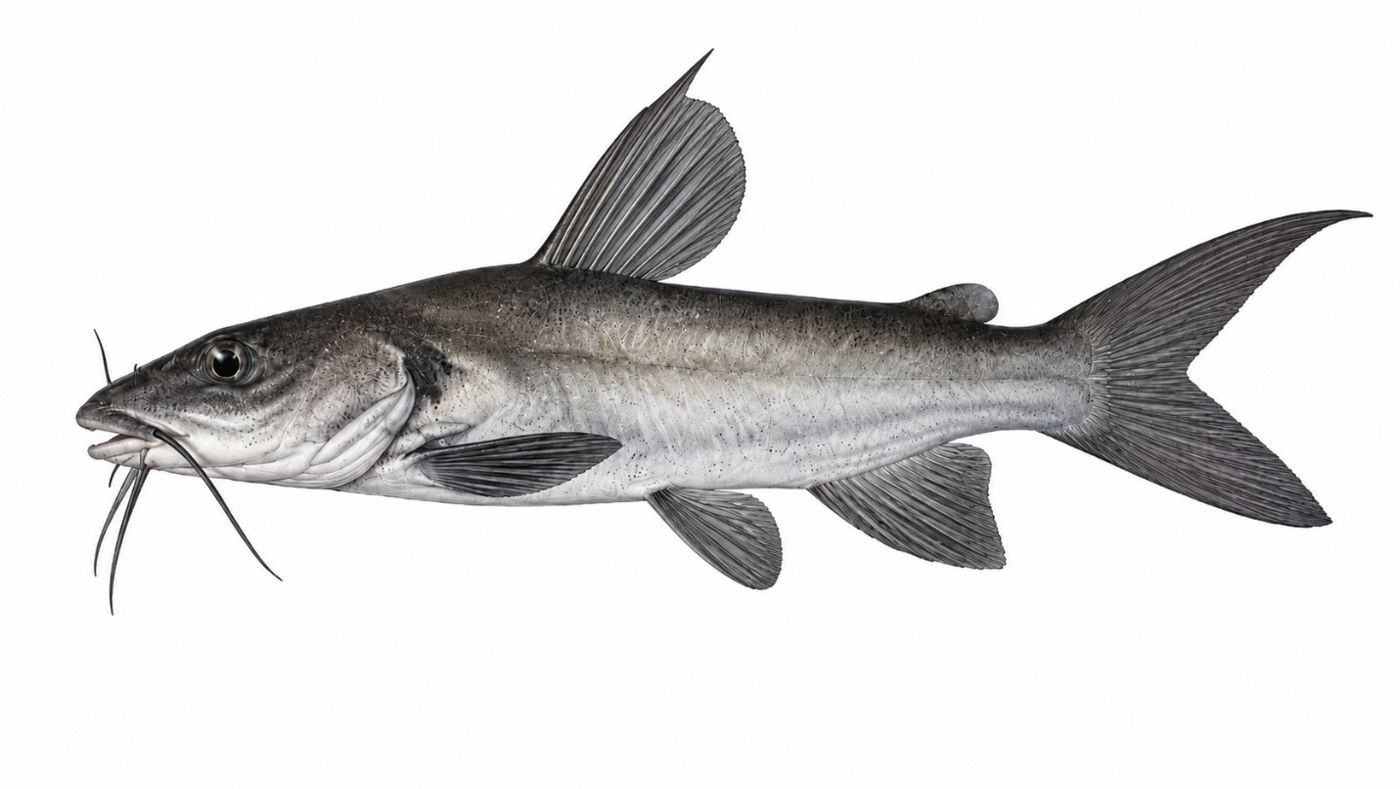
A catfish with a naked (scaleless) body, stocky at the front, greyish to brownish back, pale belly. Broad head bearing several pairs of sensory barbels. Dorsal and pectoral fins each armed with a strong spiny ray. Clearly forked tail.
Features that never mislead
- Naked, scaleless body, typical of catfishes.
- Several pairs of barbels around the mouth, a sensory organ for foraging.
- A strong spiny ray on the dorsal fin and on each pectoral fin (sharp: handle with care).
- Forked tail; fin tips often dark (hence nigrodigitatus, black fingers).
Size and weight
Published maximum length about 65 cm (SL). Common size much smaller. On the Abidjan markets, table fish often weigh from 0.5 to over 2 kg, with the big ones in high demand.
Behaviour and ecology
An omnivorous bottom fish: it probes the mud with its barbels to find molluscs, crustaceans, worms, insects and plant debris. Active mainly at night, fairly sedentary.
Emblematic of the Ébrié lagoon, it is one of the most prized fishes in Côte d’Ivoire and a mainstay of local lagoon aquaculture.
Reproduction and season
An oviparous species. In the wild, spawning in the warm season; in farming, reproduction is stimulated in tanks and pens. Strong demand supports an active fish-farming sector in the Ébrié lagoon.
Fishing practice
Techniques, from most to least effective
- With a bottom line and natural bait (worm, piece of fish, paste) in the lagoon, especially at night. The top technique.
- With bottom longlines set in the lagoon channels.
- With nets and fish traps for subsistence and commercial fishing.
A powerful, stubborn fight for its size: heavy pulls towards the bottom, the bagrid catfish does not let go. Grip the fish behind the head, never with a full hand, as the dorsal and pectoral spiny rays can pierce deeply.
Eating quality
White, firm and rich flesh, highly prized: it is the festive fish par excellence in Côte d’Ivoire, the star of the maquis. Excellent charcoal-grilled whole (braisé), in palm nut sauce (sauce graine) or in kedjenou. Demand far exceeds supply, especially on the eve of holidays.
Did you know?
In Côte d’Ivoire, the bagrid catfish is not just a fish: it is a sign of celebration. Its high price and generous flesh make it the dish for great occasions, so much so that its biggest sales take place on the eve of major celebrations. The Ébrié lagoon is its cradle, and farming it there has become an economic sector in its own right.
Sources: FishBase (Chrysichthys nigrodigitatus, Lacepède 1803); IUCN Red List 2010 (Least Concern); IRD/CRO studies on bagrid catfish aquaculture in the Ébrié lagoon. Local names to be documented.