
Red scorpionfish
Scorpaena scrofa (Linnaeus, 1758)
Family Scorpaenidae • the venomous scorpionfish of hard bottoms
2 look-alikes to know
| French name | Rascasse rouge, grande rascasse. Other name: chapon. |
|---|---|
| Scientific name | Scorpaena scrofa (Linnaeus, 1758) |
| Family | Family Scorpaenidae |
| English name (FAO) | Red scorpionfish |
| Local names | Commonly referred to by its usual French name on Ivorian markets and landing sites. Names in lagoon languages (Ébrié, Alladian, Avikam) are being collected in the field. |
| Habitat | Marine demersal, rocky and coralligenous bottoms. Depth 20 to 500 m, most often down to 150 m. |
| IUCN status | LC Least Concern. Eastern Atlantic down to Senegal and the Gulf of Guinea; locally reported to be becoming scarce. |
Identification
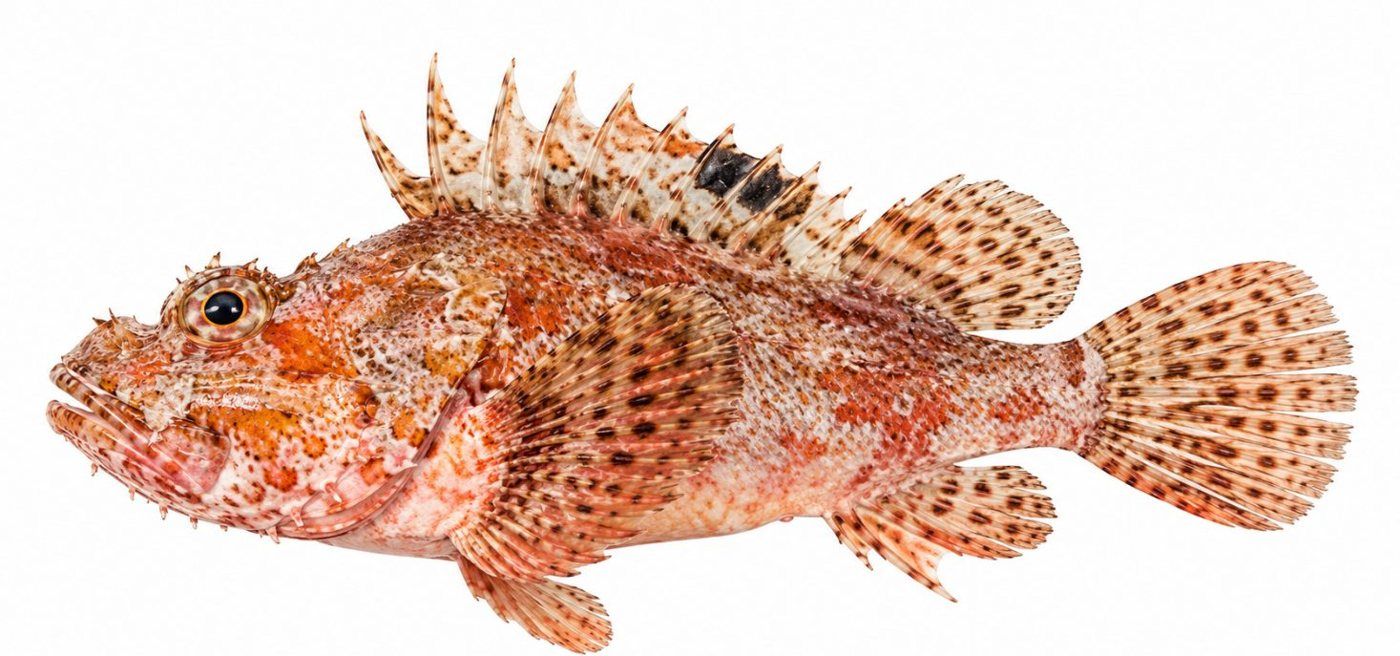
A stocky fish with a large spiny head, covered with many skin flaps (cirri) used for camouflage. Brick to pink colouring marbled with light and dark, a master of mimicry on rock. Wide mouth, large eyes topped by a small tentacle.
Features that never mislead
- Many skin flaps on the head and a tentacle above each eye.
- Dorsal fin armed with 12 hard, venomous spiny rays, with a dark spot.
- Massive, lumpy head, puffed cheeks (hence the French name chapon, ‘capon’).
- Marbled red-pink colouring, perfect camouflage on rocky bottoms.
Size and weight
Common size around 30 cm. Published maximum length 50 cm TL for a maximum weight of about 3 kg (FishBase). A slow-growing, long-lived species (15 to 25 years).
Behaviour and ecology
An ambush hunter, motionless and camouflaged on the rock, it sucks in the small fish and crustaceans that come within reach with a sudden snap of the mouth. Strictly territorial: the same individual can occupy the same crevice for years.
Along the Ivorian coast, it frequents the hard bottoms and rock heads of the shelf. Active mainly at dusk and at night.
Reproduction and season
Summer spawning at sea (Ivorian data to be confirmed). Its slow growth and strong territoriality make it sensitive to intense local fishing.
Fishing practice
Techniques, from most to least effective
- Bottom fishing with natural bait (fish, shrimp, squid) right against the rocks. The top technique.
- With a madai or light tenya over mixed sand and rock bottoms.
- With a handline anchored near a rocky shelter.
A modest fight: a few head shakes towards the bottom. The danger is on board, not in the water. A sting from the dorsal spines causes intense pain; in case of accident, immerse the area in hot water (the toxin is heat-sensitive) and seek medical advice.
Eating quality
White, firm and tasty flesh, much sought after for soups and bouillabaisse: its gelatinous head flavours the stock. Remove the venomous spines before preparation. Excellent poached or in sauce.
Did you know?
The French name chapon (‘capon’) comes from the puffy look of this fish, which recalls a well-fattened fowl; its Latin name scrofa actually means sow. But beneath this easy-going camouflage lies a serious weapon: its spiny rays inject a painful venom. The scorpionfish does not chase, it waits: resting for hours on the rock, invisible, it sucks in its prey in a fraction of a second.
Sources: FishBase (Scorpaena scrofa, Linnaeus 1758); IUCN Red List (Least Concern); DORIS-FFESSM; Fishipedia; Animalia.bio (presence in the Gulf of Guinea). Ivorian data to be reconfirmed with the CRO Abidjan.