
Pompano
Trachinotus ovatus (Linnaeus, 1758)
Family Carangidae • the silvery pompano of clear coastal waters
| French name | Liche derbio. |
|---|---|
| Scientific name | Trachinotus ovatus (Linnaeus, 1758) |
| Family | Family Carangidae |
| English name (FAO) | Pompano |
| Local names | On Ivorian markets and landing sites: “Goudron” (Ouattara et al., 2016). |
| Habitat | A coastal pelagic species that favours clear water over sandy bottoms, in the surf zone, and sometimes enters lagoons and estuarie |
| IUCN status | LC Least Concern. See main text of the sheet. |
Identification
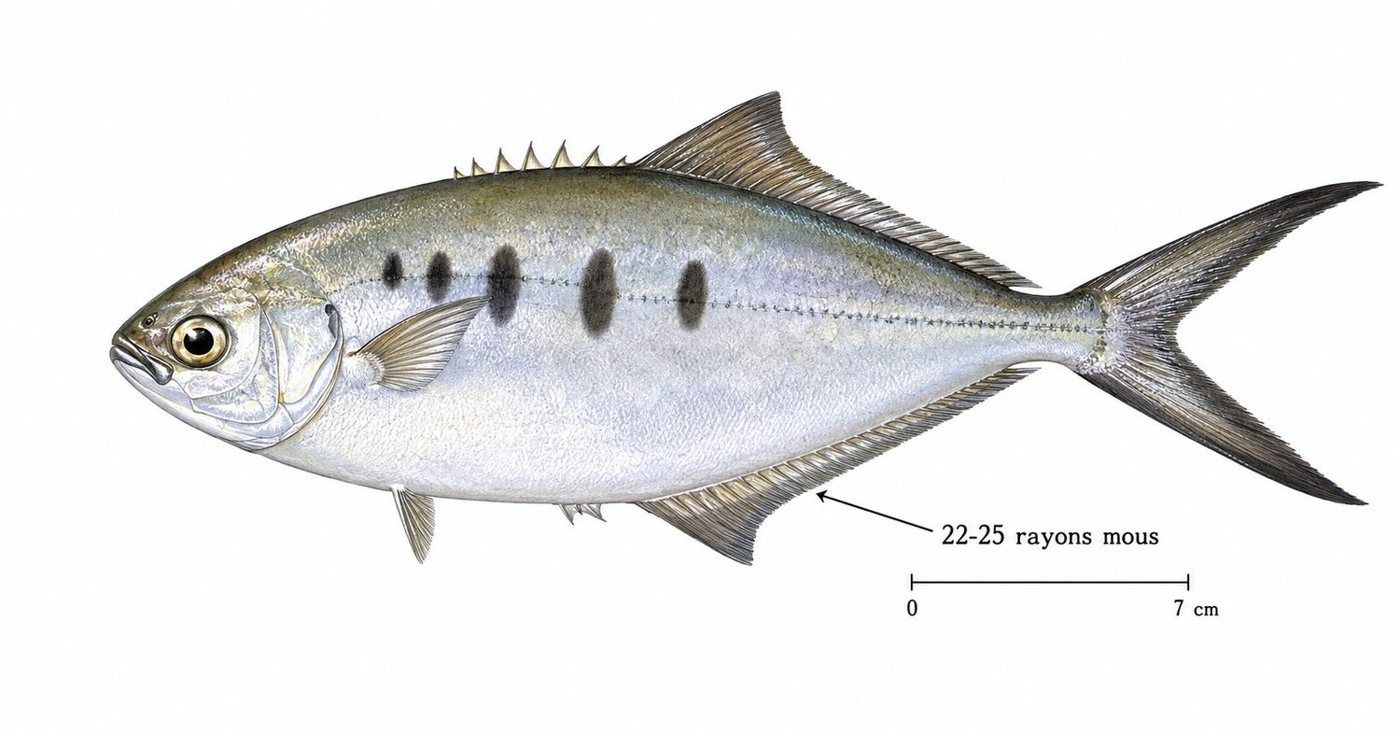
A pompano with an elongated, strongly compressed body, slimmer than the shortfin pompano, with a silvery background and a greenish back. Distinctive features: three to five dark spots in a row along the midline of the flanks, and a clearly forked tail with black edges and a white spot on the upper lobe. Dorsal and anal fins dotted with dark. No scutes on the lateral line.
Features that never mislead
Three to five dark spots in a row along the middle of the flanks.
Forked tail with black edges, white spot on the upper lobe.
Body slimmer than the shortfin pompano, greenish back.
No scutes on the lateral line, unlike Caranx.
Size and weight
Common size around 35 cm. Maximum length about 70 cm total length, with a maximum weight of around 2.8 kg (FishBase).
Behaviour and ecology
A coastal pelagic species that favours clear water over sandy bottoms, in the surf zone, and sometimes enters lagoons and estuaries. Adults are common in the shallow surf, where they hunt small fish and invertebrates.
Present in the Eastern Atlantic, from the Mediterranean and the Bay of Biscay, where it is rare and irregular, to the Gulf of Guinea and Angola, including the Atlantic islands. On the Ivorian coast it is found in the surf off the beaches and around the Vridi canal. IUCN status of Least Concern.
Reproduction and season
Spawns in coastal open water; pelagic eggs and larvae, mainly in the warm season. Young fish frequent the surf and sheltered waters.
Fishing practice
Techniques, from most to least effective
Surfcasting from the beaches, with natural bait or a small lure, in the surf.
With shiny cast lures for fish active at the surface.
Light trolling along the coast.
The fight: lively and nervy in the surf, with fast, sustained runs; an excellent surfcasting fish on light tackle.
Eating quality
White, firm and fine flesh, highly prized grilled or braised, with a reputation comparable to that of the other pompanos. Eat fresh.
Sources: FishBase (Trachinotus ovatus, Linnaeus 1758); IUCN Red List, LC; FAO Eastern Central Atlantic; Ouattara et al. 2016.