Shortfin pompano
Trachinotus teraia Cuvier, 1832
Family Carangidae • the pompano of lagoons and river mouths
| French name | Pompaneau lagunaire. |
|---|---|
| Scientific name | Trachinotus teraia Cuvier, 1832 |
| Family | Family Carangidae |
| English name (FAO) | Shortfin pompano |
| Local names | On Ivorian markets and landing sites: “Arraie” (Ouattara et al., 2016). |
| Habitat | A coastal and lagoon species par excellence, which ranges widely into the brackish waters of lagoons and river mouths, where it forages over sandy and m |
| IUCN status | Least Concern (LC), IUCN Red List, assessed on 10/05/2013. |
How to recognise it
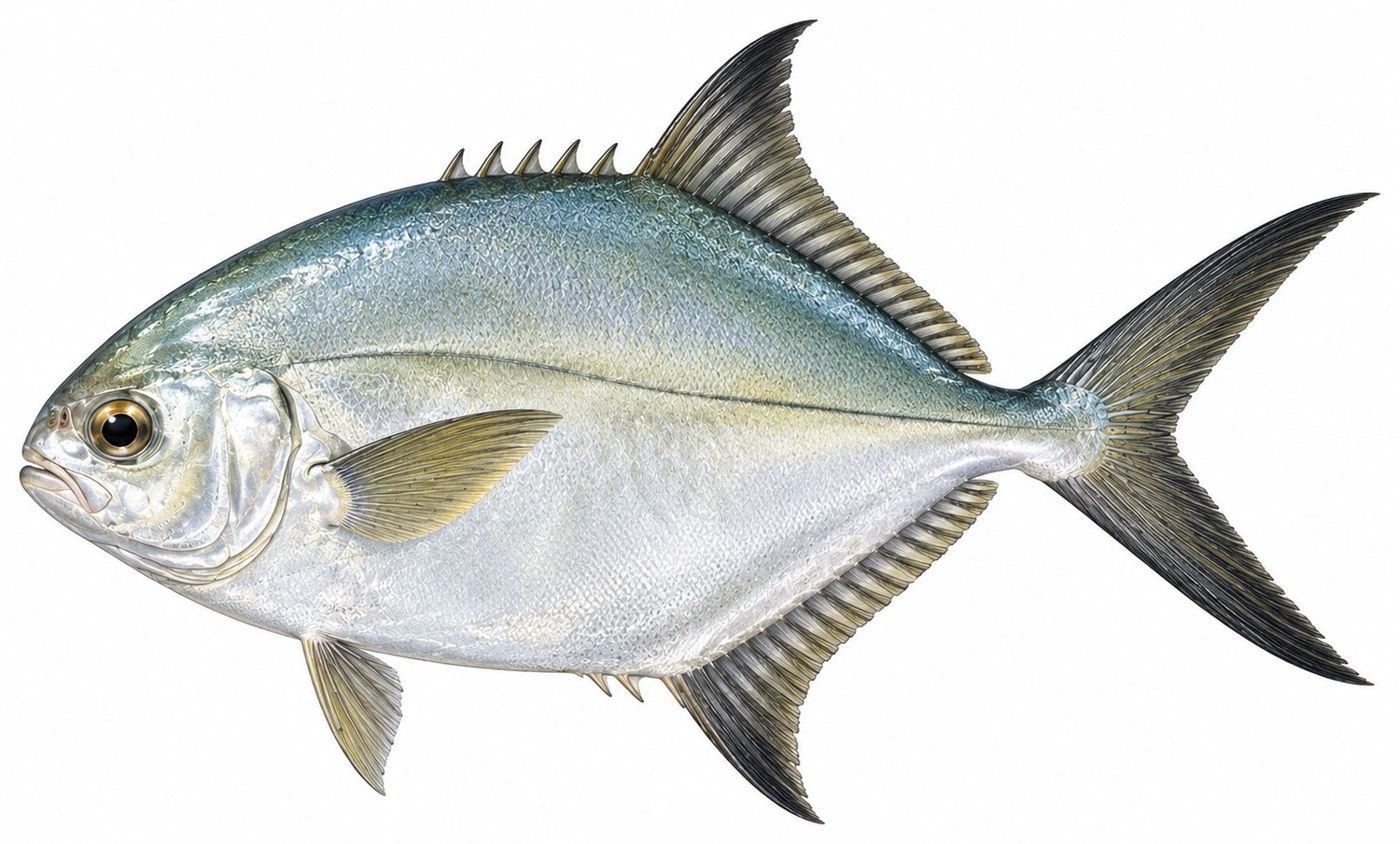
- short, deep body (depth 1.8 to 2.5 times in fork length), rounded snout, small mouth;
- 6 short spines in the first dorsal fin, then 1 spine and 19 to 21 rays; anal fin with 2 detached spines, then 1 spine and 16 to 18 rays;
- dorsal and anal fin lobes shorter than the head;
- back bluish grey to greenish, silvery flanks, no spots; dark fins.
Size
Common size 35 cm; maximum 68 cm (FishBase).
Life, fishing and table
Behaviour and ecology
A coastal and lagoon species par excellence, which ranges widely into the brackish waters of lagoons and river mouths, where it forages over sandy and muddy bottoms for molluscs, worms and small crustaceans. Very much at home in low-salinity water.
Present along the West African coast. In Côte d’Ivoire it is a familiar species of the Ébrié lagoon and the Vridi canal, where it delights bottom anglers. Local IUCN status data to be checked.
Reproduction and season
Spawns in coastal open water; pelagic eggs and larvae. Young fish use lagoons and estuaries as nurseries.
Fishing practice
Techniques, from most to least effective
Bottom fishing with natural bait (worm, crab, piece of shellfish) over the sandy bottoms of the lagoon.
Surfcasting from the beaches and the canal mouth.
With soft plastic lures worked close to the bottom for active fish.
The fight: very combative for its size, with stubborn runs and changes of direction; one of the finest lagoon fish on light spinning tackle.
The light rig, piece by piece
- Light spinning rod 2.10 to 2.40 m, 7 to 28 g
- Spinning reel size 2500 to 3000
- Main line: braid PE 0.8 to 1.2
- Fluorocarbon leader 20 to 30 lb, 1 m
- Round jig head of 7 to 20 g
- Soft plastic shad, 7 to 10 cm
- Variant: soft plastic shrimp
Eating quality
White, firm and fine flesh, among the most prized of lagoon fish. Excellent grilled or braised. Eat fresh.
Status
Least Concern (LC), IUCN Red List, assessed on 10/05/2013 (via FishBase, checked on 25/10/2026).
Local names
« Arraie »: markets and landing sites of Côte d'Ivoire (Ouattara et al., 2016); language to be specified.
Sources: FishBase, Trachinotus teraia (accessed on 25/10/2026); V13 species sheet 22.