Common dolphinfish
Coryphaena hippurus (Linnaeus, 1758)
Family Coryphaenidae • the golden sprinter of floating objects
1 look-alike to know
| French name | Dorade coryphène. Other names: coryphène, mahi-mahi, dorado. |
|---|---|
| Scientific name | Coryphaena hippurus (Linnaeus, 1758) |
| Family | Family Coryphaenidae |
| English name (FAO) | Common dolphinfish |
| Local names | On Ivorian markets and landing sites: “Machette” (Ouattara et al., 2016). |
| Habitat | Marine, surface pelagic, highly migratory. Most often in the top 10 metres. |
| IUCN status | Least Concern (LC), IUCN Red List, assessed on 17/09/2010. Fast-growing, short-lived species. |
Check against V13
Dorsal rays (58 to 66, no spines), sizes, weights and maturity consistent with FishBase; IUCN status dated (2010 assessment, old: to be monitored). V13 does not mention the lookalike: the pompano dolphinfish (Coryphaena equiselis) has been added, with separation criteria still to be documented.
How to recognise it
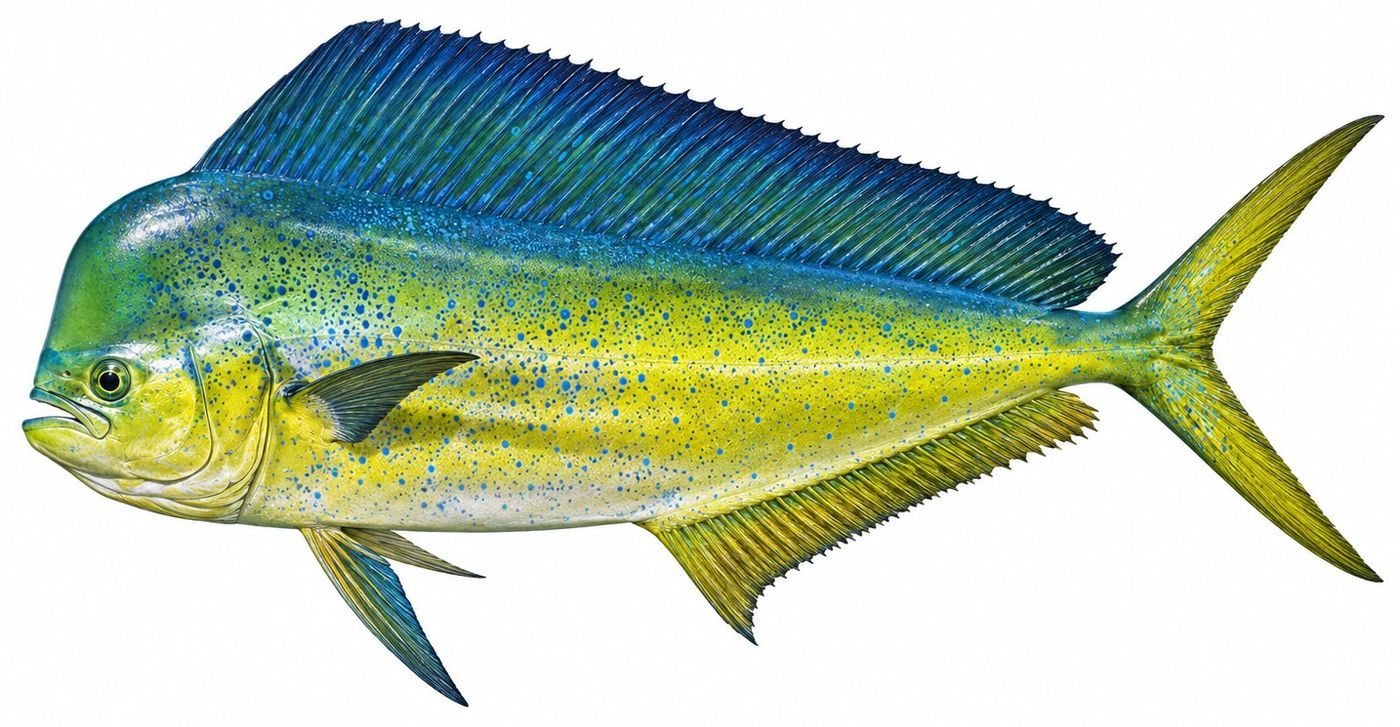
- a single long dorsal fin from the nape to the base of the tail (58 to 66 rays);
- high, square forehead in adult males, sloping profile in females;
- deeply forked tail; long, concave anal fin;
- blue-green back, golden flanks scattered with dark or blue dots, colours that fade quickly out of the water.
Size
Common size 100 cm; published maximum 210 cm and 40 kg; first maturity at about 56 cm (FishBase). Short life, fast growth.
Life
Hunts flying fish, small pelagics and cephalopods at the surface, in small schools, closely tied to floating objects.
Fishing
By trolling and casting around FADs, logs and debris lines; a hooked fish kept in the water often holds the school.
At the table
White, firm and fine flesh; grilled, as fillets or on skewers; bleed and ice as soon as it is caught. V13 mentions rare cases of ciguatera: source needed.
Status
Least Concern (LC), IUCN Red List, assessment of 17/09/2010 (via FishBase, checked on 24/10/2026).
Sources: FishBase, Coryphaena hippurus (accessed on 24/10/2026); species sheet 10 V13.