
Sampa, vundu catfish
Heterobranchus longifilis Valenciennes, 1840
Family Clariidae • the giant cousin of Clarias, a colossus with an adipose fin
| French name | Silure géant, heterobranchus |
|---|---|
| Scientific name | Heterobranchus longifilis Valenciennes, 1840 |
| Family | Family Clariidae |
| English name (FAO) | Sampa, vundu catfish |
| Local names | Silure géant; local names to be documented |
| Habitat | Freshwater: large rivers, deep holes, reservoirs; demersal. |
| IUCN status | LC Least Concern. |
Identification
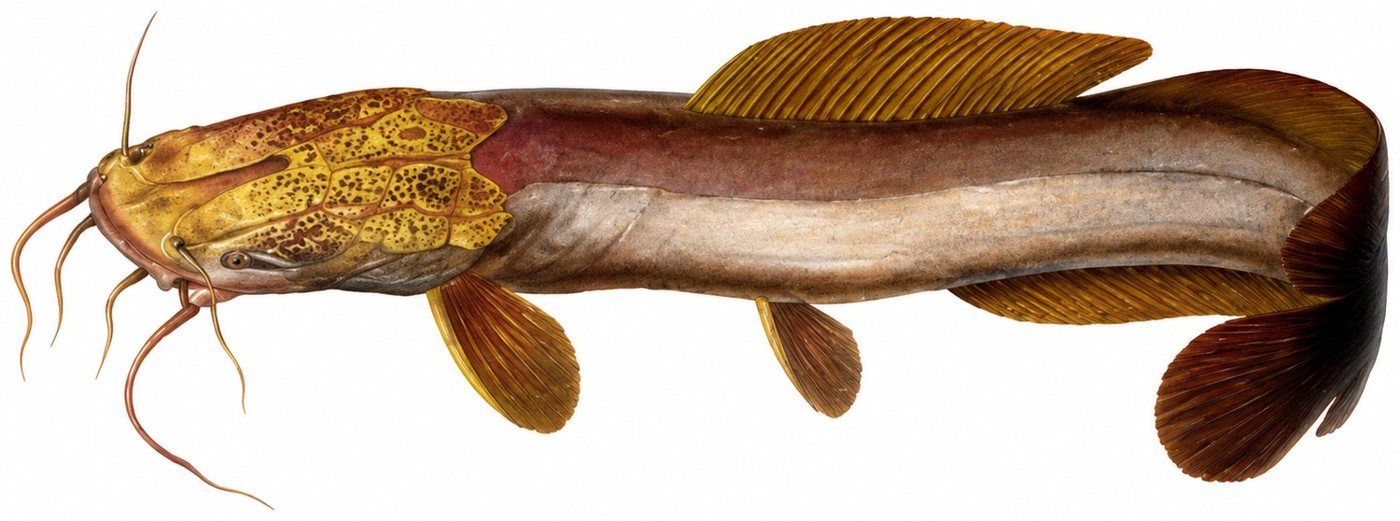
A very large naked catfish related to Clarias, grey to brown, broad head, four pairs of barbels. It differs by a long rayed dorsal fin FOLLOWED by a large adipose (fleshy) fin on the rear of the back, absent in Clarias. Massive, powerful body.
Features that never mislead
Long rayed dorsal then a large fleshy adipose fin at the rear (key feature vs Clarias).
Naked, massive body; broad head, four pairs of barbels.
Sturdy pectoral spines; very slippery skin.
Reaches larger sizes than most Clarias.
Size and weight
Usually 60 cm to 1 m; published maximum around 1.5 m for more than 30 kg (larger records reported).
Behaviour and ecology
A nocturnal predator of deep holes and channels: fish, crustaceans, insects. Breathes air like Clarias and tolerates oxygen-poor water. Prized for its fast growth, it is farmed alone or as a hybrid with Clarias.
Reproduction and season
Oviparous; spawns in the rainy season in flooded areas. Breeding induced in hatcheries; the Heterobranchus x Clarias hybrid is prized in fish farming for its vigour.
Fishing practice
Techniques, from most to least effective
Strong bottom line, fish bait (live or dead), in deep holes at night. The top technique.
Well-weighted bottom longline.
Net and trap in subsistence fishing.
A fight of pure strength: the giant catfish dives and digs in on the bottom, so strong tackle is needed. Grip it behind the head with a thick cloth, beware of the strong pectoral spines and the slippery body.
Eating quality
Firm, oily white flesh, highly prized, excellent smoked or in sauce; large specimens are sought for special occasions.
Sources: FishBase (Heterobranchus longifilis, Valenciennes 1840); IUCN Red List (Least Concern); FAO aquaculture; Lévêque & Paugy. Local names to be documented.