Nile perch
Lates niloticus (Linnaeus, 1758)
Family Latidae • the river “capitaine”, giant predator of big waters
| French name | Nile perch, river “capitaine”. Not to be confused with the marine threadfin (Polydactylus) |
|---|---|
| Scientific name | Lates niloticus (Linnaeus, 1758) |
| Family | Family Latidae |
| English name (FAO) | Nile perch |
| Local names | Capitaine (river), Nile perch; local names to be documented |
| Habitat | Freshwater: large rivers, reservoirs, lakes, deep channels. Demersal to pelagic. |
| IUCN status | LC Least Concern. |
Identification
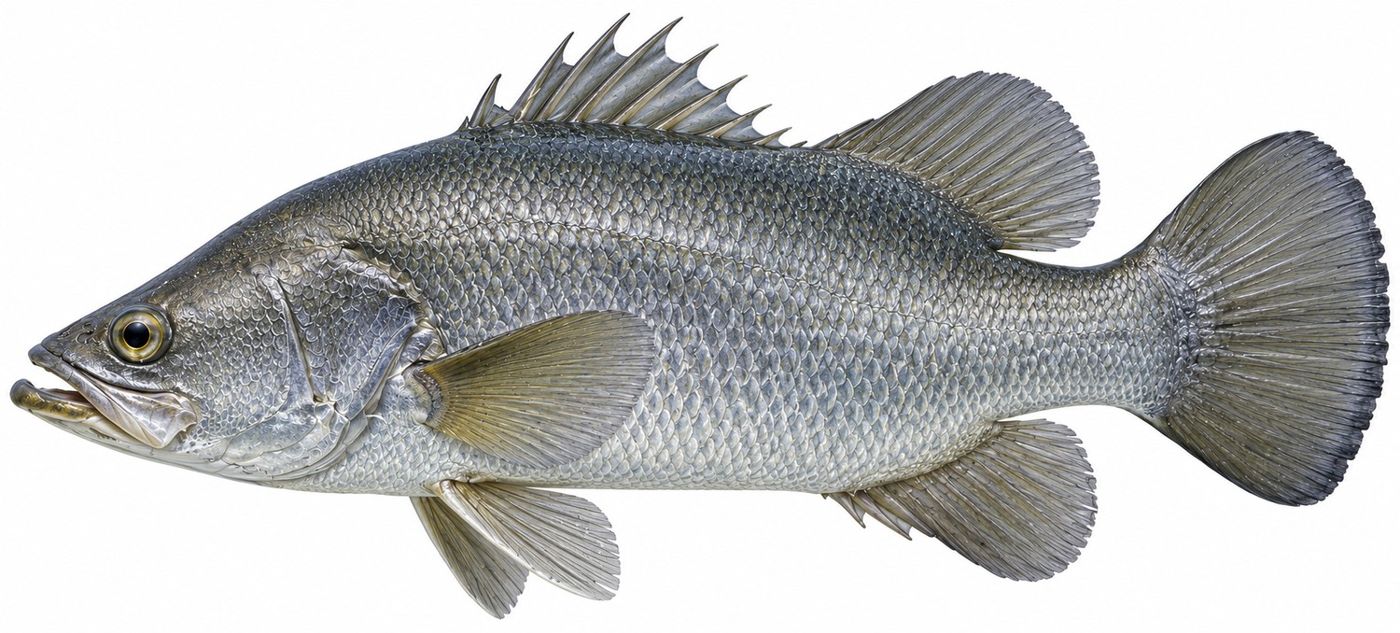
A large predator with a sturdy, elongated body, grey to bronze back, silvery flanks, pale belly, eye often tinged with gold. Two dorsal fins, the first spiny. Large mouth with a protruding lower jaw. Outline of a massive “perch”.
Features that never mislead
Thick, silvery body, the profile of a giant perch.
Two separate dorsal fins, the first strongly spiny.
Large mouth, projecting lower jaw, golden eye.
Clear lateral line; rounded caudal.
Size and weight
A species that can grow enormous: usually 40 cm to 1 m, published maximum close to 2 m for more than 200 kg in large basins.
Behaviour and ecology
A powerful predator at the top of the food chain, hunting fish (including tilapias and small characins) and crustaceans. Juveniles live along the edges, adults move into deep, open water. A key species of Africa's inland fisheries.
Reproduction and season
Very prolific and oviparous; spawns in the warm, high-water season, females releasing hundreds of thousands to millions of eggs.
Fishing practice
Techniques, from most to least effective
Lures (crankbait, spoon, large soft plastic) cast and retrieved over holes and points. The top technique.
Live bait or fish bait on a bottom line in deep channels.
Slow trolling along banks and in reservoirs.
A first-rate sporting opponent: violent runs, head shakes and jumps in young fish, dead weight and powerful runs in big ones. Strong tackle is essential. Wide, hard mouth: strike hard; handle with a lip grip; no venomous spines but strong dorsal spines.
The plug rig, piece by piece
- Stout casting rod 2.10 to 2.40 m, 20 to 80 g
- Baitcasting reel or spinning reel size 4000 to 5000
- Main line: braid 30 to 50 lb
- Fluorocarbon leader 60 to 80 lb, 1 m
- Strong snap
- Diving plug of 12 to 18 cm, reinforced treble hooks
- Variant: large soft swimbait
Eating quality
White, firm, lean flesh without small bones, highly renowned; one of the most traded fishes in Africa (fillets exported). Excellent grilled, barbecued or as fillets.
Sources: FishBase (Lates niloticus, Linnaeus 1758); IUCN Red List (Least Concern); FAO inland fisheries; Lévêque & Paugy. Local names to be documented. Illustrated rig (2026): indicative values from common sport-fishing practice (IGFA line classes, West African fishing-guide usage), to be confirmed with local anglers.