
Common guitarfish
Rhinobatos rhinobatos (Linnaeus, 1758)
Family Rhinobatidae • half shark, half ray, highly threatened, to be protected
| French name | Poisson-guitare commun, guitare de mer. Other name: ange (common usage) |
|---|---|
| Scientific name | Rhinobatos rhinobatos (Linnaeus, 1758) |
| Family | Family Rhinobatidae |
| English name (FAO) | Common guitarfish |
| Local names | Guitare de mer; local names to be documented |
| Habitat | Coastal and estuarine marine, sandy and muddy bottoms, shallow depths; demersal. |
| IUCN status | CR Critically Endangered. One of the most threatened species of the coastline. |
Identification
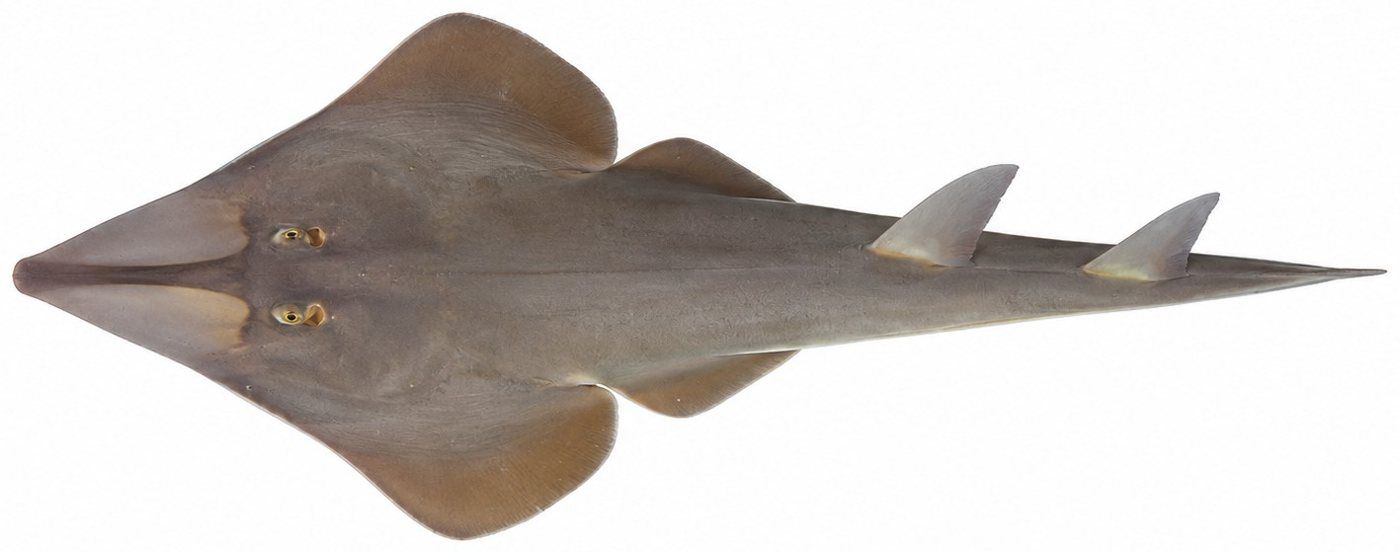
A batoid halfway between a ray and a shark: the front flattened into a triangular disc (the “ray” part), a sturdy rear with two dorsal fins and a shark-like tail (the “guitar” part). Pointed, translucent snout; sandy to grey-brown colour. Elongated, guitar-shaped body.
Features that never mislead
Guitar outline: flat ray-like front, muscular shark-like rear.
Elongated, pointed snout, often translucent at the edges.
Two well-developed dorsal fins and a true tail fin (no sting).
Uniform sandy to brown coloration, blending into the bottom.
Size and weight
Total length usually 0.7 to 1.2 m; published maximum around 1.5 to 1.7 m.
Behaviour and ecology
A bottom predator of coastal sandy areas: crustaceans, molluscs and small fish dug out of the sand. Often lies buried near beaches and river mouths. A slow-growing species with low fecundity, highly sensitive to fishing pressure.
Reproduction and season
Aplacental viviparous; small litters of fully formed young after a long gestation. This slow pace leaves the species unable to withstand heavy exploitation.
Fishing practice
Techniques, from most to least effective
NO TARGETED FISHING RECOMMENDED. Often an accidental catch when surfcasting with bottom bait or in coastal nets.
If caught, release immediately and gently, holding the fish horizontally, without dragging it over the sand.
Avoid areas and gear where the species is frequently caught.
A powerful, crawling fight, similar to that of a small shark. No venomous sting, but rough skin and a firm jaw. Given its Critically Endangered status, the goal is the animal’s survival: quick unhooking (or cutting the line close to the mouth) and careful release.
Eating quality
Historically eaten (wings and flesh), but the species is now Critically Endangered: the guide’s advice is not to keep it and to release it alive.
Sources: FishBase (Rhinobatos rhinobatos, Linnaeus 1758); IUCN Red List (Critically Endangered); studies on the rays of Côte d'Ivoire. Local names to be documented.