
Daisy stingray
Fontitrygon margarita (Günther, 1870)
Family Dasyatidae • the coastal stingray with a venomous sting
1 look-alike to know
| French name | Raie-pastenague marguerite. Closely related species: Fontitrygon margaritella |
|---|---|
| Scientific name | Fontitrygon margarita (Günther, 1870) |
| Family | Family Dasyatidae |
| English name (FAO) | Daisy stingray |
| Local names | Raie, pastenague; local names to be documented |
| Habitat | Coastal and estuarine marine, sandy and muddy bottoms, shallow depths; demersal. |
| IUCN status | VU Vulnerable. A species sensitive to coastal overfishing. |
How to recognise it
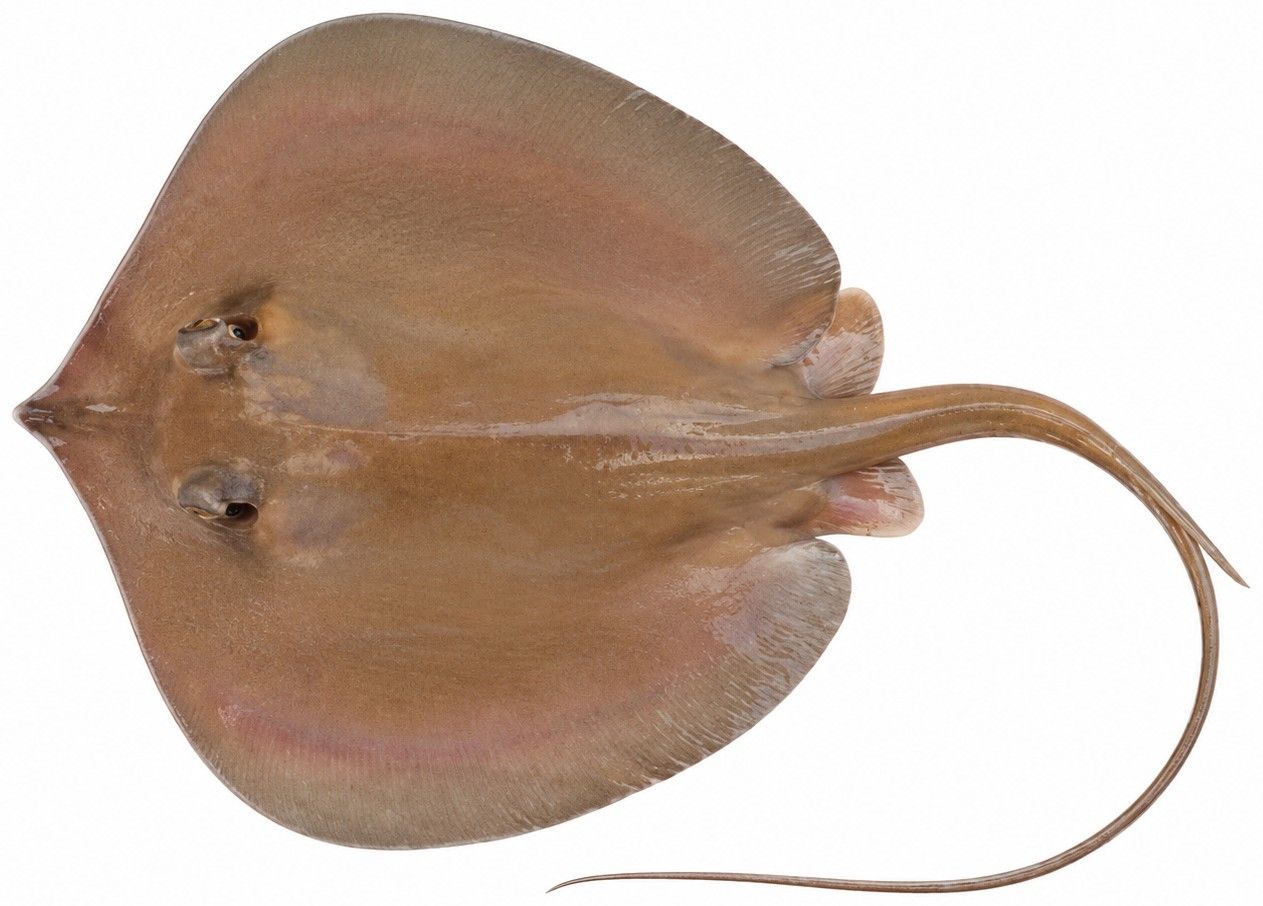
- a very large, round, pearl-like thorn in the centre of the disc, always present (FishBase): the “pearl” (margarita);
- in specimens over 20 cm wide, a band of small flat denticles along the middle third of the back, from the eyes to the base of the tail;
- upper side plain grey-brown, underside whitish;
- medium-sized eyes, slightly larger spiracles just behind;
- tail longer than the disc, broad at the base then whip-like, a weak keel on top, a clear ventral fold, a long, thin, serrated and highly venomous sting (Wikipedia).
Do not confuse with: Fontitrygon margaritella, smaller (comparison to be documented).
Size
Usual disc width 60 cm, published maximum 100 cm and 20 kg (FishBase).
Life
Hunts at night on the bottom for molluscs, worms and crustaceans, which it digs up by blowing away the sand; often buried during the day, with only the eyes and spiracles showing. Aplacental viviparous.
Fishing
Bottom line with natural bait (worm, crab, piece of fish) on beaches and at river mouths; bottom longline; frequent bycatch in coastal nets. DANGER: venomous sting. Never grab it near the tail, control it by the wings, cut the line close to the mouth if in doubt.
At the table
The wings are eaten in sauce or smoked. Take in moderation: a species listed as Vulnerable by the IUCN (2021 assessment, checked on 23/10/2026).
Sources: FishBase, Fontitrygon margarita; Wikipedia, Daisy stingray (accessed on 23/10/2026); species sheet 82 V13.