
Émissole lisse (Common smooth-hound)
Mustelus mustelus (Linnaeus, 1758)
Family Triakidae • the harmless small coastal shark, now threatened
2 look-alikes to know
| French name | Émissole lisse. Other names: chien de mer, émissole, requin lisse. |
|---|---|
| Scientific name | Mustelus mustelus (Linnaeus, 1758) |
| Family | Family Triakidae |
| English name (FAO) | Émissole lisse (Common smooth-hound) |
| Local names | On Ivorian markets and landing sites: “Requin” (Ouattara et al., 2016). |
| Habitat | Marine, demersal over coastal and shelf bottoms. Depth most often 5 to 50 m, down to several hundred metres. |
| IUCN status | EN Endangered. Population decline estimated at over 30 percent, heavy fishing pressure. |
Identification
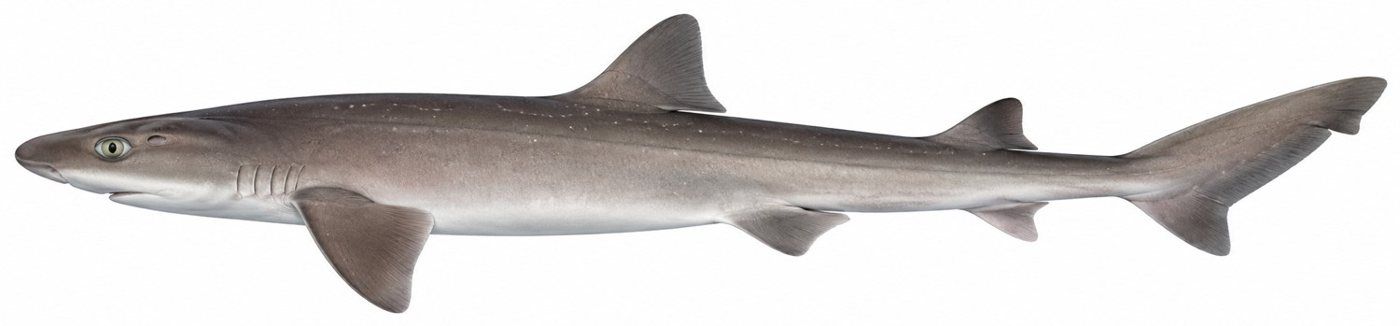
A small shark with a slender, spindle-shaped body, uniform grey to grey-brown above, white below, sometimes with a few small dark spots. Pointed snout, oval eyes. Small, flattened, pavement-like teeth, made for crushing crustaceans, not for cutting: it is a shark that is completely harmless to humans. Two dorsal fins without spines.
Features that never mislead
Small, flattened, pavement-like teeth, made for crushing (not cutting).
Slender body, uniform grey to grey-brown, white below.
Pointed snout, oval eyes, two dorsal fins without spines.
A small coastal shark, harmless to humans.
Size and weight
Common size around 100 cm. Maximum length 200 cm total length (FishBase). Maximum age about 24 years, late maturity at around 80 cm and above.
Behaviour and ecology
A coastal demersal predator that searches the bottom for crustaceans, cephalopods and small fish, which it crushes with its pavement-like teeth. Often swims close to the bottom. Viviparous with a yolk-sac placenta: the female gives birth to fully formed young.
Present from Europe to South Africa, including the Mediterranean, along the West African coast. Caught on the Ivorian coast. IUCN status ENDANGERED, in steep decline.
Reproduction and season
Placental viviparity: long gestation, small litters of already formed young. Late maturity. This slow reproductive strategy makes the species highly vulnerable to overfishing.
Fishing practice
Techniques, from most to least effective
Caught in demersal fisheries (longline, net, trawl) as a target or as bycatch.
By bottom fishing with natural bait.
A threatened species: favour release over targeted capture.
The fight: respectable and sustained, steady pulls along the bottom, no danger to the angler. But given its threatened status, this harmless shark is better released with care than kept.
Eating quality
Boneless white flesh (cartilaginous skeleton), appreciated fresh, dried and salted, or smoked. It is this commercial value, added to the fin trade, that led to its overexploitation.
Sources: FishBase (Mustelus mustelus, Linnaeus 1758); IUCN Red List 2021 (Endangered, e.T39358A124405881); FAO Eastern Central Atlantic; Ouattara et al. 2016.