
Anoli de mer (Snakefish)
Trachinocephalus myops (Forster, 1801)
Family Synodontidae • the big-eyed burrowing lizardfish
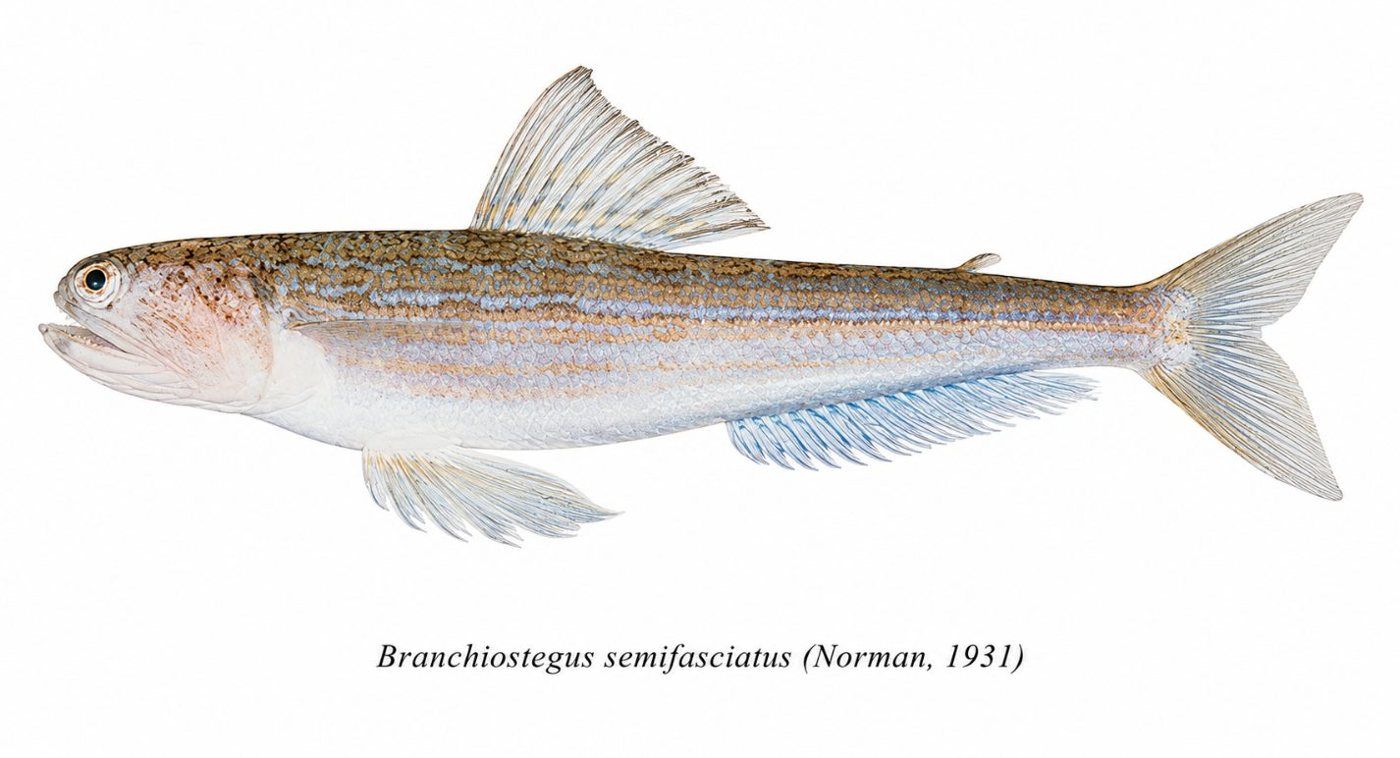
1 look-alike to know
| French name | Anoli de mer. Other names: poisson-lézard, anoli, six chinois (local usage). |
|---|---|
| Scientific name | Trachinocephalus myops (Forster, 1801) |
| Family | Family Synodontidae |
| English name (FAO) | Anoli de mer (Snakefish) |
| Local names | On Ivorian markets and landing sites: “Six chinois” (Ouattara et al., 2016). |
| Habitat | Marine, demersal on coastal and shelf sandy bottoms. Buries itself in the sand, leaving only its eyes showing. |
| IUCN status | LC Least Concern. Precise status to be confirmed. |
Identification
A small fish with a cylindrical, elongated body, a short head with a very short snout and eyes set high, almost on top of the skull. Large, wide mouth armed with fine, bristle-like teeth. Livery striped with oblique bluish and yellowish lines. Profile of a small ambush predator, buried in the sand.
Features that never mislead
Eyes set high, almost on top of the head, very short snout.
Large, wide mouth with fine, bristle-like teeth.
Cylindrical, elongated body, oblique bluish and yellowish lines.
Buries itself in the sand to lie in wait.
Size and weight
Small fish, usual catches around twenty centimetres. Precise maximum size to be confirmed on FishBase.
Behaviour and ecology
An ambush predator that buries itself in the sand with only its eyes showing, then lunges at small fish and crustaceans that pass within reach. Very fast on the strike.
Widely distributed in tropical and subtropical waters. Present on Ivorian coastal sandy bottoms. IUCN status: Least Concern.
Reproduction and season
Coastal spawning, pelagic eggs and larvae. Local spawning data to be documented.
Fishing practice
Techniques, from most to least effective
As bycatch in coastal trawls and nets over sandy bottoms.
In small-scale bottom fishing with bait.
Rarely targeted specifically.
The fight: modest given its small size. Of little direct fisheries interest, it is mainly bycatch and a link in the sandy-bottom food chain.
Eating quality
Decent but small flesh, eaten locally fried or sold in lots. Modest commercial value.
Sources: FishBase (Trachinocephalus myops, Forster 1801); FAO Eastern Central Atlantic; Ouattara et al. 2016; IUCN status to be reconfirmed.