
Denté de l'Angola (Angolan dentex)
Dentex angolensis Poll & Maul, 1953
Family Sparidae • the small coastal dentex of commercial importance
2 look-alikes to know
| French name | Denté de l'Angola. Other names: denti d'Angola, Angolan dentex. |
|---|---|
| Scientific name | Dentex angolensis Poll & Maul, 1953 |
| Family | Family Sparidae |
| English name (FAO) | Denté de l'Angola (Angolan dentex) |
| Local names | On Ivorian markets and landing sites: “Daurade” (Ouattara et al., 2016). |
| Habitat | Marine, demersal on the continental shelf, over soft and hard coastal bottoms. Coastal to moderate depth. |
| IUCN status | NE Not Evaluated / to be checked. Heavy fishing pressure reported (high exploitation rate in Ghana). |
Identification
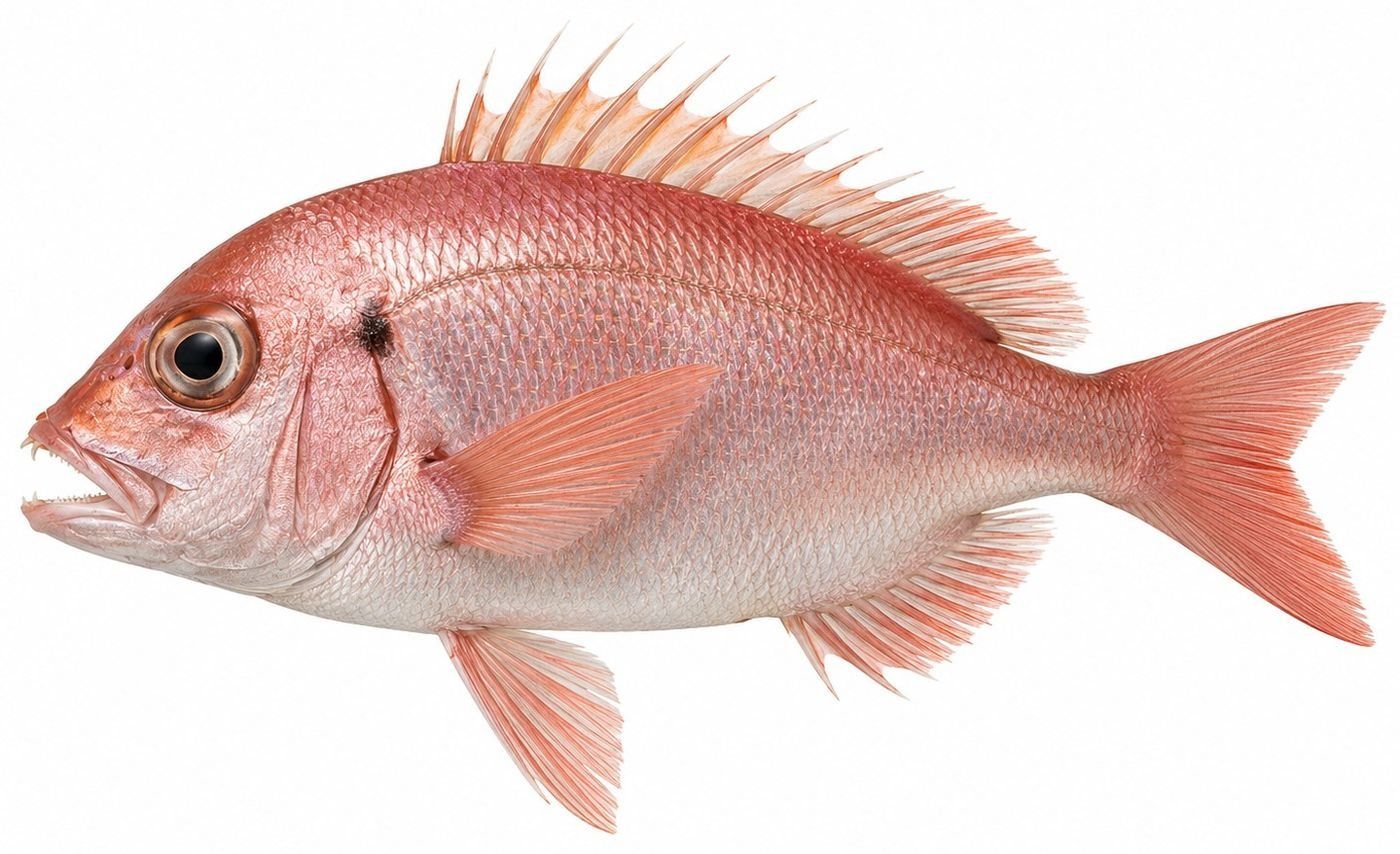
A small dentex with an oval, compressed body, pinkish to silvery, more modest than its cousins. Head with an even profile, fairly large eye, jaws armed with fine canines at the front. No forehead hump, no dorsal filaments. Golden reflections on the flanks.
Features that never mislead
Small size for a dentex, oval compressed body.
No forehead hump and no dorsal filaments.
Fine canines at the front of the jaws.
Pinkish to silvery livery, golden reflections.
Size and weight
A small species: asymptotic length estimated at around 31 to 32 cm on the coasts of the Gulf of Guinea (studies in Ghana). Precise maximum size to be confirmed on FishBase.
Behaviour and ecology
A coastal demersal predator that hunts small crustaceans, worms and small fish on the shelf. A gregarious species forming exploitable concentrations.
Originally described as a species of major economic importance on the west coast of tropical Africa. Present along the Ivorian coast, caught in coastal demersal fishing. Local stock data to be checked with the CRO.
Reproduction and season
Coastal spawning, pelagic eggs and larvae. Relatively fast growth for the genus. Local spawning data to be documented.
Fishing practice
Techniques, from most to least effective
Bottom fishing with natural bait over coastal grounds.
With a baited multi-hook rig (sabiki type) over concentrations.
Caught in coastal demersal trawls.
The fight: lively but modest given its size. It is above all a commercial fish of trawls and bottom lines, present in quantity on the markets.
Eating quality
Fine white flesh, appreciated despite the small size. Eaten grilled, braised or fried. A common food fish on West African coasts.
Sources: FishBase (Dentex angolensis, Poll & Maul 1953); Poll & Maul 1953 original description; population dynamics studies in Ghana (Clottey 2020); Ouattara et al. 2016; IUCN status to be reconfirmed.