
White grouper
Epinephelus aeneus (Geoffroy Saint-Hilaire, 1817)
Family Epinephelidae (Serranidae) • the thiof, king of rocky grounds
3 look-alikes to know
| French name | Mérou blanc. Other names: mérou bronzé, serran airain, thiof (Senegal). |
|---|---|
| Scientific name | Epinephelus aeneus (Geoffroy Saint-Hilaire, 1817) |
| Family | Family Epinephelidae (Serranidae) |
| English name (FAO) | White grouper |
| Local names | On Ivorian markets and landing sites: “Mérou” (Ouattara et al., 2016). |
| Habitat | Marine demersal and estuarine. Young fish in coastal and estuarine areas, adults at 30 to 100 m over sandy and rocky ground. |
| IUCN status | NT Near Threatened. Historically overexploited; proven overfishing in Senegal and Mauritania. |
Identification
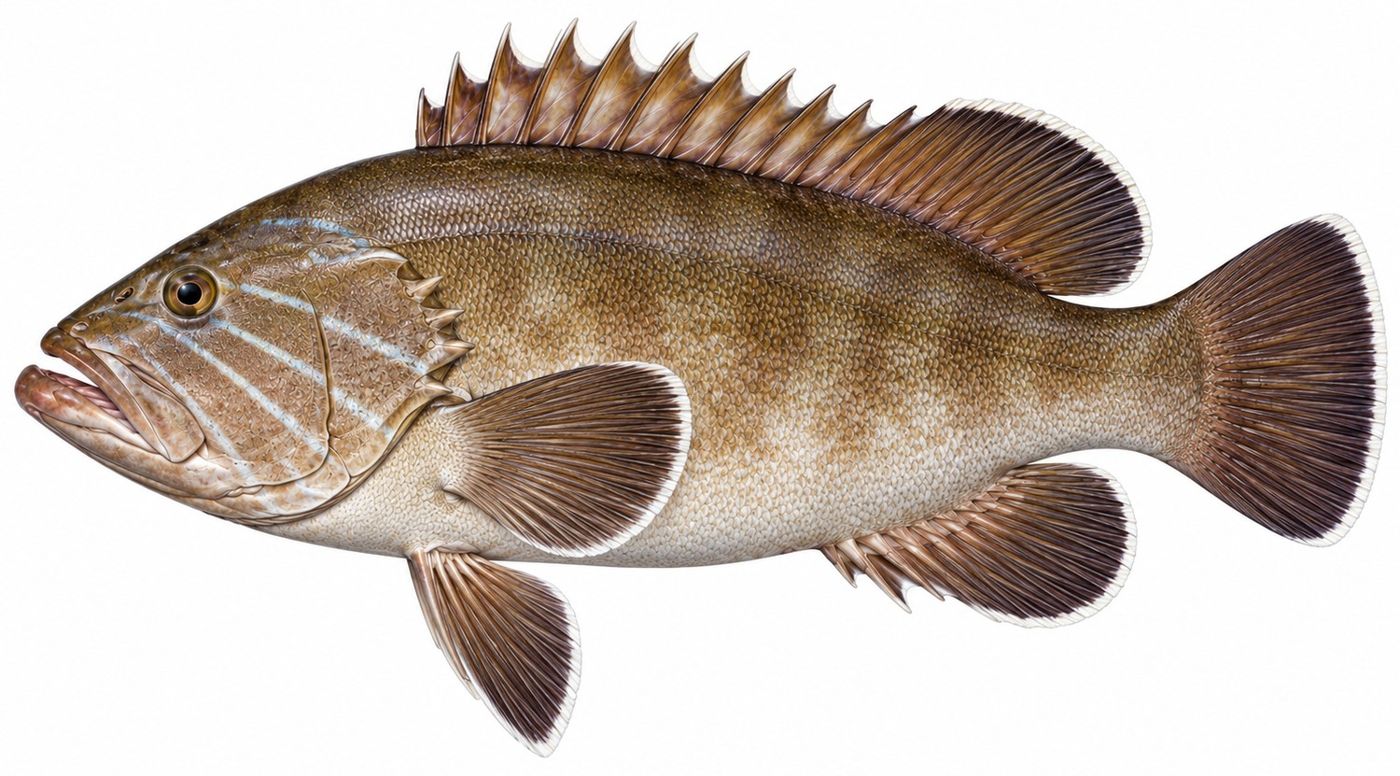
Massive, stocky body, large head, big mouth with thick lips. Grey-brown to bronze colouring, paler on the belly, sometimes marbled with lighter patches. Rounded fins. The powerful, good-natured look typical of groupers.
Features that never mislead
- Stocky, massive silhouette, bulky head, big mouth with fleshy lips.
- Uniform grey-bronze to brown colouring, without bands or marked bright spots in adults.
- Three spines on the gill cover (a grouper feature), fins with rounded outlines.
- Often lies in wait near a shelter (rock, wreck, hole).
Size and weight
A large grouper that can exceed 1 m. A protogynous hermaphrodite species: individuals are born female and change sex at around 75 cm. Lifespan estimated at around 11 years (generation length). On the coast, catches are often between 2 and 10 kg, with very large fish possible.
Behaviour and ecology
A sedentary, territorial predator, lurking near shelters (rocks, wrecks, holes). It sucks in its prey with a sudden snap of the mouth: fish, crustaceans, cephalopods. Young fish under 30 cm live mainly in coastal and estuarine areas, then move to depths of 30 to 100 m as they grow, with a preference for sandy and hard bottoms.
On the Ivorian coast, the species frequents the hard bottoms of the shelf and the approaches to estuaries, where juveniles find refuge.
Reproduction and season
Protogynous hermaphrodite: sex change from female to male at around 75 cm. This biology makes the species particularly vulnerable to overfishing, because removing large fish takes the breeding males out of the population.
Fishing practice
Techniques, from most to least effective
1. Bottom fishing with natural bait (whole fish or pieces, squid) near rocky shelters and wrecks: the top technique.
2. With a jig or madai on hard bottoms, staying close to the substrate.
3. With live bait anchored near a shelter for large territorial fish.
Everything happens in the first second: on the bite, the grouper dives for its shelter. You must pull it away at once with a firm, sustained lift, without letting it reach the rocks where it would snag the line. Drag set tight at the start. A grouper that gets back into its hole is almost always lost.
Eating quality
Firm, fine white flesh, among the most highly regarded in West Africa. In Senegal, the thiof is the emblematic fish of thieboudienne and has even appeared on a banknote. Excellent baked, braised or as fillets.
Did you know?
The White grouper is born female and becomes male as it grows, at around 75 cm: it is a protogynous hermaphrodite. This trait, common among groupers, explains its fragility in the face of fishing, because the biggest fish, the most sought after, are also the only breeding males. In Senegal, under the name thiof, it is so emblematic of the national cuisine that it has appeared on the back of a banknote.
Sources: FishBase (Epinephelus aeneus); IUCN Red List 2018 (Near Threatened, e.T132722A100459597); FAO Synopsis Bruslé 1985; Cury & Worms 1982 (thiof, Senegalese coasts). Ivorian data to be reconfirmed with the CRO Abidjan.