
Largehead hairtail
Trichiurus lepturus Linnaeus, 1758
Family Trichiuridae • the silver ribbon of coastal grounds
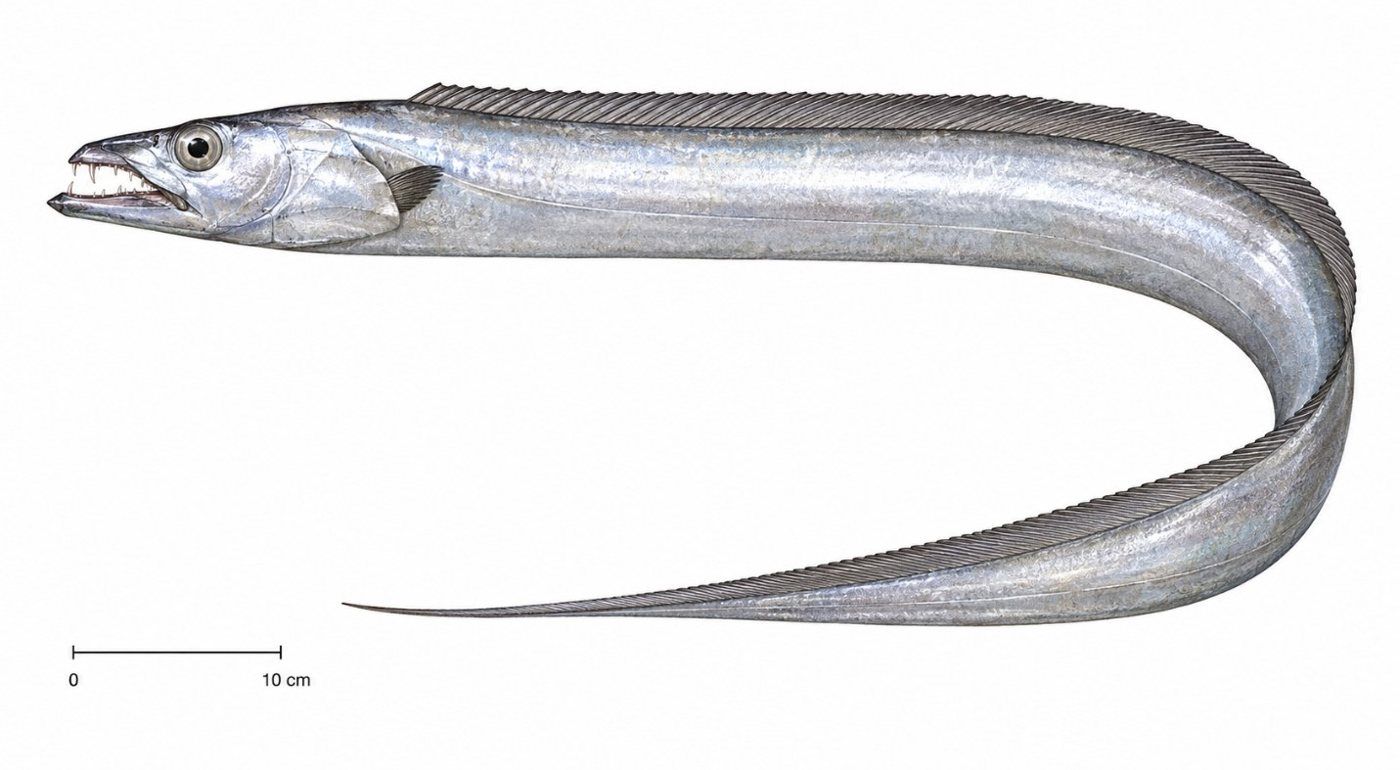
| French name | Poisson-sabre commun. |
|---|---|
| Scientific name | Trichiurus lepturus Linnaeus, 1758 |
| Family | Family Trichiuridae |
| English name (FAO) | Largehead hairtail |
| Local names | On Ivorian markets and landing sites: “Ceinture” (Ouattara et al., 2016). |
| Habitat | A benthopelagic predator of coastal grounds and the slope, mainly between 100 and 350 m, which rises towards the surface at night to hunt. |
| IUCN status | LC Least Concern. See main text of the sheet. |
Identification
Extremely elongated body, compressed like a ribbon, tapering to a thread-like point, with no tail fin. Shiny steel-silver colour, almost metallic, which dulls after death. Large mouth armed with hooked, pointed canines. A very long dorsal fin runs along the whole back, with more than 130 rays. No pelvic fins. Large eye.
Features that never mislead
Silvery, compressed, ribbon-like body ending in a point with no tail fin.
Single very long dorsal fin along the whole back, more than 130 rays.
Large hooked canines in a wide mouth.
Shiny metallic silver colouring when alive.
Size and weight
Common size around 1 m. Published maximum length about 234 cm total length, with a maximum weight of around 5 kg (FishBase). The body stays slender even in large fish.
Behaviour and ecology
A benthopelagic predator of coastal grounds and the slope, mainly between 100 and 350 m, which rises towards the surface at night to hunt. It feeds on small fish, crustaceans and squid. Young fish eat mainly crustaceans, while adults become piscivorous. It often holds itself vertically in the water, head up.
A cosmopolitan species of tropical and temperate waters worldwide. On the Ivorian coast it is caught by bottom trawl and longline and regularly landed on the markets. IUCN status of Least Concern; an abundant and widely exploited species.
Reproduction and season
Spawns in open water; pelagic eggs and larvae, spread throughout the year in warm areas. Matures at around 50 cm.
Fishing practice
Techniques, from most to least effective
Bottom trawling, the dominant commercial method.
Bottom longline baited with small fish.
Weighted bottom line in artisanal fishing, taking care with the teeth.
The fight: modest; the hairtail defends itself by twisting and jerking rather than by running. Caution is needed when unhooking because of the canines.
Eating quality
White, fine and tasty flesh, lean, highly prized fried, grilled or braised. Widely eaten in West Africa and Asia. Watch out for the many fine bones.
Sources: FishBase (Trichiurus lepturus, Linnaeus 1758); IUCN Red List 2013, LC; FAO Snake Mackerels and Cutlassfishes, Nakamura and Parin 1993; Ouattara et al. 2016.