
African moonfish
Selene dorsalis (Gill, 1862)
Family Carangidae • the silvery moonfish with the vertical forehead
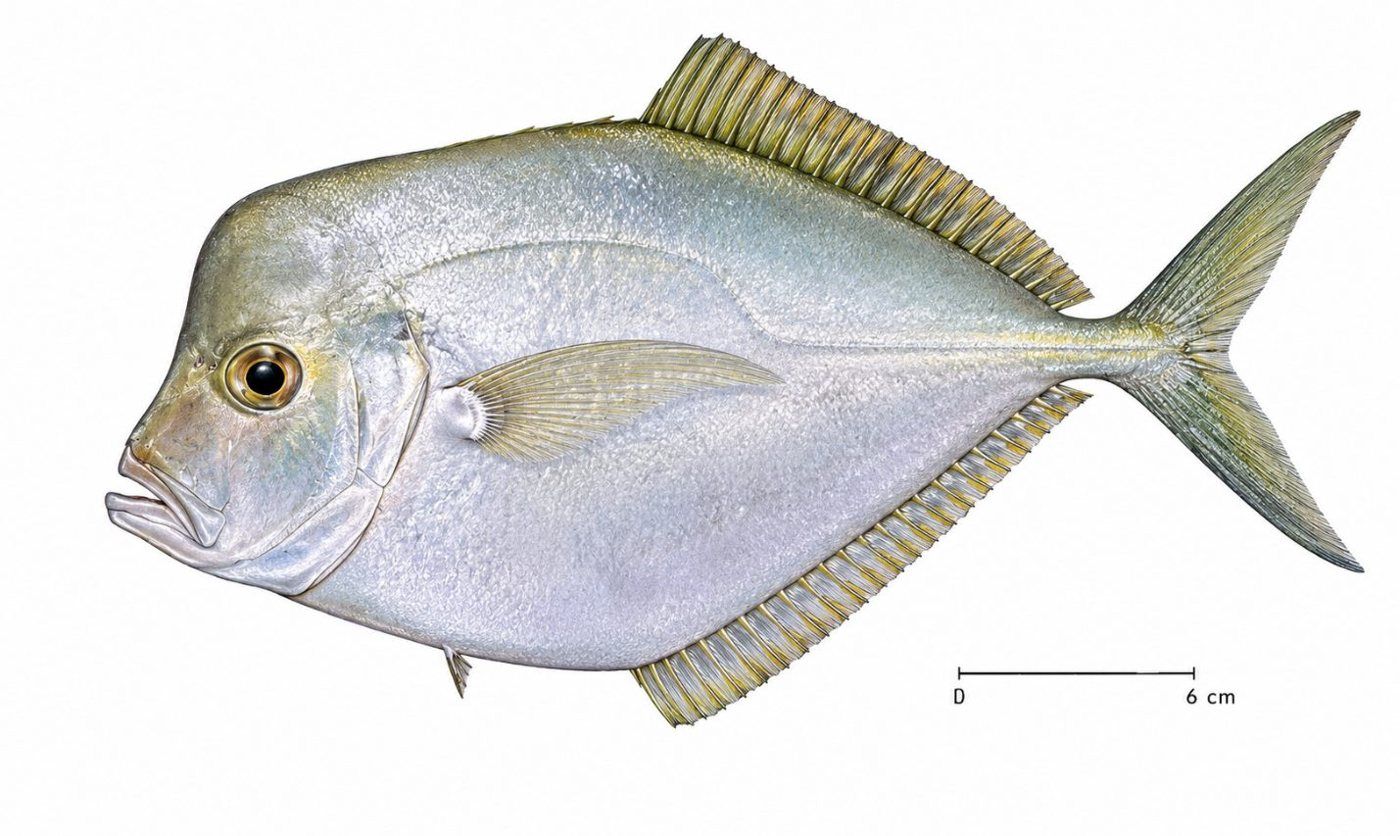
| French name | Musso d’Afrique. |
|---|---|
| Scientific name | Selene dorsalis (Gill, 1862) |
| Family | Family Carangidae |
| English name (FAO) | African moonfish |
| Local names | On Ivorian markets and landing sites: “Plat-Plat” (Ouattara et al., 2016). |
| Habitat | A coastal species living in schools near the bottom over sandy and muddy ground, and readily entering the brackish waters of river mouths. |
| IUCN status | NE Not Evaluated / to be checked. |
Identification
An unmistakable carangid: very deep, short and extremely compressed body, almost a flattened diamond, with the sheen of polished aluminium. The forehead is almost vertical and slightly concave, giving a characteristic head-on profile. First dorsal and sometimes pelvic rays drawn out into filaments in young fish. No developed scutes on the lateral line. Entirely silver livery, without clear markings. It is the Eastern Atlantic counterpart of the Western Atlantic moonfish Selene setapinnis.
Features that never mislead
Flattened diamond-shaped body, very deep and strongly compressed.
Almost vertical, concave forehead, a very typical head-on profile.
Uniform metallic silver livery, as if polished.
First dorsal rays drawn out into filaments in juveniles.
Size and weight
Common size around 25 cm. Maximum length of around 35 to 40 cm. A small to medium-sized carangid, with a silhouette deeper than it is long.
Behaviour and ecology
A coastal species living in schools near the bottom over sandy and muddy ground, and readily entering the brackish waters of river mouths. It feeds on small fish, crustaceans and benthic invertebrates. Juveniles tolerate low-salinity water well.
Present in the Eastern Atlantic, from Portugal to South Africa, including Madeira and Cape Verde. On the Ivorian coast it is found over coastal grounds and near river mouths, caught mainly by trawl and net. Local IUCN status data to be checked.
Reproduction and season
Spawns in coastal open water; pelagic eggs and larvae. Young fish frequent brackish waters before moving offshore.
Fishing practice
Techniques, from most to least effective
Bottom trawl and coastal nets, commercial catches.
Small baited bottom lines in artisanal fishing.
As bycatch in beach seines.
The fight: modest given its size, but the very flat body puts up good sideways resistance in the current. Mainly a net and market fish.
Eating quality
Decent white flesh, fine but thin because of the flattened shape. Eaten fried or braised, often sold in lots on the markets. Eat fresh.
Sources: FishBase (Selene dorsalis, Gill 1862; sister species S. setapinnis); FAO Eastern Central Atlantic; Ouattara et al. 2016.