
West African Spanish mackerel
Scomberomorus tritor (Cuvier, 1832)
Family Scombridae • the silver blade of the Guinean upwelling
3 look-alikes to know
| French name | Thazard d’Afrique de l’Ouest. Other names: maquereau-bonite, thazard blanc, serra-branca. |
|---|---|
| Scientific name | Scomberomorus tritor (Cuvier, 1832) |
| Family | Family Scombridae |
| English name (FAO) | West African Spanish mackerel |
| Local names | On Ivorian markets and landing sites: “Maquereau” (Ouattara et al., 2016). |
| Habitat | Marine, neritic pelagic, tolerates brackish water. Depth 1 to 40 m, usually 20 to 25 m. |
| IUCN status | LC Least Concern. Eastern tropical Atlantic: Canary Islands and Senegal to Angola. |
Identification
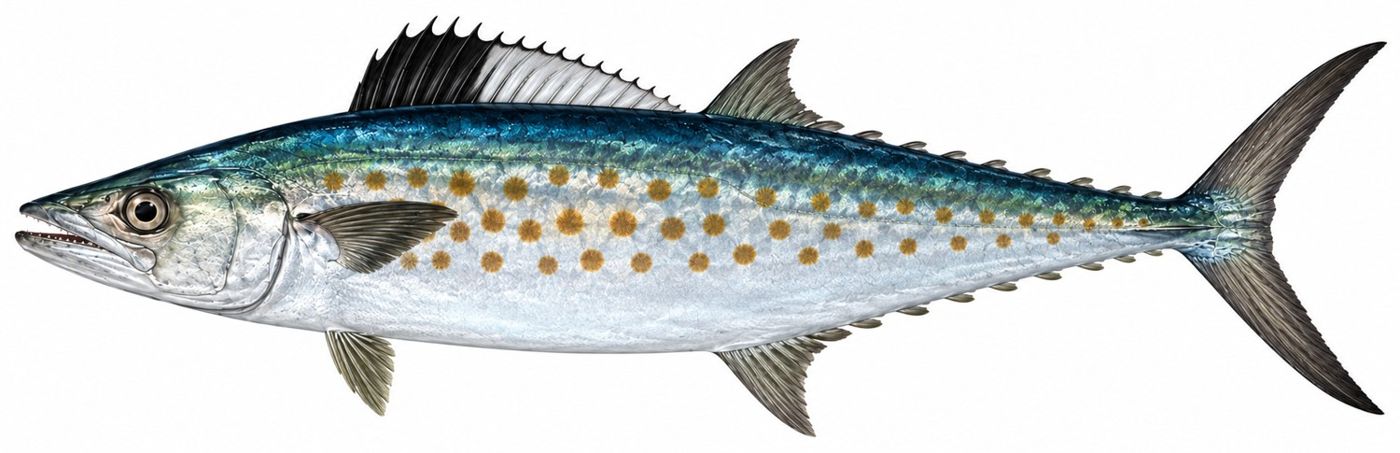
Elongated, fusiform body, laterally compressed, built for pure speed. Metallic blue-green back, silvery flanks, pearly white belly. Wide mouth with sharp, triangular teeth. Two dorsal fins very close together, followed by a series of detached finlets (a generic feature of the Scombridae).
Features that never mislead
- About three rows of vertically elongated orange spots on the silvery flanks.
- Detached finlets behind the second dorsal and anal fins.
- Slender caudal peduncle reinforced with lateral keels, deeply forked tail.
- Strongly wavy lateral line, without sharp scutes (a major difference from the Carangidae).
Size and weight
Common size around 75 cm. Published maximum length 100 cm TL, with a published maximum weight of 6 kg (FishBase, ref. 2683). Maturity reached at about 37 cm (Lm). On the Ivorian coast, typical catches are between 2 and 5 kg, with fine fish of 6 to 8 kg at the height of the upwelling season.
Behaviour and ecology
A fast, gregarious pelagic predator forming tight schools close to the coast. It feeds mainly on small clupeids, above all sardinellas and anchovies, which it chases at the surface. An oceanodromous species, closely tied to the dynamics of the Guinean upwelling and the inflow of cold, rich water that concentrates baitfish.
Off the Ivorian coast it is regularly seen at the mouth of the Vridi canal and along the beaches from Assinie to Sassandra, in noisy feeding frenzies at daybreak. Its speed of attack exceeds that of most jacks.
Reproduction and season
Spawns in tropical open water. The fishing season is concentrated from June to October, at the height of the upwelling, and secondarily in February and March. Out of season, the species disperses offshore and becomes much less accessible from the coast.
Fishing practice
Techniques, from most to least effective
1. By slow trolling (4 to 6 knots), with a diving plug or wobbling spoon, along the coastal drop-off and around reef heads. The top technique for covering ground and finding schools.
2. With poppers and stickbaits on spotted feeding frenzies, from shore or boat. Spanish mackerel strike hard at the surface when the school drives the baitfish up.
3. By surfcasting from the beaches of Assinie, Grand-Bassam or Sassandra, with natural bait (sardinella, cut bonito), deadly at the height of the season.
The fight: an explosive start, a long, straight first run out to sea, followed by short, nervy accelerations. Keep the drag moderate (5 to 8 kg) to absorb the runs without breaking off, and strike firmly on the bite, as the bony mouth needs a clean hook-set. Land the fish with a landing net: the triangular teeth cut cleanly.
Eating quality
Firm, lean white flesh with a delicate taste. Excellent grilled, as sashimi (very fresh), as braised steaks or baked with lemon and herbs. In Abidjan, smoked Spanish mackerel is a classic sold in the lagoon markets. Bleed and ice as soon as it is caught to preserve quality.
Did you know?
S. tritor is the only representative of the genus Scomberomorus in the Eastern Atlantic. Described in 1832 by Cuvier as Cybium tritor, it was long confused with its American cousin S. maculatus, to the point of being regarded as a synonym by many authors until it was reinstated in the 20th century. Its vividly contrasting orange spots on a silver background are its visual signature and make it instantly recognisable among the coastal pelagics of the Gulf of Guinea.
Sources: FishBase (Scomberomorus tritor, Cuvier 1832); FAO Field Guide Gulf of Guinea (Schneider, 1990); IUCN Red List, Least Concern; Collette, Reeb & Block 2001, Systematics of the Tunas and Mackerels (Scombridae). Ivorian data to be reconfirmed with the CRO Abidjan.